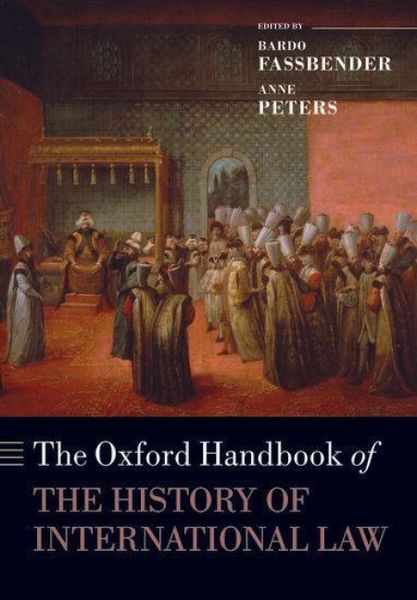
The Oxford Handbook of the History of International Law
-
- Taschenbuch ausgewählt
- eBook
-
Sprache:Englisch
114,99 €
inkl. gesetzl. MwSt.,
Beschreibung
Produktdetails
Einband
Taschenbuch
Erscheinungsdatum
10.09.2014
Herausgeber
Bardo Fassbender + weitereVerlag
Oxford AcademicSeitenzahl
1280
Maße (L/B/H)
23,8/16/2,9 cm
Gewicht
656 g
Sprache
Englisch
ISBN
978-0-19-872522-0
The Oxford Handbook of the History of International Law provides an authoritative and original overview of the origins, concepts, and core issues of international law. The first comprehensive Handbook on the history of international law, it is a truly unique contribution to the literature of international law and relations. Pursuing both a global and an interdisciplinary approach, the Handbook brings together some sixty eminent scholars of international law, legal history, and global history from all parts of the world. Covering international legal developments from the 15th century until the end of World War II, the Handbook consists of over sixty individual chapters which are arranged in six parts. The book opens with an analysis of the principal actors in the history of international law, namely states, peoples and nations, international organisations and courts, and civil society actors. Part Two is devoted to a number of key themes of the history of international law, such as peace and war, the sovereignty of states, hegemony, religion, and the protection of the individual person. Part Three addresses the history of international law in the different regions of the world (Africa and Arabia, Asia, the Americas and the Caribbean, Europe), as well as 'encounters' between non-European legal cultures (like those of China, Japan, and India) and Europe which had a lasting impact on the body of international law. Part Four examines certain forms of 'interaction or imposition' in international law, such as diplomacy (as an example of interaction) or colonization and domination (as an example of imposition of law). The classical juxtaposition of the civilized and the uncivilized is also critically studied. Part Five is concerned with problems of the method and theory of history writing in international law, for instance the periodisation of international law, or Eurocentrism in the traditional historiography of international law. The Handbook concludes with a Part Six, entitled "People in Portrait", which explores the life and work of twenty prominent scholars and thinkers of international law, ranging from Muhammad al-Shaybani to Sir Hersch Lauterpacht. The Handbook will be an invaluable resource for students and scholars of international law. It provides historians with new perspectives on international law, and increases the historical and cultural awareness of scholars of international law. It is the standard reference work for the global history of international law.
Ein neues Kapitel für Ihre Bücher
Ein neues Kapitel für Ihre Bücher
Schenken Sie Ihren alten Schätzen ein zweites Leben und erhalten Sie dafür eine Thalia Geschenkkarte.
Noch keine Bewertungen vorhanden
Verfassen Sie die erste Bewertung zu diesem Artikel
Helfen Sie anderen Kundinnen und Kunden durch Ihre Meinung.
Kurze Frage zu unserer Seite
Vielen Dank für Ihr Feedback
Wir nutzen Ihr Feedback, um unsere Produktseiten zu verbessern. Bitte haben Sie Verständnis, dass wir Ihnen keine Rückmeldung geben können. Falls Sie Kontakt mit uns aufnehmen möchten, können Sie sich aber gerne an unseren Kund*innenservice wenden.
zum Kundenservice