
KI-Beratung Beta

Gutscheinbedingungen

Gültig bis 21.10.2026 | Gültig für nicht preisgebundene fremdsprachige Bücher | Einzelne Artikel können ausgeschlossen sein | Online auf thalia.de und in der Thalia App einlösbar | Click & Collect nur mit Online-Zahlung (Paypal/Kreditkarte) vorab | Nicht kombinierbar mit anderen Gutscheinen oder Preisaktionen | Nur einmal pro Einkauf einlösbar | Gutschein wird auf max. 500€ Bestellwert angerechnet | Keine Barauszahlung | Nicht gültig für Versandkosten und Services

  • Produktbild: The Future of Policing
  • Produktbild: The Future of Policing

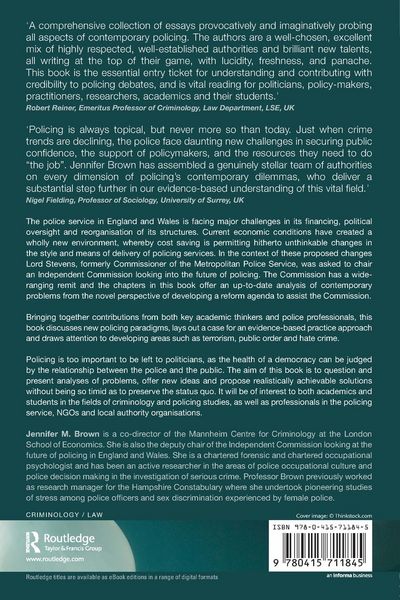
The Future of Policing

93,99 €

inkl. gesetzl. MwSt., Versandkostenfrei


Beschreibung

Produktdetails

Einband

Taschenbuch

Erscheinungsdatum

11.11.2014

Abbildungen

schwarz-weiss Illustrationen, Zeichnungen, schwarz-weiss, Tabellen, schwarz-weiss

Herausgeber

Jennifer Brown

Verlag

Taylor and Francis

Seitenzahl

554

Maße (L/B/H)

23,4/15,6/3 cm

Gewicht

831 g

Sprache

Englisch

ISBN

978-0-415-71184-5

Herstelleradresse

Libri GmbH
Europaallee 1
36244 Bad Hersfeld
DE

Email: gpsr@libri.de

Ein neues Kapitel für Ihre Bücher

Ein neues Kapitel für Ihre Bücher

Schenken Sie Ihren alten Schätzen ein zweites Leben und erhalten Sie dafür eine Thalia Geschenkkarte.

Jetzt verkaufen
Jetzt verkaufen

Noch keine Bewertungen vorhanden

Verfassen Sie die erste Bewertung zu diesem Artikel

Helfen Sie anderen Kundinnen und Kunden durch Ihre Meinung.

Kundinnen und Kunden meinen

Bewertungen (0)

Die Leseprobe wird geladen.
  • Produktbild: The Future of Policing
  • Produktbild: The Future of Policing
  • Introduction, The challenges of contemporary policing, Part 1: Purposes, 1. Peel's principles, police principles 2. Policing: privatizing and changes in the policing web 3. Why do the police matter? Beyond the myth of crime fighting 4. What are the police for? Re-thinking policing post-austerity5. Reinventing the office of constable: progressive policing in an age of austerity6. Police futures and legitimacy; redefining good policingPart 2: Culture 7. Police culture and the policing context8. Race and policing 9. Women police; potential and possibilities for police10. A diversity stone left unturned? Exploring the occupational complexities surrounding lesbian, gay and bisexual police officers,The practice of policing, Part 3: Relationships 11. The police, policing and the future of the "extended policing family" 12. A blended model for the police-private provision of policing in England and Wales13. Playing nicely with others: lessons from successes in partnership work for the police service 14. Beyond rhetoric: establishing academic-police partnerships that workPart 4: Delivery 15. From Sir Robert Peel to plts: adapting to liaison-based public order policing in England and Wales16. Landscaping the policing of organised crime; some design reflections17. The role of police in counter terrorism18. Intelligence-led policing and the national intelligence model 19. Holding the line: the sustainability of police involvement in crime prevention20. Hate Crime, Supporting policing, Part 5: Professionalising 21. The promise and perils of police professionalism,22. The pursuit of professionalism: lessons from Australasia23. The police as professional problem solvers24. Police training and education: past, present and future25. Leading by example: the untapped resource of first line police supervisors Part 6: Governance 26. Engaging the citizen 27. Making police accountable; governance and legitimacy28. The rise and rise of independent police complaints bodies, 29. Ethics and policing30. Great expectations and complex realities: assessing the impact and implications of the police reform process in Northern Ireland 31. Different and divergent trajectories? Reforming the structure, governance and narrative of policing in Scotland.