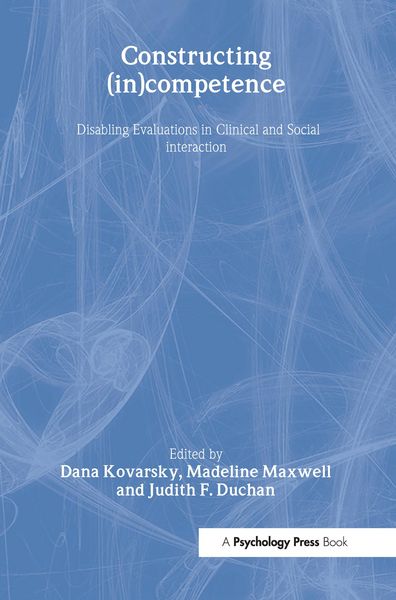
Constructing (in)competence Disabling Evaluations in Clinical and Social interaction
-
- Hardcover
- Taschenbuch
- eBook ausgewählt
-
Form:Einzelkauf Download
-
Sprache:Englisch
-
eBook Format:PDF
- PDF 92,99 € ausgewählt
- ePUB 92,99 €
92,99 €
inkl. gesetzl. MwSt.Beschreibung
Produktdetails
Format
Kopierschutz
Ja
Family Sharing
Nein
Text-to-Speech
Nein
Erscheinungsdatum
17.06.2013
Herausgeber
Dana Kovarsky + weitereVerlag
Taylor & Francis eBooksSeitenzahl
392 (Printausgabe)
Dateigröße
228422 KB
Sprache
Englisch
EAN
9781134804863
Competence and incompetence are constructs that emerge in the social milieu of everyday life. Individuals are continually making and revising judgments about each other's abilities as they interact. The flexible, situated view of competence conveyed by the research of the authors in this volume is a departure from the way that competence is usually thought about in the fields of communication disabilities and education. In the social constructivist view, competence is not a fixed mass, residing within an individual, or a fixed judgment, defined externally. Rather, it is variable, sensitive to what is going on in the here and now, and coconstructed by those present. Constructions of competence are tied to evaluations implicit in the communication of the participants as well as to explicit evaluations of how things are going.
The authors address the social construction of competence in a variety of situations: engaging in therapy for communication and other disorders, working and living with people with disabilities, speaking a second language, living with deafness, and giving and receiving instruction. Their studies focus on adults and children, including those with disabilities (aphasia, traumatic brain injury, augmentative systems users), as they go about managing their lives and identities. They examine the all-important context in which participants make competence judgments, assess the impact of implicit judgments and formal diagnoses, and look at the types of evaluations made during interaction.
This book makes an argument all helping professionals need to hear: institutional, clinical, and social practices promoting judgments must be changed to practices that are more positive and empowering.
Noch keine Bewertungen vorhanden
Verfassen Sie die erste Bewertung zu diesem Artikel
Helfen Sie anderen Kundinnen und Kunden durch Ihre Meinung.
Kurze Frage zu unserer Seite
Vielen Dank für Ihr Feedback
Wir nutzen Ihr Feedback, um unsere Produktseiten zu verbessern. Bitte haben Sie Verständnis, dass wir Ihnen keine Rückmeldung geben können. Falls Sie Kontakt mit uns aufnehmen möchten, können Sie sich aber gerne an unseren Kund*innenservice wenden.
zum Kundenservice