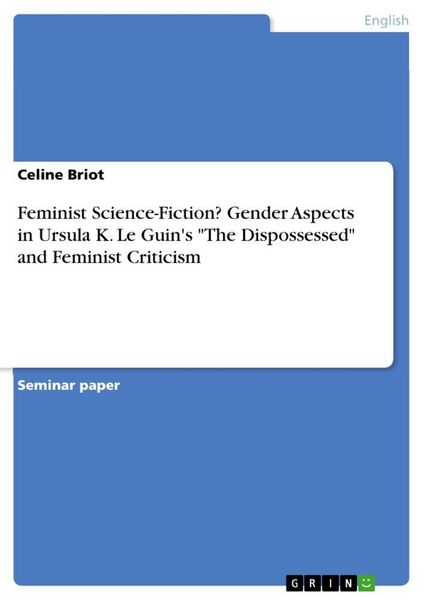
Feminist Science-Fiction? Gender Aspects in Ursula K. Le Guin's "The Dispossessed" and Feminist Criticism
-
- Taschenbuch ausgewählt
- eBook
-
Sprache:Englisch
15,95 €
inkl. gesetzl. MwSt.,
Beschreibung
Produktdetails
Einband
Taschenbuch
Erscheinungsdatum
19.08.2015
Verlag
GRINSeitenzahl
20
Maße (L/B/H)
21/14,8/0,2 cm
Gewicht
45 g
Auflage
1. Auflage
Sprache
Englisch
ISBN
978-3-668-03275-0
Seminar paper from the year 2015 in the subject English Language and Literature Studies - Literature, grade: 1,0, University of Bonn (Anglistik), course: Science-Fiction, language: English, abstract: In recent decades the literary genre of Science Fiction has experienced a rising interest which might be attributed to the rapid technological development and the deep integration of it into daily life. Science Fiction offers writers a wide range of potential themes to explore and is thus a very complex genre. While often being considered male oriented, at least during the Feminist Movement in the 1960s, female authors found their way into the genre and raised questions about gender roles, political inequality and sexuality within their works. Among those female writers was Ursula K. Le Guin who gained wide recognition for her writing and is today regarded one of the most influential science-fiction and fantasy author of the twentieth century. Asscociated with feminist tendencies in her works, her most famous novel referred to be feminist science fiction is "The Left Hand of Darkness" in which she imagined an androgynous society in order to investigate what society would be if sex did not matter. But also many other of her works have received attention from critics interested in gender and feminism. In this paper I intend to analyse and discuss the depiction of gender and the realisation of feminist aspects in Le Guin's novel "The Dispossessed: An ambiguous Utopia". The novel won several important literary awards such as the Hugo and the Nebula and gained a lot of respect among critics for its great literary qualities and its extensive exploration of political ideas and social themes, including for example anarchism, capitalism and socialism. It is set on the fictional planets Urras and Anarres which inhabit two contrasting societies, one capitalist and class oriented and the other one following the principles of anarchism, avoiding any form of social hierarchy among its population. Anarres - apparently the utopian planet in Le Guin's work, is often called a feminist utopia for its conception of gender. However, Le Guin has been highly criticised from feminist for several problematic issues in her approach of sexual politics in the novel. The question therefore arises weather "The Dispossessed" really can be labeled feminist science-fiction and if Anarres really can be called a feminist utopia?
Ein neues Kapitel für Ihre Bücher
Ein neues Kapitel für Ihre Bücher
Schenken Sie Ihren alten Schätzen ein zweites Leben und erhalten dafür eine Thalia Geschenkkarte.
Noch keine Bewertungen vorhanden
Verfassen Sie die erste Bewertung zu diesem Artikel
Helfen Sie anderen Kundinnen und Kunden durch Ihre Meinung.
Kurze Frage zu unserer Seite
Vielen Dank für Ihr Feedback
Wir nutzen Ihr Feedback, um unsere Produktseiten zu verbessern. Bitte haben Sie Verständnis, dass wir Ihnen keine Rückmeldung geben können. Falls Sie Kontakt mit uns aufnehmen möchten, können Sie sich aber gerne an unseren Kund*innenservice wenden.
zum Kundenservice