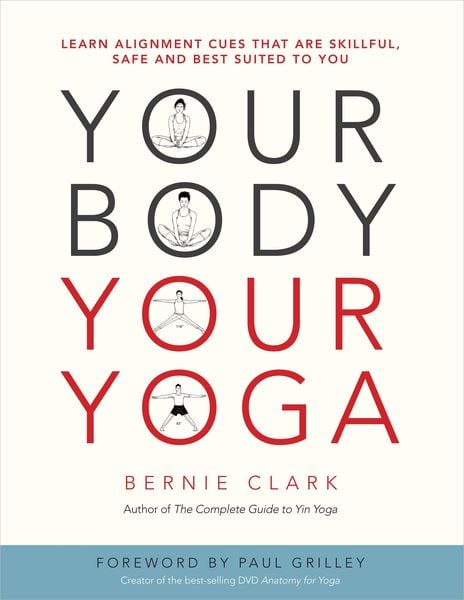
Your Body, Your Yoga Learn Alignment Cues That Are Skillful, Safe, and Best Suited to You
-
- Taschenbuch ausgewählt
- eBook
-
Sprache:Englisch
- Deutsch 29,99 €
- Englisch 18,99 € ausgewählt
18,99 €
UVP
24,00 €
inkl. gesetzl. MwSt.,
Beschreibung
Produktdetails
Verkaufsrang
28855
Einband
Taschenbuch
Erscheinungsdatum
12.04.2016
Abbildungen
15 color photos, 490 color illustrations, 17 charts, 27 tables
Illustriert von
Morgan Jeske
Herausgeber
Dania SheldonVerlag
Ingram Publisher ServicesSeitenzahl
301
Maße (L/B/H)
27,9/21,5/1,7 cm
Gewicht
915 g
Farbe
Weiß / Tabak
Sprache
Englisch
ISBN
978-0-9687665-3-8
There is a revolution occurring in yoga today around the alignment paradigm. The concept of one and only one ideal alignment for each yoga posture, taught through an aesthetic focus on how the student looks in the pose, is being replaced by a functional approach that acknowledges not only the intention of the posture but each student's unique biology and biography. In parallel, the paradigm of focusing on the muscles as the limiters and causal agents of movement is being replaced by a broader understanding. The role of fascia is being recognized and incorporated into yoga classes and trainings. Beyond muscles and fascia, there is a wide spectrum of causes for and resistance to motion, ranging from various sources of tension to the qualities of compression.
Your Body, Your Yoga goes beyond any prior yoga anatomy book available. It looks not only at the body's unique anatomical structures and what this means to everyone's individual range of motion, but also examines the physiological sources of restrictions to movement. Two volumes are provided in this book: Volume 1 raises a new mantra to be used in every yoga posture: What Stops Me? The answers presented run through a spectrum, beginning with a variety of tensile resistance to three kinds of compressive resistance. Examined is the nature of muscles, fascia, tendons, ligaments, joint capsules, bones and our extracellular matrix and their contribution to mobility. The shape of these structures also defines our individual, ultimate range of movement, which means that not every body can do every yoga posture. The reader will discover where his or her limits lie, which dictates which alignment cues will work best, and which ones should be abandoned. Volume 2 will take these principles and apply them to the lower body, examining the hip joint, the knee, ankle and foot, and will present how your unique variations in these joints will show up in your yoga practice.
Ein neues Kapitel für Ihre Bücher
Ein neues Kapitel für Ihre Bücher
Schenken Sie Ihren alten Schätzen ein zweites Leben und erhalten dafür eine Thalia Geschenkkarte.
Noch keine Bewertungen vorhanden
Verfassen Sie die erste Bewertung zu diesem Artikel
Helfen Sie anderen Kundinnen und Kunden durch Ihre Meinung.
Kurze Frage zu unserer Seite
Vielen Dank für Ihr Feedback
Wir nutzen Ihr Feedback, um unsere Produktseiten zu verbessern. Bitte haben Sie Verständnis, dass wir Ihnen keine Rückmeldung geben können. Falls Sie Kontakt mit uns aufnehmen möchten, können Sie sich aber gerne an unseren Kund*innenservice wenden.
zum Kundenservice