• Produktbild: Graph-Theoretic Concepts in Computer Science
  • Produktbild: Graph-Theoretic Concepts in Computer Science
Band 9224

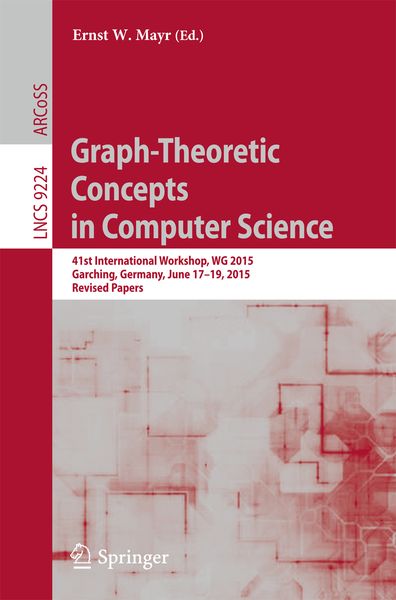
Graph-Theoretic Concepts in Computer Science 41st International Workshop, WG 2015, Garching, Germany, June 17-19, 2015, Revised Papers

49,99 €

inkl. gesetzl. MwSt., Versandkostenfrei


Beschreibung

Produktdetails

Einband

Taschenbuch

Erscheinungsdatum

05.08.2016

Abbildungen

XIV, 514 p. 106 illus.

Herausgeber

Ernst W. Mayr

Verlag

Springer Berlin

Seitenzahl

514

Maße (L/B/H)

23,5/15,5/2,9 cm

Gewicht

791 g

Auflage

1st ed. 2016

Sprache

Englisch

ISBN

978-3-662-53173-0

Beschreibung

Produktdetails

Einband

Taschenbuch

Erscheinungsdatum

05.08.2016

Abbildungen

XIV, 514 p. 106 illus.

Herausgeber

Ernst W. Mayr

Verlag

Springer Berlin

Seitenzahl

514

Maße (L/B/H)

23,5/15,5/2,9 cm

Gewicht

791 g

Auflage

1st ed. 2016

Sprache

Englisch

ISBN

978-3-662-53173-0

Herstelleradresse

Springer-Verlag KG
Sachsenplatz 4-6
1201 Wien
AT

Email: ProductSafety@springernature.com

Ein neues Kapitel für Ihre Bücher

Ein neues Kapitel für Ihre Bücher

Schenken Sie Ihren alten Schätzen ein zweites Leben und erhalten dafür eine Thalia Geschenkkarte.

Jetzt verkaufen
Jetzt verkaufen

Noch keine Bewertungen vorhanden

Verfassen Sie die erste Bewertung zu diesem Artikel

Helfen Sie anderen Kundinnen und Kunden durch Ihre Meinung.

Kundinnen und Kunden meinen

Bewertungen (0)

  • Produktbild: Graph-Theoretic Concepts in Computer Science
  • Produktbild: Graph-Theoretic Concepts in Computer Science

  • Invited Talks.- Parameterized Algorithmics for Graph Modification Problems: On Interactions with Heuristics.- Open Problems on Graph Coloring for Special Graph Classes.- On the Complexity of Approximation and Online Scheduling Problems with Applications to Optical Networks.- Computational Complexity.- The Stable Fixtures Problem with Payments.- Complexity of Secure Sets.- Efficient Domination for Some Subclasses of P6-free Graphs in Polynomial Time.- On the Tree Search Problem with Non-uniform Costs.- An O(n2) Time Algorithm for the Minimal Permutation Completion Problem.- On the Number of Minimal Separators in Graphs.- Efficient Farthest-Point Queries in Two-terminal Series-parallel Networks.- A Polynomial Delay Algorithm for Enumerating Minimal Dominating Sets in Chordal Graphs.- Finding Paths in Grids with Forbidden Transitions.- The Maximum Time of 2-neighbour Bootstrap Percolation in Grid Graphs and Parametrized Results.- Design and Analysis.- Minimum Eccentricity Shortest Paths in Some Structured Graph Classes.- Approximating Source Location and Star Survivable Network Problems.- On the Complexity of Computing the k-restricted Edge-connectivity of a Graph.- Computational Geometry.- Weak Unit Disk and Interval Representation of Graphs.- Simultaneous Visibility Representations of Plane st-graphs Using L-shapes.- An Abstract Approach to Polychromatic Coloring: Shallow Hitting Sets in ABA-free Hypergraphs and Pseudohalfplanes.- Unsplittable Coverings in the Plane.- Structural Graph Theory.- Induced Minor Free Graphs: Isomorphism and Clique-width.- On the Complexity of Probe and Sandwich Problems for Generalized Threshold Graphs.- Colouring and Covering Nowhere Dense Graphs.- Parity Linkage and the Erdös-Pósa Property of Odd Cycles Through Prescribed Vertices in Highly Connected Graphs.- Well-quasi-ordering Does Not Imply Bounded Clique-width.- A Slice Theoretic Approach for Embedding Problems on Digraphs.- Decomposition Theorems for Square-free 2-matchings in Bipartite Graphs.- Graph Drawing.- Saturated Simple and 2-simple Topological Graphs with Few Edges.- Testing Full Outer-2-planarity in Linear Time.- Fixed Parameter Tractability.- Triangulating Planar Graphs While Keeping the Pathwidth Small.- Polynomial Kernelization for Removing Induced Claws and Diamonds.- Algorithms and Complexity for Metric Dimension and Location-domination on Interval and Permutation Graphs.- On Structural Parameterizations of Hitting Set: Hitting Paths in Graphs Using 2-SAT.- Recognizing k-equistable Graphs in FPT Time.- Beyond Classes of Graphs with \Few" Minimal Separators: FPT.- Results Through Potential Maximal Cliques.