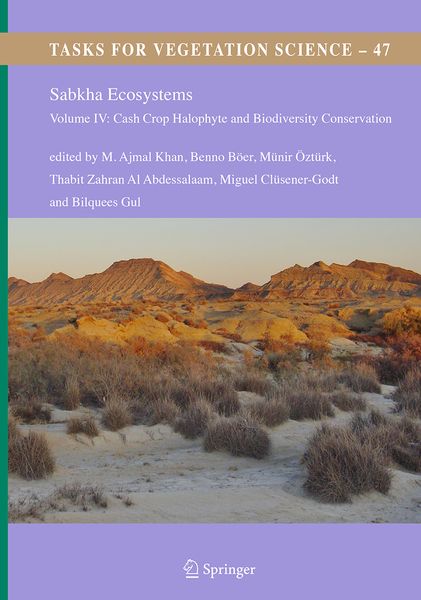
Sabkha Ecosystems Volume IV: Cash Crop Halophyte and Biodiversity Conservation
-
- Hardcover
- Taschenbuch ausgewählt
- eBook
-
Sprache:Englisch
-
Verlag:Springer Netherland
- Springer 143,99 €
- Springer Netherland 92,99 € ausgewählt
92,99 €
UVP
106,99 €
inkl. gesetzl. MwSt.,
Beschreibung
Produktdetails
Einband
Taschenbuch
Erscheinungsdatum
02.10.2016
Abbildungen
XXIII, 339 p. 121 illus.
Herausgeber
M. Ajmal Khan + weitereVerlag
Springer NetherlandSeitenzahl
339
Maße (L/B/H)
25,4/17,8/2 cm
Gewicht
684 g
Auflage
1. Auflage
Sprache
Englisch
ISBN
978-94-024-0640-5
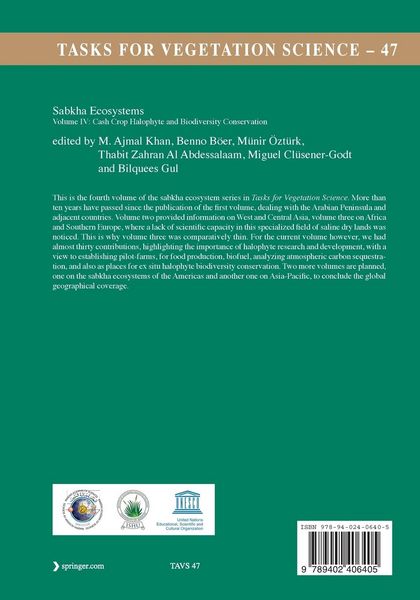
Sustainable development is the key for the survival in 21st century. The natural resources are finite and cannot be used with impunity because we are the custodian of these resources and have responsibility to pass these to the next generation. This monumental task requires several major commitments and most important of them is to arrest population explosion which has already reached seven billion. Natural resources like air to breath, food to eat, and water to drink, and fossil fuel to maintain this life style are being overexploited. Unrestrained consuming culture will accelerate undesired situation. This situation will have more dire consequences in resource limited ecosystems like dry lands. Given the severe scarcity of water, ever increasing population and soil salinization out of the box solutions for the provision of food and clean energy is required to spare meager fresh water resources for conventional agriculture. This volume contains a number of articles dealing with halophyte ecology, bio-geography, ecophysiology, hyper-saline soils, biofuels, biosaline agriculture, biosaline landscaping, climate change mitigation, and biodiversity. It also contains the communication of innovative ideas, such as the research into floating mangroves, seagrass terraces, as well as a World Halophyte Garden containing all known salt-tolerant plant species. It is hoped that the information provided will not only advance vegetation science, but that it will truly generate more interdisciplinarity, networking, awareness, and inspire farmers, and agricultural and landscaping stakeholders to seriously engage in halophyte cash crop production in coastal hyper-saline areas.
Ein neues Kapitel für Ihre Bücher
Ein neues Kapitel für Ihre Bücher
Schenken Sie Ihren alten Schätzen ein zweites Leben und erhalten Sie dafür eine Thalia Geschenkkarte.
Noch keine Bewertungen vorhanden
Verfassen Sie die erste Bewertung zu diesem Artikel
Helfen Sie anderen Kundinnen und Kunden durch Ihre Meinung.
Kurze Frage zu unserer Seite
Vielen Dank für Ihr Feedback
Wir nutzen Ihr Feedback, um unsere Produktseiten zu verbessern. Bitte haben Sie Verständnis, dass wir Ihnen keine Rückmeldung geben können. Falls Sie Kontakt mit uns aufnehmen möchten, können Sie sich aber gerne an unseren Kund*innenservice wenden.
zum Kundenservice