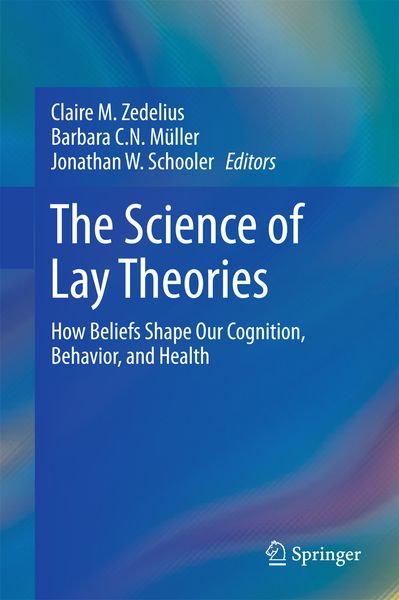
The Science of Lay Theories How Beliefs Shape Our Cognition, Behavior, and Health
-
- Hardcover ausgewählt
- Taschenbuch
- eBook
-
Sprache:Englisch
145,99 €
inkl. gesetzl. MwSt.,
Beschreibung
Produktdetails
Einband
Gebundene Ausgabe
Erscheinungsdatum
24.07.2017
Abbildungen
XII, 382 p. 2 illus.
Herausgeber
Claire M. Zedelius + weitereVerlag
SpringerSeitenzahl
382
Maße (L/B/H)
24,1/16/2,7 cm
Gewicht
706 g
Auflage
1st ed. 2017
Sprache
Englisch
ISBN
978-3-319-57305-2
This timely and important collection broadens our understanding of the ways in which lay theories (also known as folk psychologies, implicit theories, naïve theories, or mindsets) impact our lives and social relations. Moving well beyond lay theories as applied to intelligence and achievement, this volume considers lay theories in an admirably wide context, including perspectives on prejudice, creativity, self-regulation, health, free will, justice, magic, religion and more. Eminent and emerging scholars alike provide a comprehensive overview that presents and synthesizes cutting edge contemporary research on lay theories, spanning social, cognitive, developmental, cultural, and clinical psychology.
Structurally, this volume is organized in three parts. Beginning with a preface by renowned scholar Carol Dweck, the first part looks at the origins and nature of lay theories, and how malleable they are. The second part explores lay theories about common psychological phenomena. The third section discusses lay theories about the metaphysical or supernatural. Finally, the last section explores the important question of how lay theories impact health and health behavior. Taken together, the chapters provide an integrative survey of the science of lay theories, bringing together many perspectives that previously have been studied largely in isolation. This volume is more than the sum of its parts—perspectives from different strands of research provide insights that cut across research disciplines, making novel connections and prompting new directions for this field of study. Shedding light on how our beliefs shape all facets of our lives,
The Science of Lay Theories: How Beliefs Shape Our Cognition, Behavior, and Health
will appeal to researchers and practitioners in psychology, as well as philosophers, cognitive and developmental neuroscientists, religious scholars, sociologists, and anthropologists.
Ein neues Kapitel für Ihre Bücher
Ein neues Kapitel für Ihre Bücher
Schenken Sie Ihren alten Schätzen ein zweites Leben und erhalten Sie dafür eine Thalia Geschenkkarte.
Noch keine Bewertungen vorhanden
Verfassen Sie die erste Bewertung zu diesem Artikel
Helfen Sie anderen Kundinnen und Kunden durch Ihre Meinung.
Kurze Frage zu unserer Seite
Vielen Dank für Ihr Feedback
Wir nutzen Ihr Feedback, um unsere Produktseiten zu verbessern. Bitte haben Sie Verständnis, dass wir Ihnen keine Rückmeldung geben können. Falls Sie Kontakt mit uns aufnehmen möchten, können Sie sich aber gerne an unseren Kund*innenservice wenden.
zum Kundenservice