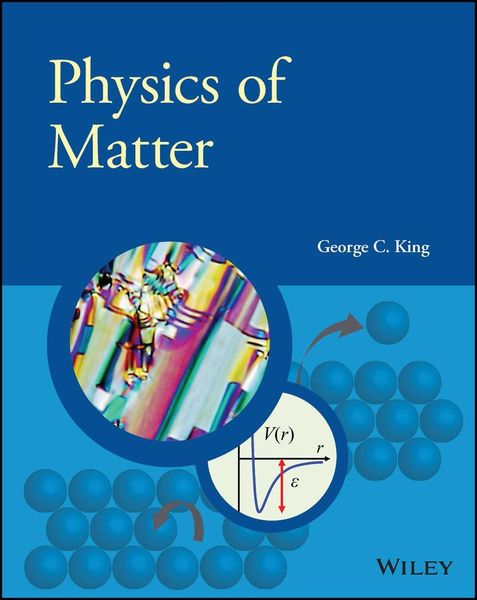
Physics of Matter
-
- Taschenbuch ausgewählt
- eBook
-
Sprache:Englisch
66,99 €
inkl. gesetzl. MwSt.,
Beschreibung
Produktdetails
Einband
Taschenbuch
Erscheinungsdatum
01.09.2023
Verlag
John Wiley & SonsSeitenzahl
464
Maße (L/B/H)
18,8/23,6/2,6 cm
Gewicht
968 g
Auflage
1. Auflage
Sprache
Englisch
ISBN
978-1-119-46858-5
First year core course introductory textbook on the nature of matter that puts the physics before mathematical description
Physics of Matter is an introductory textbook on the nature of matter, based on a description of gases, liquids, liquid crystals and solids in terms of the forces that bind atoms and molecules together and their thermal motion, that discusses the relationship of these phases of matter to heat and the basic principles of thermodynamics.
Physics of Matter is unique in its coverage of material and includes topics that have become important in recent times such as graphene and liquid crystals. Material in the book is reinforced by numerous worked examples in the text and problems and solutions at the end of each chapter, the latter ranging in difficulty from simple exercises to challenging problems. The emphasis is on clarity of exposition and explanation, putting the physics before the mathematical with general physical principles that can be more widely applied being stressed.
Published in the Manchester Physics Series, which has the reputation of providing insight, depth, and often details on a subject not found in other textbooks, sample topics covered in Physics of Matter include:
- Characteristics of atoms (sizes and masses) and Avogadro's number, the forces that bind atoms and molecules together, and the Lennard-Jones potential
- Thermal energy, temperature, and the Boltzmann law, covering equations of state, the ideal gas equation, and equipartition of energy
- Kinetic theory and transport properties of gases, covering molecular collisions, pressure of an ideal gas, the mean free path and diffusion
- Real gases, including Van der Waals equation of state, virial expansion, critical constants, and heat capacities
- Reversible processes, entropy, the Carnot cycle, the thermodynamic fundamental relationship, and Gibbs free energy
- Solids, including crystal structure, elastic moduli and Einstein's model of heat capacity
- Liquids, including liquid flow and Bernoulli's equation, and liquid crystals
Physics of Matter is a valuable learning resource for first- and second-year students in physics, chemistry, and engineering, as well as those in adjacent science courses including environmental and biological sciences. The book is written for the subject traditionally called "Properties of Matter."
Ein neues Kapitel für Ihre Bücher
Ein neues Kapitel für Ihre Bücher
Schenken Sie Ihren alten Schätzen ein zweites Leben und erhalten Sie dafür eine Thalia Geschenkkarte.
Noch keine Bewertungen vorhanden
Verfassen Sie die erste Bewertung zu diesem Artikel
Helfen Sie anderen Kundinnen und Kunden durch Ihre Meinung.
Kurze Frage zu unserer Seite
Vielen Dank für Ihr Feedback
Wir nutzen Ihr Feedback, um unsere Produktseiten zu verbessern. Bitte haben Sie Verständnis, dass wir Ihnen keine Rückmeldung geben können. Falls Sie Kontakt mit uns aufnehmen möchten, können Sie sich aber gerne an unseren Kund*innenservice wenden.
zum Kundenservice