KI-Beratung Beta

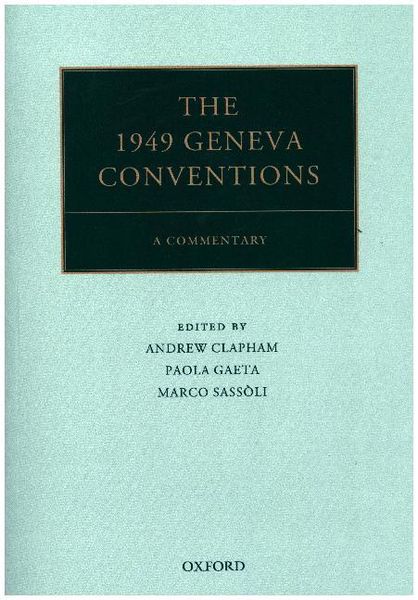
Produktbild: The 1949 Geneva Conventions

The 1949 Geneva Conventions A Commentary

135,99 €

inkl. gesetzl. MwSt., Versandkostenfrei


Beschreibung

Produktdetails

Einband

Taschenbuch

Erscheinungsdatum

14.05.2018

Herausgeber

Andrew Clapham + weitere

Verlag

Oxford University Press

Seitenzahl

1760

Maße (L/B/H)

28,9/23,3/6 cm

Gewicht

1865 g

Sprache

Englisch

ISBN

978-0-19-882567-8

Beschreibung

Rezension

One of the outstanding qualities of the book, is that despite being huge (nearly 1600-pages), The 1949 Geneva Conventions: A Commentary is surprisingly accessible...I am hugely impressed by this volume which is a staggering editorial achievement, bringing together some of the finest IHL scholarship around. There is no doubt in my mind that it will become a classic text for students and researchers. Katharine Fortin, Armed Groups and International Law

Produktdetails

Einband

Taschenbuch

Erscheinungsdatum

14.05.2018

Herausgeber

Verlag

Oxford University Press

Seitenzahl

1760

Maße (L/B/H)

28,9/23,3/6 cm

Gewicht

1865 g

Sprache

Englisch

ISBN

978-0-19-882567-8

Herstelleradresse

Libri GmbH
Europaallee 1
36244 Bad Hersfeld
DE

Email: gpsr@libri.de

Ein neues Kapitel für Ihre Bücher

Ein neues Kapitel für Ihre Bücher

Schenken Sie Ihren alten Schätzen ein zweites Leben und erhalten Sie dafür eine Thalia Geschenkkarte.

Jetzt verkaufen
Jetzt verkaufen

Noch keine Bewertungen vorhanden

Verfassen Sie die erste Bewertung zu diesem Artikel

Helfen Sie anderen Kundinnen und Kunden durch Ihre Meinung.

Kundinnen und Kunden meinen

Bewertungen (0)

  • Produktbild: The 1949 Geneva Conventions
    • PART I Cross-Cutting Issues and Common Provisions
    • Section A - Cross-Cutting Issues
    • 1: Andrew Clapham: The Concept of International Armed Conflict
    • 2: Marko Milanovic: The Applicability of the Conventions to Transnational and Mixed Conflicts
    • 3: Gabriella Venturini: The Temporal Scope of Application of the Conventions
    • 4: Katja Schoberl: The Geographical Scope of Application of the Conventions
    • 5: Yves Sandoz: Rights, Powers and Obligations of Neutral Powers under the Conventions
    • Section B - Common Provisions
    • Sub-Section 1 - General
    • 6: Robin Geiß: The Obligation to Respect and to Ensure Respect for the Conventions
    • 7: Stuart Casey-Maslen: Special Agreements in International Armed Conflicts
    • 8: Pierre d'Argent: Non Renunciation of the Rights Provided by the Conventions
    • 9: Giovanni Distefano and Etienne Henry: Final Provisions, Including the Martens Clause
    • Sub-Section 2 - Special Rules
    • 10: Gabor Rona and Robert J. McGuire: The Principle of Non-Discrimination
    • 11: Elzbieta Mikos-Skuza: Hospitals
    • 12: Flavia Lattanzi: Humanitarian Assistance
    • 13: Anna Petrig: Search for Missing Persons
    • 14: Daniela Gavshon: The Dead
    • 15: David Tuck: Taking of Hostages
    • 16: Manfred Nowak and Ralph Janik: Torture, Cruel, Inhuman or Degrading Treatment or Punishment
    • 17: Patricia Viseur Sellers and Indira Rosenthal: Rape and Other Sexual Violence
    • 18: Natalino Ronzitti: Protected Areas
    • Sub-Section 3 - Common Article 3
    • 19: Lindsay Moir: The Concept of Non-International Armed Conflict
    • 20: Sandesh Sivakumaran: The Addressees of Common Article 3
    • 21: Jann K. Kleffner: The Beneficiaries of the Rights Stemming from Common Article 3
    • 22: Sarah Knuckey: Murder in Common Article 3
    • 23: Louise Doswald-Beck: Judicial Guarantees
    • 24: Nishat Nishat: The Right of Initiative of the International Committee of the Red Cross
    • 25: Luisa Vierucci: Applicability of the Conventions by means of Ad Hoc Agreements
    • Section C - Ensuring Compliance with the Conventions
    • 26: Steven R. Ratner and Rotem Giladi: The Role of the International Committee of the Red Cross
    • 27: Robert Kolb: Protecting Powers
    • 28: Theo Boutruche: Good Offices, Conciliation, and Enquiry
    • 29: Jerôme de Hemptinne: Prohibition of Reprisals
    • 30: Elzbieta Mikos-Skuza: Dissemination of the Conventions, Including in Time of Armed Conflict
    • 31: Paola Gaeta: Grave Breaches of the Geneva Conventions
    • 32: Andreas R. Ziegler and Stefan Wehrenberg: Domestic Implementation
    • Section D - The Geneva Conventions in Context
    • 33: Frédéric Mégret: The Universality of the Geneva Conventions
    • 34: Paolo Benvenuti: Relationship with Prior and Subsequent Treaties and Conventions
    • 35: Andrew Clapham: The Complex Relationship between the 1949 Geneva Conventions and International Human Rights Law
    • 36: Paola Gaeta: The Interplay Between the Geneva Conventions and International Criminal Law
    • PART II - Specific Issues and Regimes
    • Section A - Geneva Conventions I and II
    • 37: Annyssa Bellal: Who is Wounded and Sick?
    • 38: Steven Haines: Who is Shipwrecked?
    • 39: Gilles Giacca: The Obligations to Respect, Protect, Collect and Care for the Wounded, Sick and Shipwrecked
    • 40: Stuart Casey-Maslen: The Status, Rights, and Obligations of Medical and Religious Personnel
    • 41: Katja Schöberl: Buildings, Material and Transports
    • 42: Tom Haeck: Loss of Protection
    • 43: Antoine A. Bouvier: The Use of the Emblem
    • Section B - Geneva Convention III
    • 44: Sean Watts: Who is a Prisoner of War?
    • 45: Laura M. Olson: Status and Treatment of Those Who Do Not Fulfill the Conditions for Prisoner of War Status
    • 46: Marie-Louise Tougas: Determination of Prisoner of War Status
    • 47: Keiichiro Okimoto: Evacuation and Transfer of Prisoners of War
    • 48: Silvia Sanna: Treatment of Prisoners of War
    • 49: Sharon Weill: Relations with the Outside World
    • 50: Peter Rowe: Penal or Diciplinary Proceedings Brought against a Prisoner of War
    • 51: Marco Sassòli: Release, Accommodation in Neutral Countries, and Repatriation of Prisoners of War
    • Section C - Geneva Convention IV
    • Sub-Section 1 - General
    • 52: Nishat Nishat: The Structure of Geneva Convention IV and the Resulting Gaps in that Convention
    • 53: Heike Spieker: Maintenance and Re-establishment of Family Links and Transmission of Information
    • 54: Anne-Laurence Graf-Brugere: The Derogation Clause
    • Sub-Section 2 - Civilians in the Hands of the Enemy: General Protection
    • 55: Elizabeth Salmon: Who is a Protected Civilian?
    • 56: Shane Darcy: The Prohibition of Collective Punishment
    • 57: Pamela Anne Hylton: The Right to Leave
    • 58: Vincent Chetail: The Transfer and Deportation of Civilians
    • 59: Payam Akhavan: Judicial Guarantees
    • 60: Iris van der Heijden: Other Issues Relating to the Treatment of Civilians in Enemy Hands
    • Sub-Section 3 - Specific Protection
    • 61: Noelle Quenivet: Special Rules on Women
    • 62: Hans-Joachim Heintze and Charlotte Lulf: Special Rules on Children
    • 63: François Crépeau and Bethany Hastie: Special Rules on Refugees
    • Sub-Section 4 - Internment
    • 64: Laura M. Olson: Admissibility of and Procedures for Internment
    • 65: Bruce Oswald and Lucrezia Iapichino: Treatment of Internees
    • 66: Bruce Oswald: End of Internment
    • Sub-Section 5 - Occupied Territories
    • 67: Marco Sassoli: The Concept and the Beginning of Occupation
    • 68: Yutaka Arai-Takahashi: Law-Making and the Judicial Guarantees in Occupied Territories
    • 69: Michael Bothe: The Administration of Occupied Territory
    • 70: Gilles Giacca: Economic, Social and Cultural Rights in Occupied Territories
    • 71: Yutaka Arai-Takahashi: Protection of Private Property
    • 72: Anicee Van Engeland: Protection of Public Property
    • 73: Christian Tomuschat: Prohibition of Settlements
    • 74: Julia Grignon: The Geneva Conventions and the End of Occupation