KI-Beratung Beta

Produktbild: Software Engineering and Formal Methods
Band 10729

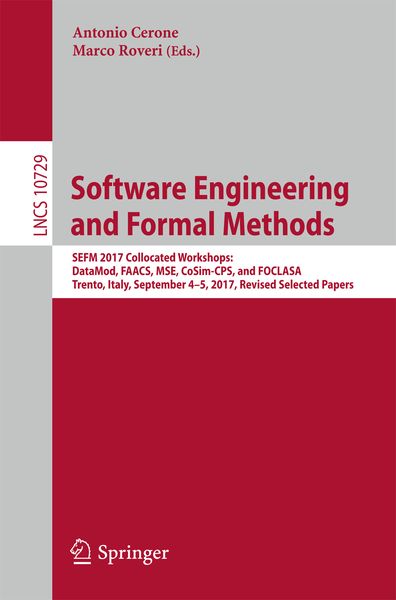
Software Engineering and Formal Methods SEFM 2017 Collocated Workshops: DataMod, FAACS, MSE, CoSim-CPS, and FOCLASA, Trento, Italy, September 4-5, 2017, Revised Selected Papers

71,99 €

inkl. gesetzl. MwSt., Versandkostenfrei


Beschreibung

Produktdetails

Einband

Taschenbuch

Erscheinungsdatum

03.02.2018

Abbildungen

X, 592 p. 204 illus.

Herausgeber

Antonio Cerone + weitere

Verlag

Springer

Seitenzahl

592

Maße (L/B/H)

23,5/15,5/3,3 cm

Gewicht

902 g

Auflage

1st ed. 2018

Sprache

Englisch

ISBN

978-3-319-74780-4

Beschreibung

Portrait


Produktdetails

Einband

Taschenbuch

Erscheinungsdatum

03.02.2018

Abbildungen

X, 592 p. 204 illus.

Herausgeber

Verlag

Springer

Seitenzahl

592

Maße (L/B/H)

23,5/15,5/3,3 cm

Gewicht

902 g

Auflage

1st ed. 2018

Sprache

Englisch

ISBN

978-3-319-74780-4

Herstelleradresse

Springer-Verlag KG
Sachsenplatz 4-6
1201 Wien
AT

Email: ProductSafety@springernature.com

Ein neues Kapitel für Ihre Bücher

Ein neues Kapitel für Ihre Bücher

Schenken Sie Ihren alten Schätzen ein zweites Leben und erhalten Sie dafür eine Thalia Geschenkkarte.

Jetzt verkaufen
Jetzt verkaufen

Noch keine Bewertungen vorhanden

Verfassen Sie die erste Bewertung zu diesem Artikel

Helfen Sie anderen Kundinnen und Kunden durch Ihre Meinung.

Kundinnen und Kunden meinen

Bewertungen (0)

  • Produktbild: Software Engineering and Formal Methods
  • DataMod.- Temporal Analytics for Software Usage Models.- Sequential Pattern Mining for ICT Risk Assessment and Prevention.- Student performance prediction and optimal course selection: An MDP approach.- An Algorithm for Simulating Human Selective Attention.- Learning Decision Trees from Synthetic Data Models for Human Security Behaviour.- Controlling Production Variances in Complex Business Processes.- A computational model of Internet addiction phenomena in social networks.- What belongs to context? A definition, a criterion and a method for deciding on what context-aware systems should sense and adapt to.- Finding all minimum-size DFA consistent with given examples: SAT-based approach.- FAACS.- Intercepting Blackhole Attacks in MANETs: An ASM-based Model.- Formalizing Monitoring Processes for Large-Scale Distributed Systems using Abstract State Machines.- Design-time to Run-time Verification of Microservices Based Applications.- Generalized Oracle for Testing Machine Learning Computer Programs.- MSE@SEFM 2017.- A Formal Framework for Specifying and Verifying Microservices Based Process Flows.- Towards a Taxonomy of Microservices Architectures.- Towards a reference dataset of microservice-based applications.- Towards a UML Profile for Domain-driven Design of Microservice Architectures.- A Framework for Modelling Variable Microservices as Software Product Lines.- CoSim-CPS.- A Refinement Approach to Analyse Critical Cyber-Physical Systems.- Injecting Formal Verification in FMI-based Co-Simulations of Cyber-Physical Systems.- Integrated simulation and formal verification of a simple autonomous vehicle.- Co-Simulation between Trnsys and Simulink based on Type155.- Development of a Driverless Lawn Mower using Co-Simulation.- Approximated Stability Analysis of Bi-Modal Hybrid Co-simulation Scenarios.- Towards Resilience-Explicit Modelling and Co-simulation of Cyber-Physical Systems.- Features of Integrated Model-based Co-modelling and Co-simulation Technology.- A Tool Integration Language to Formalize Co-simulation Tool-chains for Cyber-physical System (CPS).- A Framework for Analyzing Adaptive Autonomous Aerial Vehicles.- Co-simulation of semi-autonomous systems: the Line Follower Robot case study.- A Framework for the Co-Simulation of Engine Controls and Task Scheduling.- Formalising Cosimulation Models.- FOCLASA.- Towards the performance analysis of elastic systems with e-Motions.- From (incomplete) TOSCA speci_cations to running applications, with Docker.- Combining Trust and Aggregate Computing.- Reasoning about Sensing Uncertainty in Decision-Making for Self-Adaptation.- Lightweight Preprocessing for Agent-Based Simulation of Smart Mobility Initiatives.- Using Coq for Formal Modeling and Verification of Timed Connectors.- An initial user study comparing the readability of a graphical coordination model with Event-B notation.