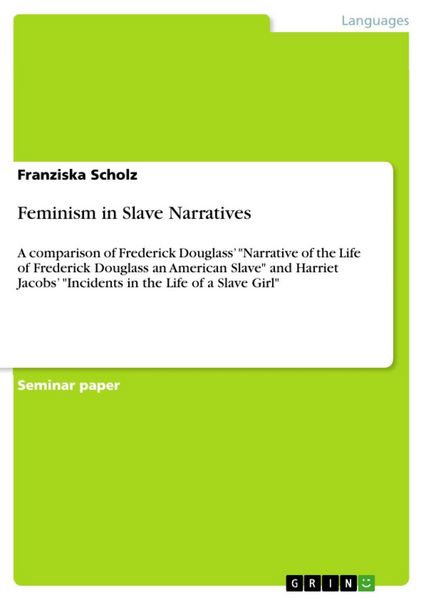
Feminism in Slave Narratives A comparison of Frederick Douglass' "Narrative of the Life of Frederick Douglass an American Slave" and Harriet Jacobs' "Incidents in the Life of a Slave Girl"
-
- Einzelkauf Download ausgewählt
-
Sprache:Englisch
13,99 €
inkl. gesetzl. MwSt.Beschreibung
Produktdetails
Format
ePUB
Kopierschutz
Nein
Family Sharing
Nein
Text-to-Speech
Ja
Erscheinungsdatum
23.11.2009
Verlag
GRINSeitenzahl
13 (Printausgabe)
Dateigröße
514 KB
Auflage
1. Auflage
Sprache
Englisch
EAN
9783640477241
The first chapter gives an insight into the characteristics of slave narratives such as style, structure, themes and aims. Slave narratives are a product of abolitionism, but the aim of this paper is to show feministic influences as well, as the second chapter illustrates.
By comparing the Narrative of the Life of Frederick Douglass an American Slave, written by himself with Harriet Jacobs' Incidents in the Life of a Slave Girl I want to show that the motifs for escape out of slavery are connected to very different factors for a slave woman compared to those of a slave man. Both Douglass and Jacobs suffer from the prevailing system of slavery, but Jacobs' female point-of-view adds the suffrage from patriarchy as well.
Finally I am going to follow the question why Douglass' narrative gained more success in the 19th century than Jacobs' narrative, although both stories deal with antislavery, oppression and the struggle for freedom.
Wir kaufen Ihren tolino
Wir kaufen Ihren tolino
Verkaufen Sie Ihren alten tolino und erhalten Sie dafür eine Thalia Geschenkkarte.
Noch keine Bewertungen vorhanden
Verfassen Sie die erste Bewertung zu diesem Artikel
Helfen Sie anderen Kundinnen und Kunden durch Ihre Meinung.
Kurze Frage zu unserer Seite
Vielen Dank für Ihr Feedback
Wir nutzen Ihr Feedback, um unsere Produktseiten zu verbessern. Bitte haben Sie Verständnis, dass wir Ihnen keine Rückmeldung geben können. Falls Sie Kontakt mit uns aufnehmen möchten, können Sie sich aber gerne an unseren Kund*innenservice wenden.
zum Kundenservice