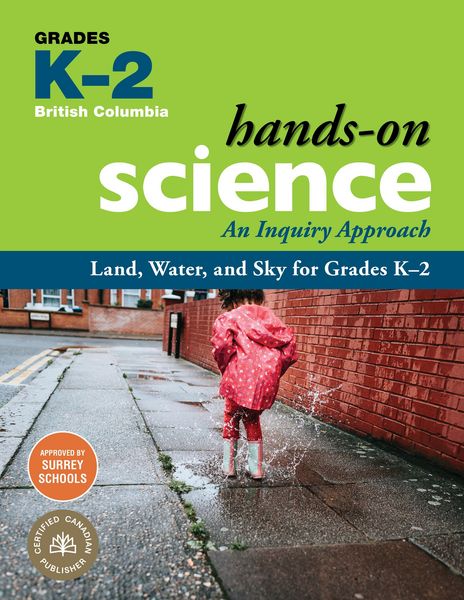
Land, Water, and Sky for Grades K-2 An Inquiry Approach
-
- Taschenbuch ausgewählt
- eBook
-
Sprache:Englisch
88,99 €
inkl. gesetzl. MwSt.,
Beschreibung
Produktdetails
Einband
Taschenbuch
Altersempfehlung
4 - 8 Jahr(e)
Erscheinungsdatum
10.04.2019
Verlag
Portage & Main PressSeitenzahl
178
Maße (L/B/H)
27,7/22,1/1,5 cm
Gewicht
540 g
Sprache
Englisch
ISBN
978-1-55379-797-5
Land, Water, and Sky for Grades K-2 from Hands-On Science for British Columbia: An Inquiry Approach completely aligns with BC's New Curriculum for science. Grounded in the Know-Do-Understand model, First Peoples knowledge and perspectives, and student-driven scientific inquiry, this custom-written resource:
- emphasizes Core Competencies, so students engage in deeper and lifelong learning
- develops Curricular Competencies as students explore science through hands-on activities
- fosters a deep understanding of the Big Ideas in science
Using proven Hands-On features, Land, Water, and Sky for Grades K-2 contains information and materials for both teachers and students including: Curricular Competencies correlation charts; background information on the science topics; complete, easy-to-follow lesson plans; digital reproducible student materials; and materials lists.
Innovative new elements have been developed specifically for the new curriculum:
- a multi-age approach
- a five-part instructional process-Engage, Explore, Expand, Embed, Enhance
- an emphasis on technology, sustainability, and personalized learning
- a fully developed assessment plan for summative, formative, and student self-assessment
- a focus on real-life Applied Design, Skills, and Technologies
- learning centres that focus on multiple intelligences and universal design for learning (UDL)
- place-based learning activities, Makerspaces, and Loose Parts
In Land, Water, and Sky for Grades K-2 students investigate characteristics of the land, water, and sky. Core Competencies and Curricular Competencies will be addressed while students explore the following Big Ideas:
- Daily and seasonal changes affect all living things.
- Observable patterns and cycles occur in the local sky and landscape.
- Water is essential to all living things, and it cycles through the environment.
Ein neues Kapitel für Ihre Bücher
Ein neues Kapitel für Ihre Bücher
Schenken Sie Ihren alten Schätzen ein zweites Leben und erhalten Sie dafür eine Thalia Geschenkkarte.
Noch keine Bewertungen vorhanden
Verfassen Sie die erste Bewertung zu diesem Artikel
Helfen Sie anderen Kundinnen und Kunden durch Ihre Meinung.
Kurze Frage zu unserer Seite
Vielen Dank für Ihr Feedback
Wir nutzen Ihr Feedback, um unsere Produktseiten zu verbessern. Bitte haben Sie Verständnis, dass wir Ihnen keine Rückmeldung geben können. Falls Sie Kontakt mit uns aufnehmen möchten, können Sie sich aber gerne an unseren Kund*innenservice wenden.
zum Kundenservice