KI-Beratung Beta

  • Produktbild: Applied Reconfigurable Computing
  • Produktbild: Applied Reconfigurable Computing
Band 11444

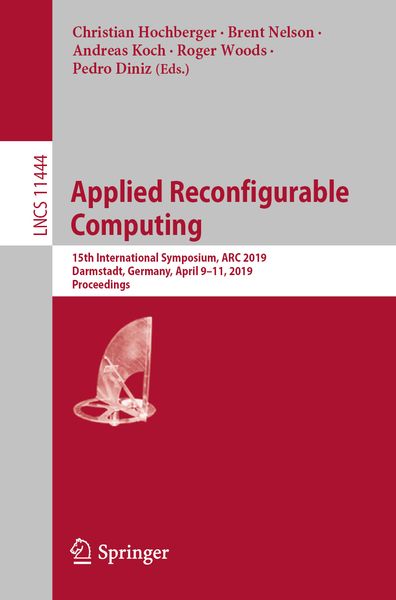
Applied Reconfigurable Computing 15th International Symposium, ARC 2019, Darmstadt, Germany, April 9–11, 2019, Proceedings

49,99 €

inkl. gesetzl. MwSt., Versandkostenfrei


Beschreibung

Produktdetails

Einband

Taschenbuch

Erscheinungsdatum

29.03.2019

Abbildungen

XIII, 418 p. 217 illus., 110 illus. in color.

Herausgeber

Christian Hochberger + weitere

Verlag

Springer

Seitenzahl

418

Maße (L/B/H)

23,5/15,5/2,4 cm

Gewicht

651 g

Auflage

19001 Auflage 1st edition 2019

Sprache

Englisch

ISBN

978-3-030-17226-8

Beschreibung

Produktdetails

Einband

Taschenbuch

Erscheinungsdatum

29.03.2019

Abbildungen

XIII, 418 p. 217 illus., 110 illus. in color.

Herausgeber

Verlag

Springer

Seitenzahl

418

Maße (L/B/H)

23,5/15,5/2,4 cm

Gewicht

651 g

Auflage

19001 Auflage 1st edition 2019

Sprache

Englisch

ISBN

978-3-030-17226-8

Herstelleradresse

Springer-Verlag KG
Sachsenplatz 4-6
1201 Wien
AT

Email: ProductSafety@springernature.com

Ein neues Kapitel für Ihre Bücher

Ein neues Kapitel für Ihre Bücher

Schenken Sie Ihren alten Schätzen ein zweites Leben und erhalten Sie dafür eine Thalia Geschenkkarte.

Jetzt verkaufen
Jetzt verkaufen

Noch keine Bewertungen vorhanden

Verfassen Sie die erste Bewertung zu diesem Artikel

Helfen Sie anderen Kundinnen und Kunden durch Ihre Meinung.

Kundinnen und Kunden meinen

Bewertungen (0)

  • Produktbild: Applied Reconfigurable Computing
  • Produktbild: Applied Reconfigurable Computing

  • Applications.-
    Fault-Tolerant Architecture for On-Board Dual-Core Synthetic-Aperture Radar Imaging.- Optimizing CNN-based Hyperspectral Image Classification on FPGAs.- Supporting Columnar In-Memory Formats on FPGA: The Hardware Design of Fletcher for Apache Arrow.- A Novel Encoder for TDCs.- A Resource Reduced Application-Specific FPGA Switch.- Software-Defined FPGA Accelerator Design for Mobile Deep Learning Applications.- Partial Reconfiguration and Security.- Probabilistic Performance Modelling when using Partial Reconfiguration to Accelerate Streaming Applications with Non-Deterministic Task Scheduling.- Leveraging the Partial Reconfiguration Capability of FPGAs for Processor-Based Fail-Operational Systems.- (ReCo)Fuse Your PRC or Lose Security: Finally Reliable Reconfiguration-based Countermeasures on FPGAs.- Proof-Carrying Hardware versus the Stealthy Malicious LUT Hardware Trojan.- Secure Local Configuration of Intellectual Property Without a Trusted Third Party.-
    Image/Video Processing.-
    HiFlipVX: an Open Source High-Level Synthesis FPGA Library for Image Processing.- Real-time FPGA implementation of connected component labelling for a 4K video stream.- A Scalable FPGA-based Architecture for Depth Estimation in SLAM.-
    High-Level Synthesis.-
    Evaluating LULESH Kernels on OpenCL FPGA.- The TaPaSCo Open-Source Toolflow for the Automated Composition of Task-Based Parallel Reconfigurable Computing Systems.- Graph-based Code Restructuring Targeting HLS for FPGAs.-
    CGRAs and Vector Processing.-
    UltraSynth: Integration of a CGRA into a Control Engineering Environment.- Exploiting reconfigurable vector processing for energy-efficient computation in 3D-stacked memories.- Automatic Toolflow for VCGRA Generation to Enable CGRA Evaluation for Arithmetic Algorithms.-
    Architectures.-
    ReM: a Reconfigurable Multipotent Cell for New Distributed Reconfigurable Architectures.- Update or Invalidate: Influence of Coherence Protocols on Configurable HW Accelerators.-
    Design Frameworks and Methodology.-
    Hybrid Prototyping for Manycore Design and Validation.- Evaluation of FPGA Partitioning Schemes for Time and Space Sharing of Heterogeneous Tasks.-
    Invited Talk.-
    Third Party CAD Tools for FPGA Design | A Survey of the Current Landscape.-
    Convolutional Neural Networks.-
    Filter-wise Pruning Approach to FPGA Implementation of Fully Convolutional Network for Semantic Segmentation.- Exploring Data Size to Run Convolutional Neural Networks in Low Density FPGAs.- Faster Convolutional Neural Networks in Low Density FPGAs using Block Pruning.