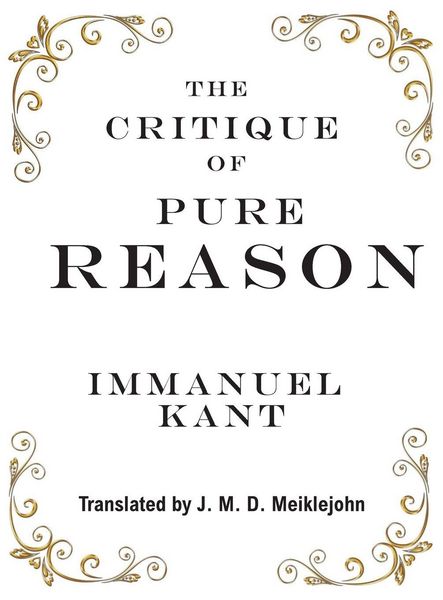
The Critique of Pure Reason
-
- Hardcover ausgewählt
- Taschenbuch
- eBook
- Hörbuch
-
Sprache:Englisch
-
Verlag:Classic Wisdom Reprint
- Outlook 69,90 €
- Cambridge Academic 83,99 €
- British Library, Historical Print Editions 38,99 €
- Www.bnpublishing.net 19,99 €
- Cambridge University Press 71,99 €
- Cosimo 39,99 €
- A & D Publishing 26,99 €
- Creative Media Partners, LLC 38,99 €
- Start Publishing PD 17,99 €
- Classic Wisdom Reprint 27,99 € ausgewählt
- Repro India Limited 39,99 €
27,99 €
inkl. gesetzl. MwSt.,
Beschreibung
Produktdetails
Einband
Gebundene Ausgabe
Erscheinungsdatum
10.04.2019
Verlag
Classic Wisdom ReprintSeitenzahl
274
Maße (L/B/H)
28,6/22,1/1,9 cm
Gewicht
956 g
Sprache
Englisch
ISBN
978-1-950330-18-8
Kant builds on the work of empiricist philosophers such as John Locke and David Hume, as well as rationalists such as Gottfried Wilhelm Leibniz and Christian Wolff. He expounds new ideas on the nature of space and time, and tries to provide solutions to Hume's scepticism regarding human knowledge of the relation of cause and effect, and René Descartes' scepticism regarding knowledge of the external world. This is argued through the transcendental idealism of objects (as appearance) and their form of appearance. Kant regards the former "as mere representations and not as things in themselves", and the latter as "only sensible forms of our intuition, but not determinations given for themselves or conditions of objects as things in themselves". This grants the possibility of a priori knowledge, since objects as appearance "must conform to our cognition . . . which is to establish something about objects before they are given to us". Knowledge independent of experience Kant calls "a priori" knowledge, while knowledge obtained through experience is termed "a posteriori". In Kant's view, a priori intuitions and concepts provide some a priori knowledge, which also provides the framework for a posteriori knowledge. Kant also believed that causality is a conceptual organizing principle imposed upon nature, albeit nature understood as the sum of appearances that can be synthesized according to a priori concepts. In other words, space and time are a form of perceiving and causality is a form of knowing. Both space and time and conceptual principles and processes pre-structure experience. Things as they are "in themselves"—the thing in itself or das Ding an sich—are unknowable. For something to become an object of knowledge, it must be experienced, and experience is structured by the mind—both space and time being the forms of intuition (Anschauung in German; for Kant, intuition is the process of sensing or the act of having a sensation)
Ein neues Kapitel für Ihre Bücher
Ein neues Kapitel für Ihre Bücher
Schenken Sie Ihren alten Schätzen ein zweites Leben und erhalten Sie dafür eine Thalia Geschenkkarte.
Noch keine Bewertungen vorhanden
Verfassen Sie die erste Bewertung zu diesem Artikel
Helfen Sie anderen Kundinnen und Kunden durch Ihre Meinung.
Kurze Frage zu unserer Seite
Vielen Dank für Ihr Feedback
Wir nutzen Ihr Feedback, um unsere Produktseiten zu verbessern. Bitte haben Sie Verständnis, dass wir Ihnen keine Rückmeldung geben können. Falls Sie Kontakt mit uns aufnehmen möchten, können Sie sich aber gerne an unseren Kund*innenservice wenden.
zum Kundenservice