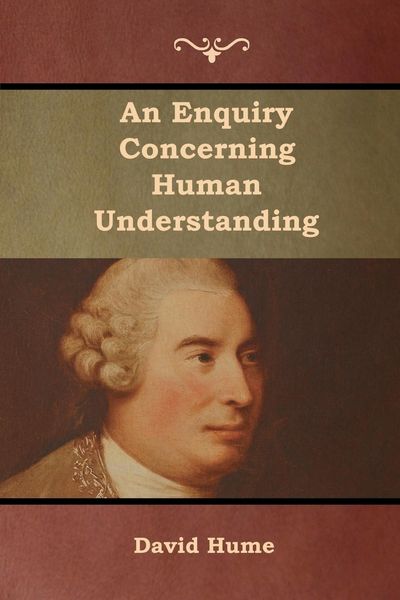
An Enquiry Concerning Human Understanding
-
- Hardcover
- Taschenbuch ausgewählt
- eBook
- Hörbuch
-
Sprache:Englisch
-
Verlag:Bibliotech Pr
- Globe Pequot Publishing Group Inc 13,99 €
- Lector House 15,99 €
- Hackett Publishing Co, Inc 16,99 €
- True Sign Publishing House 19,99 €
- Tredition 12,90 €
- Ockham Publishing 15,99 €
- Oxford University Press 11,17 €
- Bibliotech Pr 18,99 € ausgewählt
- Classy Publishing 19,99 €
- A & D Publishing 16,99 €
- Sanage Publishing House 19,99 €
- Digireads.com 13,99 €
- Simon & Brown 16,99 €
- Blurb 17,99 €
- Double 9 Booksllp 19,99 €
- Dover Publications 8,59 €
- Repro India Limited 16,99 €
- Indoeuropeanpublishing.Com 16,99 €
18,99 €
inkl. gesetzl. MwSt.,
Beschreibung
Produktdetails
Einband
Taschenbuch
Erscheinungsdatum
10.07.2019
Verlag
Bibliotech PrSeitenzahl
120
Maße (L/B/H)
22,9/15,2/0,7 cm
Gewicht
187 g
Sprache
Englisch
ISBN
978-1-61895-576-0
David Hume (born David Home; 7 May 1711 NS (26 April 1711 OS) – 25 August 1776) was a Scottish Enlightenment philosopher, historian, economist, and essayist, who is best known today for his highly influential system of philosophical empiricism, scepticism, and naturalism. Hume's empiricist approach to philosophy places him with John Locke, George Berkeley, Francis Bacon and Thomas Hobbes as a British Empiricist. Beginning with his A Treatise of Human Nature (1738), Hume strove to create a total naturalistic science of man that examined the psychological basis of human nature. Against philosophical rationalists, Hume held that passion rather than reason governs human behaviour. Hume argued against the existence of innate ideas, positing that all human knowledge is founded solely in experience. In what is sometimes referred to as Hume's problem of induction, he argued that inductive reasoning and belief in causality cannot be justified rationally; instead, our trust in causality and induction result from custom and mental habit, and are attributable only to the experience of "constant conjunction" of events. This is because we can never actually perceive that one event causes another, but only that the two are always conjoined. Accordingly, to draw any causal inferences from past experience it is necessary to presuppose that the future will resemble the past, a presupposition which cannot itself be grounded in prior experience. Hume's opposition to the teleological argument for God's existence, the argument from design, is generally regarded as the most intellectually significant attempt to rebut the argument prior to Darwinism. Hume influenced utilitarianism, logical positivism, Immanuel Kant, the philosophy of science, early analytic philosophy, cognitive science, theology, and other movements and thinkers.
Ein neues Kapitel für Ihre Bücher
Ein neues Kapitel für Ihre Bücher
Schenken Sie Ihren alten Schätzen ein zweites Leben und erhalten dafür eine Thalia Geschenkkarte.
Noch keine Bewertungen vorhanden
Verfassen Sie die erste Bewertung zu diesem Artikel
Helfen Sie anderen Kundinnen und Kunden durch Ihre Meinung.
Kurze Frage zu unserer Seite
Vielen Dank für Ihr Feedback
Wir nutzen Ihr Feedback, um unsere Produktseiten zu verbessern. Bitte haben Sie Verständnis, dass wir Ihnen keine Rückmeldung geben können. Falls Sie Kontakt mit uns aufnehmen möchten, können Sie sich aber gerne an unseren Kund*innenservice wenden.
zum Kundenservice