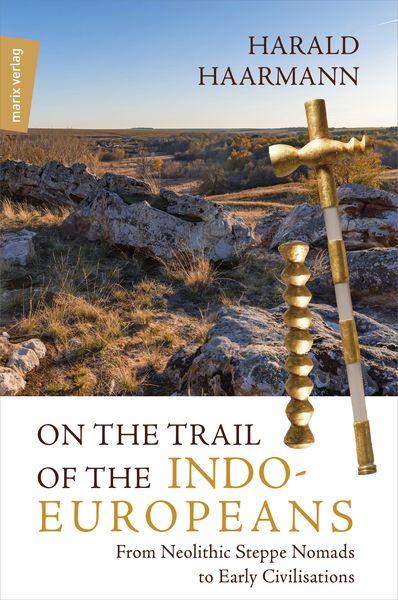
Produktbild: On the Trail of the Indo-Europeans: From Neolithic Steppe Nomads to Early Civilisations

On the Trail of the Indo-Europeans: From Neolithic Steppe Nomads to Early Civilisations

20,00 €

inkl. gesetzl. MwSt., Versandkostenfrei


Beschreibung

Produktdetails

Einband

Gebundene Ausgabe

Erscheinungsdatum

16.09.2020

Verlag

Marix Verlag ein Imprint von Verlagshaus Römerweg

Seitenzahl

368

Maße (L/B/H)

21,8/15,1/3,4 cm

Gewicht

593 g

Auflage

1. Auflage

Sprache

Englisch

ISBN

978-3-7374-1157-8

Beschreibung

Produktdetails

Einband

Gebundene Ausgabe

Erscheinungsdatum

16.09.2020

Verlag

Marix Verlag ein Imprint von Verlagshaus Römerweg

Seitenzahl

368

Maße (L/B/H)

21,8/15,1/3,4 cm

Gewicht

593 g

Auflage

1. Auflage

Sprache

Englisch

ISBN

978-3-7374-1157-8

Herstelleradresse

Marix Verlag
Römerweg 10
65187 Wiesbaden
DE

Email: info@marixverlag.de

Ein neues Kapitel für Ihre Bücher

Ein neues Kapitel für Ihre Bücher

Schenken Sie Ihren alten Schätzen ein zweites Leben: Einfach Barcode scannen, Versandetikett ausdrucken, Bücher verschicken und Thalia Geschenkkarte erhalten.

Jetzt verkaufen
Jetzt verkaufen

Kundinnen und Kunden meinen

0 Bewertungen

Informationen zu Bewertungen

Zur Abgabe einer Bewertung ist eine Anmeldung im Konto notwendig. Die Authentizität der Bewertungen wird von uns nicht überprüft. Wir behalten uns vor, Bewertungstexte, die unseren Richtlinien widersprechen, entsprechend zu kürzen oder zu löschen.

Die Bewertungen sind nach Format, Anzahl Sterne und Datum sortiert.

Verfassen Sie die erste Bewertung zu diesem Artikel

Helfen Sie anderen Kund*innen durch Ihre Meinung

Kundinnen und Kunden meinen

0 Bewertungen filtern

  • Produktbild: On the Trail of the Indo-Europeans: From Neolithic Steppe Nomads to Early Civilisations
  • Contents

    Introduction: The mystery of the Indo‑Europeans
    In search of linguistic affinities from a people to a race: Indo-Europeans and Aryans
    The swastika, an Aryan symbol?

    1.Homeland in the southern Russian steppe (11th – 8th millennium BCE)
    Neolithic transitions: nomadic herders in the East, farmers in the West
    Homeland Anatolia? New findings in human genetics 28 natural environment of the steppe
    Indo-Europeans and Uralians: Early encounters

    2.Proto‑Indo‑European language and culture (from the 7th millennium BCE)
    Basic structures and properties 46 names as ethnic identity markers
    functional variations of proto-Indo-European

    3.Early steppe nomads: Social systems and worldviews (from the 7th millennium BCE)
    Proto-Indo-European regional cultures
    Early social hierarchies and patriarchal power structures
    Families, kinship, clans
    Outlines of a proto-Indo-European mythology

    4.Contacts with farmers to the west (from the 5th millennium BCE)
    Adoption of the ‘agrarian package’
    Technological innovations

    5.The first migration of the steppe nomads (from the middle of the 5th millennium BCE)
    Migration and the motivation behind it
    Evidence of the nomads’ migrations
    Primary Indo-Europeanisation: adaptation to the elite and language shift

    6.The fragmentation of Proto‑Indo‑European (from 4000 BCE)
    Southwards: Interactions with the Old Europeans
    Eastwards: Exploration of central Asia and southern Siberia
    The fragmentation of the common language
    Indo-Iranian as a macro-group
    The Armenians: Outlier in the Caucasus

    7.Southeast Europe: The emergence of Hellenic culture (from the 3rd millennium BCE)
    How the Hellads became the Hellenes
    Under the patronage of pre-Greek deities
    From ritual to theatre
    The Hellenes and their political systems
    The development of the Greek language

    8.Apennine Peninsula: The dominance of Latin (from the 2nd millennium BCE)
    Indo-Europeans in Italy
    The Etruscans, teachers of the romans
    The birth of a world language

    9.The Balkans: Between Roman and Greek Civilisation (from the 2nd millennium BCE)
    The roman-Greek linguistic and cultural border
    Ancient Balkan tribal associations and kingdoms
    Fusion culture: Albanian

    10.Central and Western Europe: Celtic and Germanic peoples (from the 2nd millennium BCE)
    All the way to the Atlantic coast: Celtic cultures and languages
    Germanic cultures, languages and nation building

    11.Eastern Europe: Slavs and Balts (from the 2nd millennium BCE)
    The evolution of Slavic
    Contacts with non-Slavic peoples
    The splitting-off of Baltic
    Baltic-Finnish contacts in the Baltic Sea region: sedentary versus mobile

    12.Asia Minor: Anatolian languages and cultures (from the 2nd millennium BCE)
    Hittites and Luwians
    Non-Indo-European languages and cultures in Anatolia
    The cult of Artemis of Ephesus
    Phrygian: an Indo-European outlier

    13.From Central Asia to the Iranian Plateau (from the 2nd millennium BCE)
    The Aryan warrior caste and the Kingdom of Mitanni
    Early states founded by Iranian peoples
    Iranian languages
    Zoroastrianism

    14.India: Dravidians and Aryans (2nd millennium BCE)
    Dravidian culture
    Aryan ‘immigration’
    Cultural symbioses
    From Vedic to Sanskrit
    The Prakrits and successor languages
    Indic languages in southeast Asia

    15.Outlying Indo‑European settlements in western China (2nd millennium BCE)
    The mystery of the Tarim mummies
    Tocharian language and culture

    16.Experiments with writing: From Linear B to Ogham (1700 BCE – 500 CE)
    Syllabaries
    Alphabetic scripts

    17.Epilogue: Indo‑European globalisation

    Bibliography

    Sources of maps and illustrations

    Index