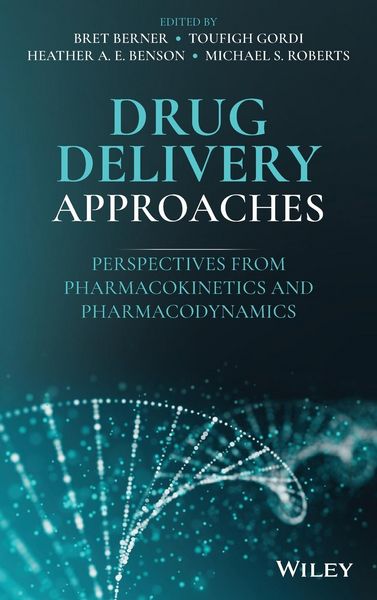
Drug Delivery Approaches Perspectives from Pharmacokinetics and Pharmacodynamics
269,99 €
inkl. gesetzl. MwSt.,
Beschreibung
Produktdetails
Einband
Gebundene Ausgabe
Erscheinungsdatum
31.08.2021
Herausgeber
Bret Berner + weitereVerlag
John Wiley & Sons IncSeitenzahl
464
Maße (L/B/H)
23,5/15,7/2,9 cm
Gewicht
811 g
Auflage
1. Auflage
Sprache
Englisch
ISBN
978-1-119-77273-6
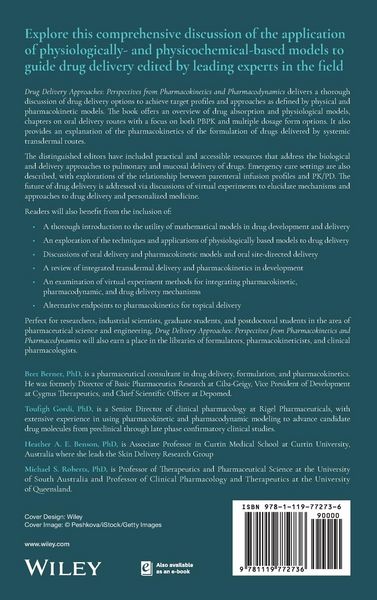
Drug Delivery Approaches: Perspectives from Pharmacokinetics and Pharmacodynamics delivers a thorough discussion of drug delivery options to achieve target profiles and approaches as defined by physical and pharmacokinetic models. The book offers an overview of drug absorption and physiological models, chapters on oral delivery routes with a focus on both PBPK and multiple dosage form options. It also provides an explanation of the pharmacokinetics of the formulation of drugs delivered by systemic transdermal routes.
The distinguished editors have included practical and accessible resources that address the biological and delivery approaches to pulmonary and mucosal delivery of drugs. Emergency care settings are also described, with explorations of the relationship between parenteral infusion profiles and PK/PD. The future of drug delivery is addressed via discussions of virtual experiments to elucidate mechanisms and approaches to drug delivery and personalized medicine.
Readers will also benefit from the inclusion of:
* A thorough introduction to the utility of mathematical models in drug development and delivery
* An exploration of the techniques and applications of physiologically based models to drug delivery
* Discussions of oral delivery and pharmacokinetic models and oral site-directed delivery
* A review of integrated transdermal delivery and pharmacokinetics in development
* An examination of virtual experiment methods for integrating pharmacokinetic, pharmacodynamic, and drug delivery mechanisms
* Alternative endpoints to pharmacokinetics for topical delivery
Perfect for researchers, industrial scientists, graduate students, and postdoctoral students in the area of pharmaceutical science and engineering, Drug Delivery Approaches: Perspectives from Pharmacokinetics and Pharmacodynamics will also earn a place in the libraries of formulators, pharmacokineticists, and clinical pharmacologists.
Ein neues Kapitel für Ihre Bücher
Ein neues Kapitel für Ihre Bücher
Schenken Sie Ihren alten Schätzen ein zweites Leben und erhalten Sie dafür eine Thalia Geschenkkarte.
Noch keine Bewertungen vorhanden
Verfassen Sie die erste Bewertung zu diesem Artikel
Helfen Sie anderen Kundinnen und Kunden durch Ihre Meinung.
Kurze Frage zu unserer Seite
Vielen Dank für Ihr Feedback
Wir nutzen Ihr Feedback, um unsere Produktseiten zu verbessern. Bitte haben Sie Verständnis, dass wir Ihnen keine Rückmeldung geben können. Falls Sie Kontakt mit uns aufnehmen möchten, können Sie sich aber gerne an unseren Kund*innenservice wenden.
zum Kundenservice