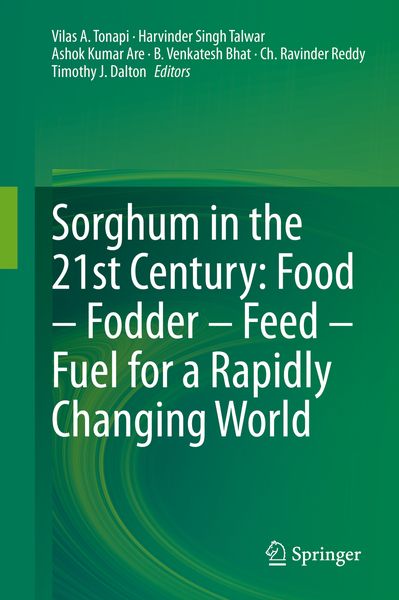
Sorghum in the 21st Century: Food – Fodder – Feed – Fuel for a Rapidly Changing World
-
- Hardcover ausgewählt
- Taschenbuch
- eBook
-
Sprache:Englisch
166,99 €
UVP
192,59 €
inkl. gesetzl. MwSt.,
Beschreibung
Produktdetails
Einband
Gebundene Ausgabe
Erscheinungsdatum
05.01.2021
Abbildungen
XXVI, 940 p. 137 illus.
Herausgeber
Vilas A. Tonapi + weitereVerlag
Springer SingaporeSeitenzahl
940
Maße (L/B/H)
24,1/16/5,7 cm
Gewicht
1545 g
Auflage
1st edition 2020
Sprache
Englisch
ISBN
978-981-15-8248-6
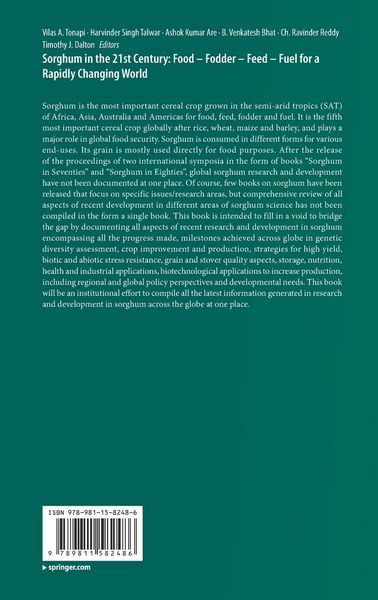
Sorghum is the most important cereal crop grown in the semi-arid tropics (SAT) of Africa, Asia, Australia and Americas for food, feed, fodder and fuel. It is the fifth most important cereal crop globally after rice, wheat, maize and barley, and plays a major role in global food security. Sorghum is consumed in different forms for various end-uses. Its grain is mostly used directly for food purposes. After the release of the proceedings of two international symposia in the form of books “Sorghum in Seventies” and “Sorghum in Eighties”, global sorghum research and development have not been documented at one place. Of course, few books on sorghum have been released that focus on specific issues/research areas, but comprehensive review of all aspects of recent development in different areas of sorghum science has not been compiled in the form a single book. This book is intended to fill in a void to bridge the gap by documenting all aspects of recent research and development in sorghum encompassing all the progress made, milestones achieved across globe in genetic diversity assessment, crop improvement and production, strategies for high yield, biotic and abiotic stress resistance, grain and stover quality aspects, storage, nutrition, health and industrial applications, biotechnological applications to increase production, including regional and global policy perspectives and developmental needs. This book will be an institutional effort to compile all the latest information generated in research and development in sorghum across the globe at one place.
Ein neues Kapitel für Ihre Bücher
Ein neues Kapitel für Ihre Bücher
Schenken Sie Ihren alten Schätzen ein zweites Leben und erhalten Sie dafür eine Thalia Geschenkkarte.
Noch keine Bewertungen vorhanden
Verfassen Sie die erste Bewertung zu diesem Artikel
Helfen Sie anderen Kundinnen und Kunden durch Ihre Meinung.
Kurze Frage zu unserer Seite
Vielen Dank für Ihr Feedback
Wir nutzen Ihr Feedback, um unsere Produktseiten zu verbessern. Bitte haben Sie Verständnis, dass wir Ihnen keine Rückmeldung geben können. Falls Sie Kontakt mit uns aufnehmen möchten, können Sie sich aber gerne an unseren Kund*innenservice wenden.
zum Kundenservice