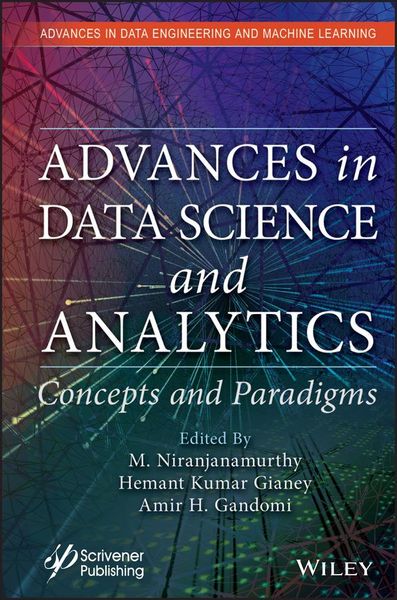
Advances in Data Science and Analytics Concepts and Paradigms
216,99 €
inkl. gesetzl. MwSt.,
Beschreibung
Produktdetails
Einband
Gebundene Ausgabe
Erscheinungsdatum
15.11.2022
Herausgeber
M. Niranjanamurthy + weitereVerlag
John Wiley & SonsSeitenzahl
352
Maße (L/B/H)
22,9/15,2/2 cm
Gewicht
794 g
Auflage
1. Auflage
Sprache
Englisch
ISBN
978-1-119-79188-1
Presenting the concepts and advances of data science and analytics, this volume, written and edited by a global team of experts, also goes into the practical applications that can be utilized across multiple disciplines and industries, for both the engineer and the student, focusing on machining learning, big data, business intelligence, and analytics.
Data science is an interdisciplinary field that uses scientific methods, processes, algorithms, and systems to extract knowledge and insights from many structural and unstructured data. Data science is related to data mining, deep learning, and big data. Data analytics software is a more focused version of this and can even be considered part of the larger process. Analytics is devoted to realizing actionable insights that can be applied immediately based on existing queries. For the purposes of this volume, data science is an umbrella term that encompasses data analytics, data mining, machine learning, and several other related disciplines. While a data scientist is expected to forecast the future based on past patterns, data analysts extract meaningful insights from various data sources.
Although data mining and other related areas have been around for a few decades, data science and analytics are still quickly evolving, and the processes and technologies change, almost on a day-to-day basis. This volume provides an overview of some of the most important advances in these areas today, including practical coverage of the daily applications. Valuable as a learning tool for beginners in this area as well as a daily reference for engineers and scientists working in these areas, this is a must-have for any library.
Ein neues Kapitel für Ihre Bücher
Ein neues Kapitel für Ihre Bücher
Schenken Sie Ihren alten Schätzen ein zweites Leben und erhalten Sie dafür eine Thalia Geschenkkarte.
Noch keine Bewertungen vorhanden
Verfassen Sie die erste Bewertung zu diesem Artikel
Helfen Sie anderen Kundinnen und Kunden durch Ihre Meinung.
Kurze Frage zu unserer Seite
Vielen Dank für Ihr Feedback
Wir nutzen Ihr Feedback, um unsere Produktseiten zu verbessern. Bitte haben Sie Verständnis, dass wir Ihnen keine Rückmeldung geben können. Falls Sie Kontakt mit uns aufnehmen möchten, können Sie sich aber gerne an unseren Kund*innenservice wenden.
zum Kundenservice