KI-Beratung Beta

  • Produktbild: PRIMA 2020: Principles and Practice of Multi-Agent Systems
  • Produktbild: PRIMA 2020: Principles and Practice of Multi-Agent Systems
Band 12568

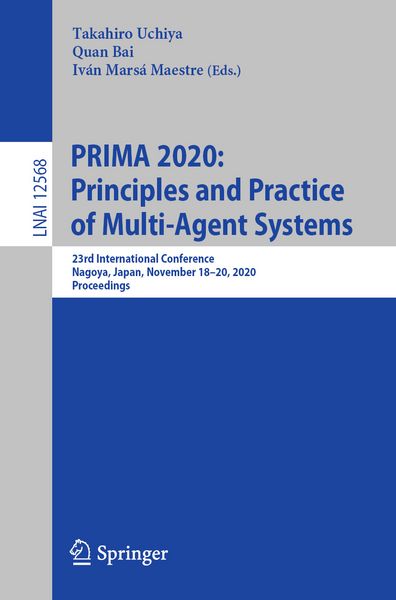
PRIMA 2020: Principles and Practice of Multi-Agent Systems 23rd International Conference, Nagoya, Japan, November 18–20, 2020, Proceedings

51,99 €

inkl. gesetzl. MwSt., Versandkostenfrei


Beschreibung

Produktdetails

Einband

Taschenbuch

Erscheinungsdatum

14.02.2021

Abbildungen

XIII, 430 p. 124 illus., 101 illus. in color.

Herausgeber

Takahiro Uchiya + weitere

Verlag

Springer

Seitenzahl

430

Maße (L/B/H)

23,5/15,5/2,4 cm

Gewicht

668 g

Auflage

1st ed. 2021

Sprache

Englisch

ISBN

978-3-030-69321-3

Beschreibung

Produktdetails

Einband

Taschenbuch

Erscheinungsdatum

14.02.2021

Abbildungen

XIII, 430 p. 124 illus., 101 illus. in color.

Herausgeber

Verlag

Springer

Seitenzahl

430

Maße (L/B/H)

23,5/15,5/2,4 cm

Gewicht

668 g

Auflage

1st ed. 2021

Sprache

Englisch

ISBN

978-3-030-69321-3

Herstelleradresse

Springer-Verlag KG
Sachsenplatz 4-6
1201 Wien
AT

Email: ProductSafety@springernature.com

Ein neues Kapitel für Ihre Bücher

Ein neues Kapitel für Ihre Bücher

Schenken Sie Ihren alten Schätzen ein zweites Leben und erhalten Sie dafür eine Thalia Geschenkkarte.

Jetzt verkaufen
Jetzt verkaufen

Noch keine Bewertungen vorhanden

Verfassen Sie die erste Bewertung zu diesem Artikel

Helfen Sie anderen Kundinnen und Kunden durch Ihre Meinung.

Kundinnen und Kunden meinen

Bewertungen (0)

  • Produktbild: PRIMA 2020: Principles and Practice of Multi-Agent Systems
  • Produktbild: PRIMA 2020: Principles and Practice of Multi-Agent Systems
  • Implementation of Real Data for Financial Market Simulation using Clustering, Deep Learning, and Artificial Financial Market.- Hybrid Dynamic Programming for Simultaneous Coalition Structure Generation and Assignment.- A Socio-Psychological Approach To Simulate Trust and Reputation in Modal Choices.- Reasoning about Trustworthiness in Cyber-Physical Systems Using Ontology-Based Representation and ASP.- Optimal Deterministic Time-based Policy in Automated Negotiation.-

    Agent Simulation of Collision Avoidance based on Meta-Strategy Model.- The Smart Appliance Scheduling Problem: A Bayesian Optimization Approach.- Distance-based Heuristic Solvers for Cooperative Path Planning with Heterogeneous Agents.-

    Policy Advisory Module for Exploration Hindrance Problem in Multi-agent Deep Reinforcement Learning.- Analysis of Coordination Structures of Partially Observing Cooperative Agents by Multi-Agent Deep Q-Learning.- Policy Adaptive Multi-Agent Deep Deterministic Policy Gradient.- Multi-Agent Planning with High-Level Human Guidance.- Preference Elicitation in Assumption-Based Argumentation.- Declarative Preferences in Reactive BDI Agents.- Predicting the Priority of Social Situations for Personal Assistant Agents.- Mutex Propagation for SAT-based Multi-Agent Path Finding.- A SMT-based Implementation for Safety Checking of Parameterized Multi-Agent Systems.- A Goal-Based Framework For Supporting Medical Assistance: The Case of Chronic Diseases.- Optimal Control of Pedestrian Flows by Congestion Forecasts Satisfying User Equilibrium Conditions.- Automated Negotiation Mechanism and Strategy for Compensational Vehicular Platooning.- A Cognitive Agent Framework in Information Retrieval: Using User Beliefs to Customize Results.- Deep Reinforcement Learning for Pedestrian Guidance.- NegMAS: A platform for automated negotiations.- Simulation of Unintentional Collusion Caused by Auto Pricing in Supply Chain Markets.- Construct an Artificial Population with Urban and Rural Population Differences Considered: to support long-term care system evaluation by agent-based simulation.- Multi-Agent Path Finding with Destination Choice.-

    Abductive Design of BDI Agent-based Digital Twins of Organizations.- Beliefs, Time and Space: A Language for the Ykai Board Game.- Argumentation-based Explanations of Multimorbidity Treatment Plans.- The Persistence of False Memory: Brain in a Vat despite Perfect Clocks.- Box-Office Prediction Based on Essential Features Extracted from Agent-Based Modeling.- Short Duration Aggregate Statistical Model Checking for Multi-Agent Systems.