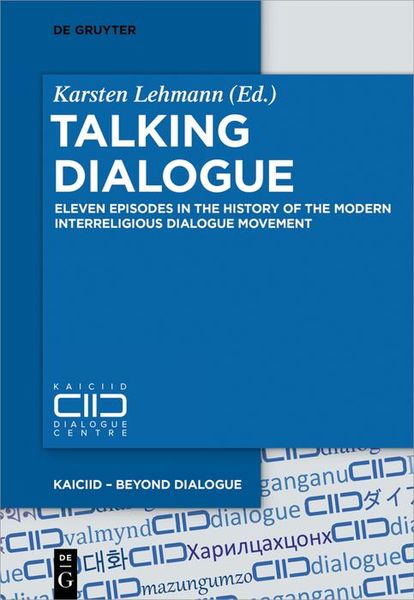
Talking Dialogue Eleven Episodes in the History of the Modern Interreligious Dialogue Movement
-
- Einzelkauf Download ausgewählt
-
Sprache:Englisch
-
eBook Format:PDF
- PDF 0,00 € ausgewählt
- ePUB 0,00 €
0,00 €
inkl. gesetzl. MwSt.Artikel erhalten
Beschreibung
Produktdetails
Format
Kopierschutz
Nein
Family Sharing
Nein
Text-to-Speech
Nein
Erscheinungsdatum
22.02.2021
Herausgeber
Karsten LehmannVerlag
De Gruyter OldenbourgSeitenzahl
386 (Printausgabe)
Auflage
1. Auflage
Sprache
Englisch
EAN
9783110529173
Throughout the last two decades, the modern dialogue movement has gained worldwide significance. The knowledge about its origins is, however, still very limited. This book presents a wide range of insights from eleven case studies into the early history of several important international interreligious/interfaith dialogue organizations that have shaped the modern development of interreligious dialogue from the late nineteenth century up to the present. Based on new archival research, they describe, on the one hand, how these actors put their ideals into practice and, on the other, how they faced many challenges as pioneers in the establishment of new interreligious/interfaith organizational structures. This book concludes with a comparison of those case studies, bringing to light new and broader historico-sociological understanding of the beginnings of international and multi-religious interreligious/interfaith dialogue organizations over more than one century.¿
The World's Parliament of Religions / 1893
The Religiöser Menschheitsbund / 1921
The World Congress of Faiths / 1933-1950
The Committee on the Church and the Jewish People of the World Council of Churches / 1961
The Temple of Understanding / 1968
The International Association for Religious Freedom / 1969
The World Conference on Religion and Peace / 1970
The Council for a Parliament of the World's Religions / 1989-1991
The Oxford International Interfaith Centre / 1993
The United Religions Initiative / 2000
The Universal Peace Federation / 2005
Based on these analyses, the authors identify three distinct groups with sometimes-conflicting interests that are shaping the movement: individual religious virtuosi, countercultural activists, and representatives of religious institutions.
Published in cooperation with the King Abdullah Bin Abdulaziz International Centre for Interreligious & Intercultural Dialogue, Vienna.
Noch keine Bewertungen vorhanden
Verfassen Sie die erste Bewertung zu diesem Artikel
Helfen Sie anderen Kundinnen und Kunden durch Ihre Meinung.
Kurze Frage zu unserer Seite
Vielen Dank für Ihr Feedback
Wir nutzen Ihr Feedback, um unsere Produktseiten zu verbessern. Bitte haben Sie Verständnis, dass wir Ihnen keine Rückmeldung geben können. Falls Sie Kontakt mit uns aufnehmen möchten, können Sie sich aber gerne an unseren Kund*innenservice wenden.
zum Kundenservice