
KI-Beratung Beta

Gutscheinbedingungen

Gültig bis 21.10.2026 | Gültig für nicht preisgebundene fremdsprachige Bücher | Einzelne Artikel können ausgeschlossen sein | Online auf thalia.de und in der Thalia App einlösbar | Click & Collect nur mit Online-Zahlung (Paypal/Kreditkarte) vorab | Nicht kombinierbar mit anderen Gutscheinen oder Preisaktionen | Nur einmal pro Einkauf einlösbar | Gutschein wird auf max. 500€ Bestellwert angerechnet | Keine Barauszahlung | Nicht gültig für Versandkosten und Services

  • Produktbild: The Routledge Handbook of Social Epistemology
  • Produktbild: The Routledge Handbook of Social Epistemology
- 15%

The Routledge Handbook of Social Epistemology

15% sparen

63,99 € UVP 75,80 €

inkl. gesetzl. MwSt., Versandkostenfrei


Beschreibung

Produktdetails

Einband

Taschenbuch

Erscheinungsdatum

30.06.2021

Herausgeber

Miranda Fricker + weitere

Verlag

Taylor & Francis

Seitenzahl

512

Maße (L/B/H)

25,4/17,8/2,8 cm

Gewicht

953 g

Sprache

Englisch

ISBN

978-1-03-209098-6

Beschreibung

Produktdetails

Einband

Taschenbuch

Erscheinungsdatum

30.06.2021

Herausgeber

Verlag

Taylor & Francis

Seitenzahl

512

Maße (L/B/H)

25,4/17,8/2,8 cm

Gewicht

953 g

Sprache

Englisch

ISBN

978-1-03-209098-6

Herstelleradresse

Libri GmbH
Europaallee 1
36244 Bad Hersfeld
DE

Email: gpsr@libri.de

Ein neues Kapitel für Ihre Bücher

Ein neues Kapitel für Ihre Bücher

Schenken Sie Ihren alten Schätzen ein zweites Leben und erhalten Sie dafür eine Thalia Geschenkkarte.

Jetzt verkaufen
Jetzt verkaufen

Noch keine Bewertungen vorhanden

Verfassen Sie die erste Bewertung zu diesem Artikel

Helfen Sie anderen Kundinnen und Kunden durch Ihre Meinung.

Kundinnen und Kunden meinen

Bewertungen (0)

Die Leseprobe wird geladen.
  • Produktbild: The Routledge Handbook of Social Epistemology
  • Produktbild: The Routledge Handbook of Social Epistemology
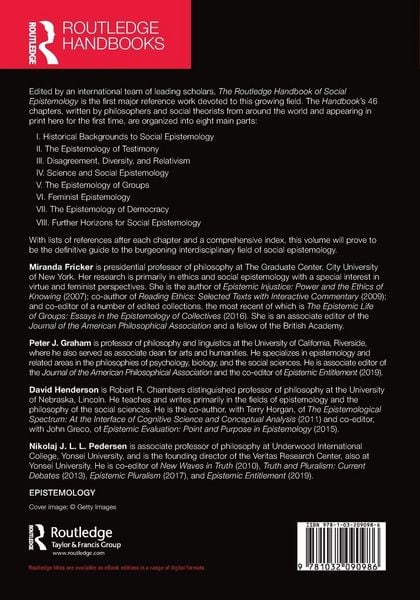
  • Introduction Part 1: Historical Backgrounds to Social Epistemology On the background of social epistemology; The What, Why, and How of Social Epistemology; The twin roots and branches of social epistemology; The Philosophical Origins of Classical Sociology of Knowledge; Kuhn and the History of Science; The Naturalized Turn in Epistemology: Engineering for Truth-Seeking; Part 2: The Epistemology of Testimony Counterexamples to Testimonial Transmission; Trust and Reputation as Filtering Mechanisms of Knowledge; Socially Distributed Cognition and the Epistemology of Testimony; Assurance views of testimony; Testimonial Knowledge: Understanding the Evidential, Uncovering the Interpersonal; The Epistemology of Expertise; Moral Testimony; Testimony and Grammatical Evidentials; Part 3: Disagreement, Diversity and Relativism Epistemic Disagreement, Diversity and Relativism; The Epistemic Significance of Diversity; Epistemic Relativism; Epistemic Peer Disagreement; Religious Diversity and Disagreement; Epistemology without Borders: Epistemological Thought Experiments and Intuitions in Cross-Cultural Contexts; Part 4: Science and Social Epistemology Overview: on Science and Social Epistemology; The Sociology of Science and Social Constructivism; The Social Epistemology of Consensus and Dissent; Modeling epistemic communities; Feminist Philosophy of Science as Social Epistemology; Part 5: The Epistemology of Groups The Epistemology of Groups; Group Belief and Knowledge; The Reflexive Social Epistemology of Human Rights; Part 6: Feminist Epistemology Feminist Epistemology; Race and Gender and Epistemologies of Ignorance; Implicit Bias and Prejudice; Epistemic Justice and Injustice; Standpoint Then and Now; Sympathetic Knowledge and the Scientific Attitude: Classic Pragmatist Resources for Feminist; Part 7: The Epistemology of Democracy The Epistemology of Democracy: An Overview; Pragmatism and Epistemic Democracy; Epistemic Proceduralism; Jury Theorems; The epistemic role of science and expertise in liberal democracy; The Epistemic Benefits of Democracy: A Critical Assessment; Part 8: Further Horizons for Social Epistemology Social Epistemology, Descriptive and Normative; Epistemic Norms as Social Norms; Educating for Good Questioning as a Democratic Skill; Intellectual Virtues, Critical Thinking, and the Aims of Education; Computational Models in Social Epistemology; Epistemology and Climate Change.