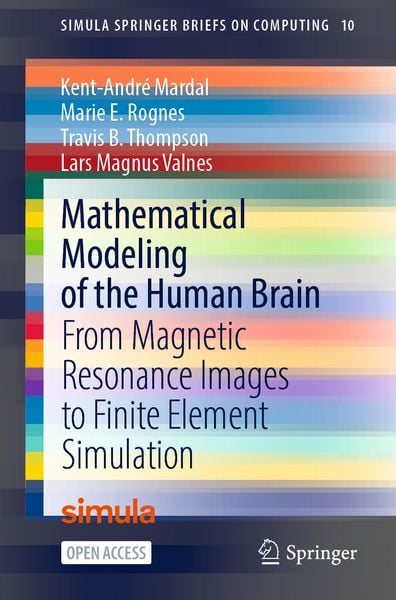

Mathematical Modeling of the Human Brain From Magnetic Resonance Images to Finite Element Simulation
-
- Englisch ausgewählt
29,99 €
inkl. gesetzl. MwSt.,
Beschreibung
Produktdetails
Einband
Taschenbuch
Erscheinungsdatum
26.02.2022
Abbildungen
XVI, 118 p. 32 illus., 25 illus. in color.
Verlag
SpringerSeitenzahl
118
Maße (L/B/H)
23,5/15,5/0,8 cm
Gewicht
219 g
Auflage
1st ed. 2022
Sprache
Englisch
ISBN
978-3-030-95135-1
This open access book bridges common tools in medical imaging and neuroscience with the numerical solution of brain modelling PDEs. The connection between these areas is established through the use of two existing tools, FreeSurfer and FEniCS, and one novel tool, the SVM-Tk, developed for this book. The reader will learn the basics of magnetic resonance imaging and quickly proceed to generating their first FEniCS brain meshes from T1-weighted images. The book's presentation concludes with the reader solving a simplified PDE model of gadobutrol diffusion in the brain that incorporates diffusion tensor images, of various resolution, and complex, multi-domain, variable-resolution FEniCS meshes with detailed markings of anatomical brain regions. After completing this book, the reader will have a solid foundation for performing patient-specific finite element simulations of biomechanical models of the human brain.
Ein neues Kapitel für Ihre Bücher
Ein neues Kapitel für Ihre Bücher
Schenken Sie Ihren alten Schätzen ein zweites Leben und erhalten Sie dafür eine Thalia Geschenkkarte.
Noch keine Bewertungen vorhanden
Verfassen Sie die erste Bewertung zu diesem Artikel
Helfen Sie anderen Kundinnen und Kunden durch Ihre Meinung.
Kurze Frage zu unserer Seite
Vielen Dank für Ihr Feedback
Wir nutzen Ihr Feedback, um unsere Produktseiten zu verbessern. Bitte haben Sie Verständnis, dass wir Ihnen keine Rückmeldung geben können. Falls Sie Kontakt mit uns aufnehmen möchten, können Sie sich aber gerne an unseren Kund*innenservice wenden.
zum Kundenservice