
Carceral Communities in Latin America Troubling Prison Worlds in the 21st Century
-
- Hardcover
- Taschenbuch ausgewählt
- eBook
-
Sprache:Englisch
131,99 €
UVP
149,79 €
inkl. gesetzl. MwSt.,
Beschreibung
Produktdetails
Einband
Taschenbuch
Erscheinungsdatum
29.03.2022
Abbildungen
XVII, 420 p. 6 illus.
Herausgeber
Sacha Darke + weitereVerlag
SpringerSeitenzahl
420
Maße (L/B/H)
21/14,8/2,4 cm
Gewicht
565 g
Auflage
22001 Auflage 1st ed. 2021
Sprache
Englisch
ISBN
978-3-030-61501-7
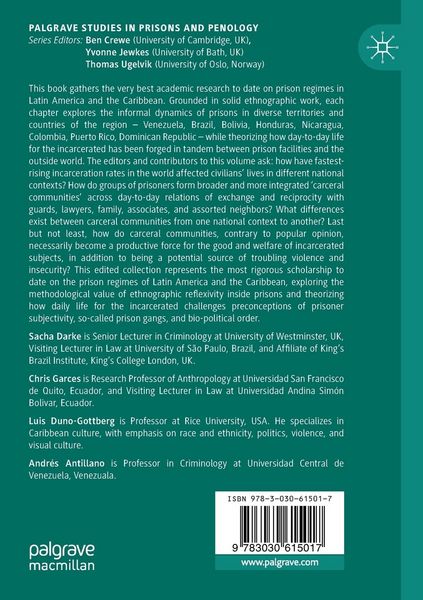
This book gathers the very best academic research to date on prison regimes in Latin America and the Caribbean. Grounded in solid ethnographic work, each chapter explores the informal dynamics of prisons in diverse territories and countries of the region - Venezuela, Brazil, Bolivia, Honduras, Nicaragua, Colombia, Puerto Rico, Dominican Republic - while theorizing how day-to-day life for the incarcerated has been forged in tandem between prison facilities and the outside world. The editors and contributors to this volume ask: how have fastest-rising incarceration rates in the world affected civilians' lives in different national contexts? How do groups of prisoners form broader and more integrated 'carceral communities' across day-to-day relations of exchange and reciprocity with guards, lawyers, family, associates, and assorted neighbors? What differences exist between carceral communities from one national context to another? Last but not least, how do carceral communities, contrary to popular opinion, necessarily become a productive force for the good and welfare of incarcerated subjects, in addition to being a potential source of troubling violence and insecurity? This edited collection represents the most rigorous scholarship to date on the prison regimes of Latin America and the Caribbean, exploring the methodological value of ethnographic reflexivity inside prisons and theorizing how daily life for the incarcerated challenges preconceptions of prisoner subjectivity, so-called prison gangs, and bio-political order.
Sacha Darke is Senior Lecturer in Criminology at University of Westminster, UK, Visiting Lecturer in Law at University of São Paulo, Brazil, and Affiliate of King's Brazil Institute, King's College London, UK.
Chris Garces is Research Professor of Anthropology at Universidad San Francisco de Quito, Ecuador, and Visiting Lecturer in Law at Universidad Andina Simón Bolivar, Ecuador.
Luis Duno-Gottberg is Professor at Rice University, USA. He specializes in Caribbean culture, with emphasis on race and ethnicity, politics, violence, and visual culture.
Andrés Antillano is Professor in Criminology at Universidad Central de Venezuela, Venezuala.
Ein neues Kapitel für Ihre Bücher
Ein neues Kapitel für Ihre Bücher
Schenken Sie Ihren alten Schätzen ein zweites Leben und erhalten Sie dafür eine Thalia Geschenkkarte.
Noch keine Bewertungen vorhanden
Verfassen Sie die erste Bewertung zu diesem Artikel
Helfen Sie anderen Kundinnen und Kunden durch Ihre Meinung.
Kurze Frage zu unserer Seite
Vielen Dank für Ihr Feedback
Wir nutzen Ihr Feedback, um unsere Produktseiten zu verbessern. Bitte haben Sie Verständnis, dass wir Ihnen keine Rückmeldung geben können. Falls Sie Kontakt mit uns aufnehmen möchten, können Sie sich aber gerne an unseren Kund*innenservice wenden.
zum Kundenservice