KI-Beratung Beta

Gutscheinbedingungen

Gültig bis 21.10.2026 | Gültig für nicht preisgebundene fremdsprachige Bücher | Einzelne Artikel können ausgeschlossen sein | Online auf thalia.de und in der Thalia App einlösbar | Click & Collect nur mit Online-Zahlung (Paypal/Kreditkarte) vorab | Nicht kombinierbar mit anderen Gutscheinen oder Preisaktionen | Nur einmal pro Einkauf einlösbar | Gutschein wird auf max. 500€ Bestellwert angerechnet | Keine Barauszahlung | Nicht gültig für Versandkosten und Services

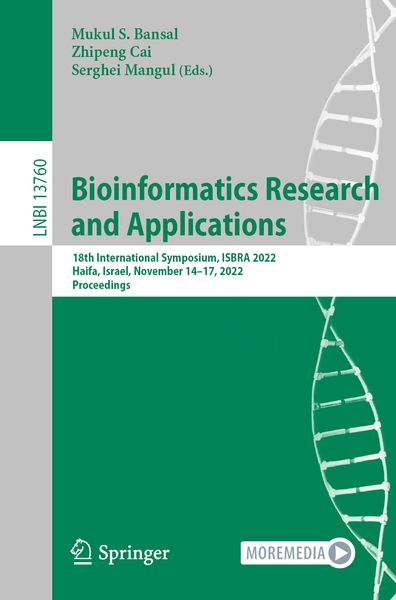
  • Produktbild: Bioinformatics Research and Applications
  • Produktbild: Bioinformatics Research and Applications
Band 13760

Bioinformatics Research and Applications 18th International Symposium, ISBRA 2022, Haifa, Israel, November 14–17, 2022, Proceedings

69,99 €

inkl. gesetzl. MwSt., Versandkostenfrei


Beschreibung

Produktdetails

Einband

Taschenbuch

Erscheinungsdatum

02.01.2023

Abbildungen

XIV, 390 p. 126 illus., 108 illus. in color.

Herausgeber

Mukul S. Bansal + weitere

Verlag

Springer

Seitenzahl

390

Maße (L/B/H)

23,5/15,5/2,3 cm

Gewicht

616 g

Auflage

1st ed. 2022

Sprache

Englisch

ISBN

978-3-031-23197-1

Beschreibung

Produktdetails

Einband

Taschenbuch

Erscheinungsdatum

02.01.2023

Abbildungen

XIV, 390 p. 126 illus., 108 illus. in color.

Herausgeber

Verlag

Springer

Seitenzahl

390

Maße (L/B/H)

23,5/15,5/2,3 cm

Gewicht

616 g

Auflage

1st ed. 2022

Sprache

Englisch

ISBN

978-3-031-23197-1

Herstelleradresse

Springer-Verlag GmbH
Tiergartenstr. 17
69121 Heidelberg
DE

Email: ProductSafety@springernature.com

Ein neues Kapitel für Ihre Bücher

Ein neues Kapitel für Ihre Bücher

Schenken Sie Ihren alten Schätzen ein zweites Leben und erhalten Sie dafür eine Thalia Geschenkkarte.

Jetzt verkaufen
Jetzt verkaufen

Noch keine Bewertungen vorhanden

Verfassen Sie die erste Bewertung zu diesem Artikel

Helfen Sie anderen Kundinnen und Kunden durch Ihre Meinung.

Kundinnen und Kunden meinen

Bewertungen (0)

  • Produktbild: Bioinformatics Research and Applications
  • Produktbild: Bioinformatics Research and Applications
  • MLMVFE: A Machine Learning Approach Based on Muli-View Features Extraction for Drug-Disease Associations Prediction.- STgcor: A Distribution-based Correlation MeasurementMethod for Spatial Transcriptome Data.- Automatic ICD Coding based on Multi-granularity Feature Fusion.- Effectively Training MRI Reconstruction Network via Sequentially Using  Undersampled k-Space Data with Very Low Frequency Gaps.- Fusing Label Relations for Chinese EMR Named Entity Recognition with Machine Reading Comprehension.- Private Epigenetic PaceMaker Detector using Homomorphic Encryption - Extended Abstract.- NIDN: Medical Code Assignment via Note-Code Interaction Denoising Network.- Research on the prediction method of disease classification based on imaging features.- M-US-EMRs: A Multi-Modal Data Fusion Method of Ultrasonic Images and Electronic Medical Records Used for Screening of Coronary Heart Disease.- Transposition Distance Considering Intergenic Regions for Unbalanced Genomes.- An SMT-based Framework for Reasoning about Discrete Biological Models.- ARGLRR: An Adjusted Random Walk Graph Regularization Sparse Low-rank Representation Method for Single-cell RNA-sequencing Data Clustering.- An Efficient and User-friendly Software for PCR Primer Design for Detection of Highly Variable Bacteria.- A Network-Based Voting Method for Identification and Prioritization of Personalized Cancer Driver Genes.- TDCOSR: A multimodality fusion framework for association analysis between genes and ROIs of Alzheimer’s disease.- Policy-based Hypertension Monitoring using Formal Runtime Verification Monitors.- Deep learning-enhanced MHC-II presentation prediction and peptidome deconvolution.- MMLN: Leveraging Domain Knowledge for Multimodal Diagnosis.- Optimal sequence alignment to ED-strings.- Heterogeneous PPInetwork representation learning for protein complex identification.- A Clonal Evolution Simulator for Planning Somatic Evolution Studies.- Prediction of Drug-disease Relationship on Heterogeneous Networks Based on Graph  Convolution.- t-SNE Highlights Phylogenetic and Temporal Patterns of SARS-CoV-2 Spike and Nucleocapsid Protein Evolution.- MPCDDI: A Secure Multiparty Computation-based Deep Learning Framework for Drug-drug Interaction Predictions.- A Multimodal Data Fusion-based Deep Learning Approach for Drug-Drug Interaction Prediction.- GNN-Dom: an unsupervised method for protein domain partition via protein contact map.- A Locality-Constrained Linear Coding-Based Ensemble Learning Framework for Predicting Potentially Disease-Associated MiRNAs.- Gaussian-enhanced Representation Model for Extracting Protein-Protein Interactions Affected by Mutations.- Distance Profiles of Optimal RNA Foldings.- 2D Photogrammetry Image of Adolescent Idiopathic Scoliosis Screening Using Deep Learning.- EMRShareChain: A Privacy-Preserving EMR Sharing System Model Based on the Consortium Blockchain.- Simulating Spiking Neural Networks based on SW26010pro.- Entropy Based Clustering of Viral Sequences.- A Tensor Robust Model Based on Enhanced Tensor Nuclear Norm and Low-Rank Constraint for Multi-view Cancer Genomics Data.