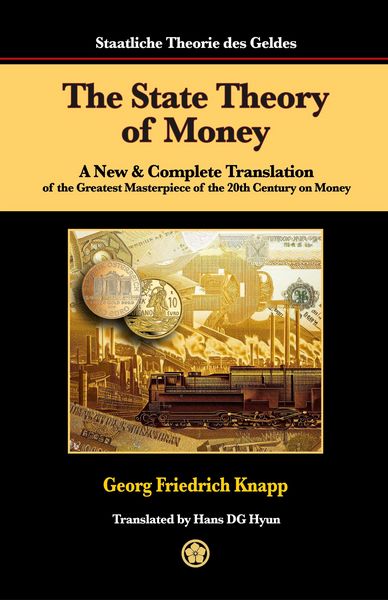
The State Theory of Money A New & Complete Translation of the Greatest Masterpiece of the 20th Century on Money
-
- Englisch ausgewählt
55,99 €
inkl. gesetzl. MwSt.,
Beschreibung
Produktdetails
Einband
Gebundene Ausgabe
Erscheinungsdatum
19.07.2023
Verlag
Shoin HouseSeitenzahl
504
Maße (L/B/H)
23,5/15,7/3,4 cm
Gewicht
978 g
Übersetzt von
Hans Dg Hyun
Sprache
Englisch
ISBN
978-1-08-820310-1
An Iconic Money Masterpiece from the 20th Century: Influencing Keynes, Max Weber and Modern Monetary Theory (MMT). Knapp's State Theory of Money has had a profound impact on shaping modern perspectives on money and banking, notably influencing prominent figures such as John Maynard Keynes, Max Weber, neo-chartalism, Post Keynesian monetary theory, and Modern Monetary Theory (MMT). It marks the foundation of various contemporary nominalist theories of money and is essential reading for economists and intellectually curious readers seeking to grasp the complexities of money and monetary phenomena. Knapp's ideas have gained significant attention as alternatives to neoclassical economic doctrines that propose the emergence of money from a barter economy (catallactic theory of money). Shortcomings of the 1924 English Translation: Incompleteness and Bias However, the English translation published in 1924 is incomplete, omitting the final chapter and presenting only abridged versions of the surviving chapters. Moreover, the translation fails to accurately convey the original meaning, resulting in the near absence of some essential concepts. German-speaking readers face the challenge of deciphering Fraktur, an old-style Gothic typeface, which renders the German edition illegible for modern readers. Consequently, there is an urgent need for a complete and precise translation that includes a detailed index and extensive glossaries of Knapp's neologisms. Without these resources, readers may struggle to navigate the abundance of neologisms and hinder their understanding. Salient Features of this New Translation This new edition offers several advantages over the 1924 translation 1. Complete and unabridged translation. 2. Faithfulness to the original text, preserving its essence and nuances. 3. Greater consistency in translated terms. 4. Inclusion of an extensive Glossary of Knapp's neologisms and fundamental concepts. 5. Complete bibliography. 6. Comprehensive index, including original German terms. 7. Inclusion of page numbers from the 1924 English edition for cross-referencing. Author: Georg Friedrich Knapp (1842-1926) Knapp, a prominent figure in the German Historical School, held a significant position as a professor at the University of Straßburg. His expertise in German agricultural history transitioned into the writing of this book in 1905. Knapp founded the chartalist school of monetary theory, leaving a profound impact on John Maynard Keynes and post-Keynesian economics, including Modern Monetary Theory (MMT). Translator: Hans DG Hyun With over 30 years of extensive banking industry experience, including regional leadership positions in renowned global banks, the translator also excels as a researcher in Post Keynesian economics. He has authored numerous articles in economics journals and published Abenomics and Enemies from Alice's Wonderland (2023), a book delving into the foundations of Abenomics. Additionally, he has translated various books on economic theories and economic sociology, including Bernhard Laum's Heliges Geld (1924) under the English title Sacred Money. He holds postgraduate degrees in economics from the London School of Economics and the University of Cambridge.
Ein neues Kapitel für Ihre Bücher
Ein neues Kapitel für Ihre Bücher
Schenken Sie Ihren alten Schätzen ein zweites Leben und erhalten Sie dafür eine Thalia Geschenkkarte.
Noch keine Bewertungen vorhanden
Verfassen Sie die erste Bewertung zu diesem Artikel
Helfen Sie anderen Kundinnen und Kunden durch Ihre Meinung.
Kurze Frage zu unserer Seite
Vielen Dank für Ihr Feedback
Wir nutzen Ihr Feedback, um unsere Produktseiten zu verbessern. Bitte haben Sie Verständnis, dass wir Ihnen keine Rückmeldung geben können. Falls Sie Kontakt mit uns aufnehmen möchten, können Sie sich aber gerne an unseren Kund*innenservice wenden.
zum Kundenservice