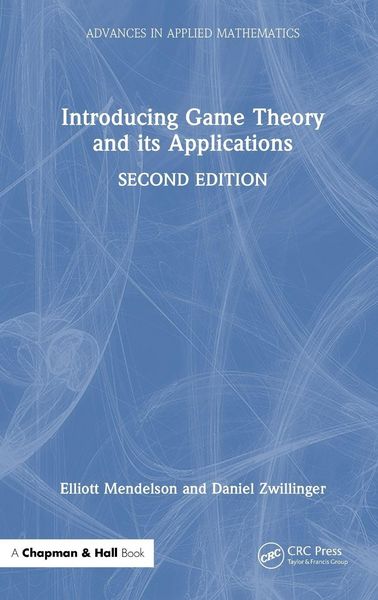

Introducing Game Theory and its Applications
-
- Hardcover ausgewählt
- Taschenbuch
- eBook
-
Sprache:Englisch
266,99 €
inkl. gesetzl. MwSt.,
Beschreibung
Produktdetails
Einband
Gebundene Ausgabe
Erscheinungsdatum
02.08.2024
Abbildungen
73 SW-Abb., 73 SW-Fotos
Verlag
Taylor & FrancisSeitenzahl
288
Maße (L/B/H)
24/16,1/2 cm
Gewicht
599 g
Auflage
2. Auflage
Sprache
Englisch
ISBN
978-0-367-50791-6
This classic text, originally from the noted logician Elliot Mendelson, is intended to be an easy-to-read introduction to the basic ideas and techniques of game theory. It can be used as a class textbook or for self-study.
Introducing Game Theory and its Applications, Second Edition presents an easy-to-read introduction to the basic ideas and techniques of game theory. After a brief introduction, the authors begin with a chapter devoted to combinatorial games--a topic neglected or treated minimally in most other texts. The focus then shifts to two-person zero-sum games and their solutions.
Here the authors present the simplex method based on linear programming for solving these games and develop within this presentation the required background. The final chapter presents some of the fundamental ideas and tools of non-zero-sum games and games with more than two players, including an introduction to cooperative game theory.
The book is suitable for a first undergraduate course in game theory, or a graduate course for students with limited previous exposure. It is useful for students who need to learn some game theory for a related subject (e.g., microeconomics) and have a limited mathematical background. It also prepares its readers for more advanced study of game theory's applications in economics, business, and the physical, biological, and social sciences.
The authors hope this book breeds curiosity about the subject as its design is meant to to satisfy the readers. The book will prepare readers for deeper study of game theory applications in many fields of study.
Ein neues Kapitel für Ihre Bücher
Ein neues Kapitel für Ihre Bücher
Schenken Sie Ihren alten Schätzen ein zweites Leben und erhalten Sie dafür eine Thalia Geschenkkarte.
Noch keine Bewertungen vorhanden
Verfassen Sie die erste Bewertung zu diesem Artikel
Helfen Sie anderen Kundinnen und Kunden durch Ihre Meinung.
Kurze Frage zu unserer Seite
Vielen Dank für Ihr Feedback
Wir nutzen Ihr Feedback, um unsere Produktseiten zu verbessern. Bitte haben Sie Verständnis, dass wir Ihnen keine Rückmeldung geben können. Falls Sie Kontakt mit uns aufnehmen möchten, können Sie sich aber gerne an unseren Kund*innenservice wenden.
zum Kundenservice