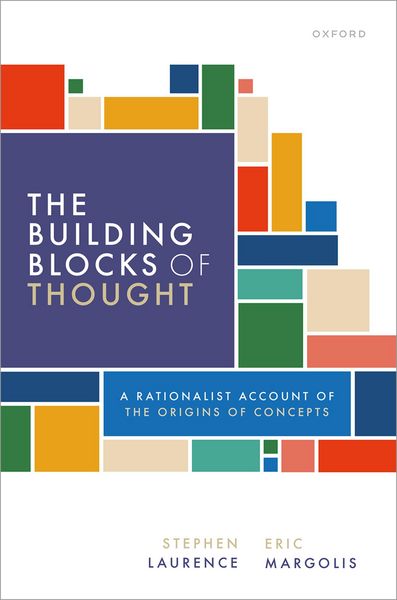
Laurence, S: Building Blocks of Thought A Rationalist Account of the Origins of Concepts
-
- Hardcover
- Taschenbuch ausgewählt
- eBook
-
Sprache:Englisch
34,99 €
UVP
41,00 €
inkl. gesetzl. MwSt.,
Beschreibung
Produktdetails
Einband
Taschenbuch
Erscheinungsdatum
22.11.2024
Abbildungen
5 colour and 16 black-and-white illustrations
Verlag
Oxford University PressSeitenzahl
704
Maße (L/B/H)
23,1/15,4/3,7 cm
Gewicht
1174 g
Sprache
Englisch
ISBN
978-0-19-289892-0
This is a broad and authoritative study of one of the central topics in the study of the mind: the origins of concepts. The authors survey the debate between rationalists and empiricists which stretches back to the very beginnings of philosophy, and has been at the centre of some of the most exciting research in cognitive science. Many have charged that the debate is riddled with confusion or that rationalist approaches, in particular, are deeply problematic. The Building Blocks of Thought offers a comprehensive rethinking of the foundations of this debate, showing that these negative appraisals are based on misunderstandings. Stephen Laurence and Eric Margolis argue that the debate should be understood to concern the nature of the unlearned psychological traits that provide the foundation for learning all concepts. They go on to argue for a version of concept nativism according to which there is a rationalist account of the origins of many concepts across many different conceptual domains. This rationalist view is developed around seven distinct arguments, drawing on a wealth of data across the cognitive sciences, which are shown to come together to form a unified large-scale argument to the best explanation for a rationalist account of the origins of concepts. Rounding out the case for concept nativism, the book contrasts this view with the most important and influential empiricist views, as well as alternative rationalist views, including Fodor's infamous radical concept nativism and his claim that concept learning is impossible. The Building Blocks of Thought argues for the enormous importance of learning and culture, showing how a thoroughly rationalist approach facilitates and enhances cultural learning and provides the foundations for the best overall account of the origins of concepts.
Ein neues Kapitel für Ihre Bücher
Ein neues Kapitel für Ihre Bücher
Schenken Sie Ihren alten Schätzen ein zweites Leben und erhalten Sie dafür eine Thalia Geschenkkarte.
Noch keine Bewertungen vorhanden
Verfassen Sie die erste Bewertung zu diesem Artikel
Helfen Sie anderen Kundinnen und Kunden durch Ihre Meinung.
Kurze Frage zu unserer Seite
Vielen Dank für Ihr Feedback
Wir nutzen Ihr Feedback, um unsere Produktseiten zu verbessern. Bitte haben Sie Verständnis, dass wir Ihnen keine Rückmeldung geben können. Falls Sie Kontakt mit uns aufnehmen möchten, können Sie sich aber gerne an unseren Kund*innenservice wenden.
zum Kundenservice