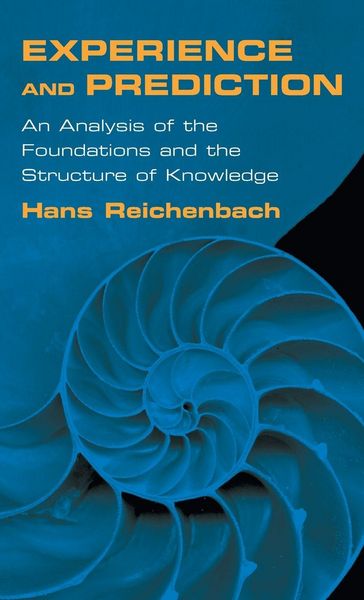
Experience and Prediction An Analysis of the Foundations and the Structure of Knowledge
-
- Englisch ausgewählt
178,99 €
inkl. gesetzl. MwSt.,
Beschreibung
Produktdetails
Einband
Gebundene Ausgabe
Erscheinungsdatum
15.08.2022
Verlag
University Of Notre Dame PressSeitenzahl
456
Maße (L/B/H)
22,2/14,5/3 cm
Gewicht
770 g
Sprache
Englisch
ISBN
978-0-268-20614-7
Hans Reichenbach (1891-1953) was a formidable figure in early-twentieth-century philosophy of science. Educated in Germany, he was influential in establishing the so-called Berlin Circle, a companion group to the Vienna Circle founded by his colleague Rudolph Carnap. The movement they founded-usually known as "logical positivism," although it is more precisely known as "scientific philosophy" or "logical empiricism"-was a form of epistemology that privileged scientific over metaphysical truths. Reichenbach, like other young philosophers of the exact sciences of his generation, was deeply impressed by the far-reaching changes in physics brought about by Einstein's special and general theories of relativity. Reichenbach responded to scientific advances by doing fundamental work in space-time theories, in quantum mechanics, in statistical mechanics, and in the development of probability theory-making him the most important philosopher of physics in the first generation of logical empiricism. Forced from his academic position by the Nazi race laws in 1933, Reichenbach wrote Experience and Prediction at the University of Istanbul, where had had fled, expressly to introduce logical positivism to English speakers. In the two decades following World War II, during the explosion of scientific advances in North America, logical positivism was the reigning theory of the philosophy of science and Reichenbach was at the peak of his career. But, inevitably, support for logical positivism began to wane as it became obvious that the justification of scientific theories could not be entirely resolved by relying on strictly formal, technical processes. The growth of the discipline of the history of philosophy of science, which has created an audience of scholars eager for seminal classics in scientific philosophy, and the evidence supporting a historicist paradigm within logical positivism are two important reasons to make Experience and Prediction available once again.
Ein neues Kapitel für Ihre Bücher
Ein neues Kapitel für Ihre Bücher
Schenken Sie Ihren alten Schätzen ein zweites Leben und erhalten Sie dafür eine Thalia Geschenkkarte.
Noch keine Bewertungen vorhanden
Verfassen Sie die erste Bewertung zu diesem Artikel
Helfen Sie anderen Kundinnen und Kunden durch Ihre Meinung.
Kurze Frage zu unserer Seite
Vielen Dank für Ihr Feedback
Wir nutzen Ihr Feedback, um unsere Produktseiten zu verbessern. Bitte haben Sie Verständnis, dass wir Ihnen keine Rückmeldung geben können. Falls Sie Kontakt mit uns aufnehmen möchten, können Sie sich aber gerne an unseren Kund*innenservice wenden.
zum Kundenservice