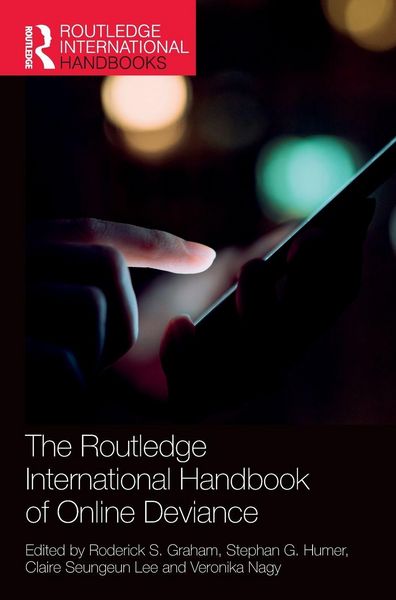
The Routledge International Handbook of Online Deviance
-
- Hardcover ausgewählt
- Taschenbuch
- eBook
-
Sprache:Englisch
309,99 €
UVP
372,80 €
inkl. gesetzl. MwSt.,
Beschreibung
Produktdetails
Einband
Gebundene Ausgabe
Erscheinungsdatum
16.09.2024
Abbildungen
30 SW-Abb., 12 SW-Fotos, 18 SW-Zeichn., 33 Tabellen
Herausgeber
Roderick S. Graham + weitereVerlag
Taylor & FrancisSeitenzahl
794
Maße (L/B/H)
25/17,5/4,7 cm
Gewicht
1523 g
Sprache
Englisch
ISBN
978-1-03-223447-2
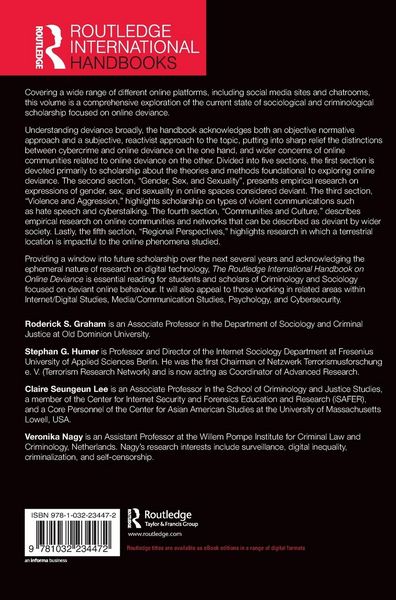
Covering a wide range of different online platforms, including social media sites and chatrooms, this volume is a comprehensive exploration of the current state of sociological and criminological scholarship focused on online deviance.
Understanding deviance broadly, the handbook acknowledges both an objective normative approach and a subjective, reactivist approach to the topic, putting into sharp relief the distinctions between cybercrime and online deviance on the one hand, and wider concerns of online communities related to online deviance on the other. Divided into five sections, the first section is devoted primarily to scholarship about the theories and methods foundational to exploring online deviance. The second section, "Gender, Sex, and Sexuality", presents empirical research on expressions of gender, sex, and sexuality in online spaces considered deviant. The third section, "Violence and Aggression," highlights scholarship on types of violent communications such as hate speech and cyberstalking. The fourth section, "Communities and Culture," describes empirical research on online communities and networks that can be described as deviant by wider society. Lastly, the fifth section, "Regional Perspectives," highlights research in which a terrestrial location is impactful to the online phenomena studied.
Providing a window into future scholarship over the next several years and acknowledging the ephemeral nature of research on digital technology, The Routledge International Handbook on Online Deviance is essential reading for students and scholars of Criminology and Sociology focused on deviant online behaviour. It will also appeal to those working in related areas within Internet/Digital Studies, Media/Communication Studies, Psychology, and Cybersecurity.
Ein neues Kapitel für Ihre Bücher
Ein neues Kapitel für Ihre Bücher
Schenken Sie Ihren alten Schätzen ein zweites Leben und erhalten Sie dafür eine Thalia Geschenkkarte.
Noch keine Bewertungen vorhanden
Verfassen Sie die erste Bewertung zu diesem Artikel
Helfen Sie anderen Kundinnen und Kunden durch Ihre Meinung.
Kurze Frage zu unserer Seite
Vielen Dank für Ihr Feedback
Wir nutzen Ihr Feedback, um unsere Produktseiten zu verbessern. Bitte haben Sie Verständnis, dass wir Ihnen keine Rückmeldung geben können. Falls Sie Kontakt mit uns aufnehmen möchten, können Sie sich aber gerne an unseren Kund*innenservice wenden.
zum Kundenservice