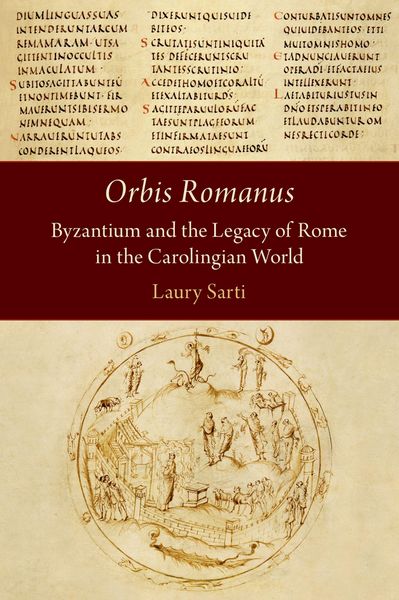
Orbis Romanus Byzantium and the Legacy of Rome in the Carolingian World
-
- Englisch ausgewählt
131,99 €
inkl. gesetzl. MwSt.,
Beschreibung
Produktdetails
Einband
Gebundene Ausgabe
Erscheinungsdatum
07.06.2024
Abbildungen
38 b/w illustrations, 2 maps
Verlag
Oxford AcademicSeitenzahl
412
Maße (L/B/H)
23,8/16/3,1 cm
Gewicht
740 g
Sprache
Englisch
ISBN
978-0-19-774652-3
How did the medieval Frankish world relate to the orbis Romanus? Although this term is only sporadically attested in the early medieval evidence, Laury Sarti makes use of it to designate the sum of what may have been understood, from a western medieval perspective, as characteristic of or belonging to the Roman world. She argues that, although the Roman empire mainly persisted in the east beyond the fifth century, the orbis Romanus was not limited to Byzantium. The medieval west had emerged from that same Roman imperial tradition, and it retained some notable Roman characteristics and features even after it ceased to belong to the empire."The Byzantines acknowledged that the Franks had their share in the Roman world, which they conceived as a connatural people." In this book, Sarti challenges the caesura between a Roman and a post-Roman west by arguing that the Carolingian world, ruled by the Franks, still belonged to the multi-ethnic orbis Romanus.Instead of relying upon intense connectivity to the Byzantine east, which had ceased by the sixth century, ongoing Frankish participation in Roman identity emanated from the significance attributed to the Roman heritage. The Frankish kingdoms had emerged from the Roman world with a large Roman population and continuity on virtually every level of society, including governance, law, the Church and Christian belief, language, and culture. Although the Franks never designated themselves as Romans, Sarti demonstrates how Frankish Romanness--defined by the imperial past, the Byzantine present, and markedly western Roman characteristics--remained a constitutive feature of Frankish identity. While the Frankish relation to the Byzantine empire is more difficult to grasp, western and eastern notions of Romanness had common origins, and both implied a genuinely Christian understanding of Roman identity. When the Franks revived western emperorship through Charlemagne, the Roman and Christian elements were implemented as essential features of its conception. The book touches on a wide range of topics, including notions of empire, the connectivity between the Frankish kingdoms and Byzantium, mutual perceptions of Roman identities, the role of the Church and religious controversies, the reception of Antiquity, the use of and significance attributed to Greek and Latin, and Roman culture in the west. Its conclusions--which challenge basic assumptions about the Carolingian period--and its up-to-date discussion of the evidence and research will be of interest to students and scholars alike.
Ein neues Kapitel für Ihre Bücher
Ein neues Kapitel für Ihre Bücher
Schenken Sie Ihren alten Schätzen ein zweites Leben und erhalten Sie dafür eine Thalia Geschenkkarte.
Noch keine Bewertungen vorhanden
Verfassen Sie die erste Bewertung zu diesem Artikel
Helfen Sie anderen Kundinnen und Kunden durch Ihre Meinung.
Kurze Frage zu unserer Seite
Vielen Dank für Ihr Feedback
Wir nutzen Ihr Feedback, um unsere Produktseiten zu verbessern. Bitte haben Sie Verständnis, dass wir Ihnen keine Rückmeldung geben können. Falls Sie Kontakt mit uns aufnehmen möchten, können Sie sich aber gerne an unseren Kund*innenservice wenden.
zum Kundenservice