KI-Beratung Beta

Gutscheinbedingungen

Gültig bis 21.10.2026 | Gültig für nicht preisgebundene fremdsprachige Bücher | Einzelne Artikel können ausgeschlossen sein | Online auf thalia.de und in der Thalia App einlösbar | Click & Collect nur mit Online-Zahlung (Paypal/Kreditkarte) vorab | Nicht kombinierbar mit anderen Gutscheinen oder Preisaktionen | Nur einmal pro Einkauf einlösbar | Gutschein wird auf max. 500€ Bestellwert angerechnet | Keine Barauszahlung | Nicht gültig für Versandkosten und Services

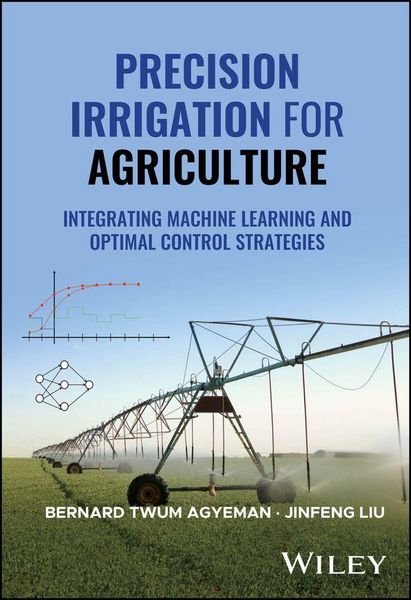
Produktbild: Precision Irrigation for Agriculture

Precision Irrigation for Agriculture Integrating Machine Learning and Optimal Control Strategies

169,99 €

inkl. gesetzl. MwSt., Versandkostenfrei


Beschreibung

Produktdetails

Einband

Gebundene Ausgabe

Erscheinungsdatum

13.04.2026

Verlag

John Wiley & Sons

Seitenzahl

208

Maße (H)

1,3 cm

Gewicht

510 g

Sprache

Englisch

ISBN

978-1-394-28852-6

Beschreibung

Produktdetails

Einband

Gebundene Ausgabe

Erscheinungsdatum

13.04.2026

Verlag

John Wiley & Sons

Seitenzahl

208

Maße (H)

1,3 cm

Gewicht

510 g

Sprache

Englisch

ISBN

978-1-394-28852-6

Herstelleradresse

Libri GmbH
Europaallee 1
36244 Bad Hersfeld
DE

Email: gpsr@libri.de

Ein neues Kapitel für Ihre Bücher

Ein neues Kapitel für Ihre Bücher

Schenken Sie Ihren alten Schätzen ein zweites Leben und erhalten Sie dafür eine Thalia Geschenkkarte.

Jetzt verkaufen
Jetzt verkaufen

Noch keine Bewertungen vorhanden

Verfassen Sie die erste Bewertung zu diesem Artikel

Helfen Sie anderen Kundinnen und Kunden durch Ihre Meinung.

Kundinnen und Kunden meinen

Bewertungen (0)

Die Leseprobe wird geladen.
  • Produktbild: Precision Irrigation for Agriculture
  • List of Figures ix

    List of Tables xiii

    Preface xv

    1 Introduction 1

    1.1 Challenges in Irrigation and a Need for Innovation 1

    1.2 Current Advances and Unresolved Challenges 2

    1.3 Objectives and Organization of the Book 7

    2 Background on Soil Moisture Modeling 11

    2.1 Introduction 11

    2.2 Water Content 12

    2.3 Energy Status of Soil Water 13

    2.4 Soil-Water Retention Curve 14

    2.5 Darcy's Law 14

    2.6 Richards' Equation 15

    2.6.1 Solution of the Richards' Equation 17

    2.6.2 Sink Term 19

    2.7 The General Form of the Richards' Equation 20

    2.8 Conclusion 21

    3 Background on Machine Learning and Model Predictive Control 23

    3.1 Machine Learning 23

    3.1.1 Supervised Machine Learning 23

    3.1.2 Unsupervised Machine Learning 27

    3.1.3 Reinforcement Learning 29

    3.1.4 Multi-agent Reinforcement Learning 33

    3.2 Model Predictive Control 34

    3.2.1 Formulation of MPC 35

    3.2.2 Solving MPC 36

    3.2.3 Feasibility of MPC 36

    3.2.4 Tuning of MPC 37

    3.3 Conclusion 37

    4 Soil Moisture and Hydraulic Parameter Estimation in Agro-hydrological Systems 39

    4.1 Introduction 39

    4.2 Model Development 40

    4.3 Sensitivity Analysis for Parameter Estimability 43

    4.3.1 Output Sensitivity Matrix for Spatially Varying Measurements 45

    4.4 Parameter Selection Through Orthogonal Projection 47

    4.5 EKF Design 48

    4.6 Simulated Case Study 49

    4.6.1 Simulation Results 50

    4.7 Real Case Study 52

    4.7.1 Study Site and Microwave Sensor Configuration 52

    4.7.2 Numerical Representation of the Study Site 54

    4.7.3 Sensor Data Preprocessing 54

    4.7.4 Analysis of Parameter Estimability and Selection Studies 55

    4.7.5 Estimator Design 55

    4.7.6 Evaluation Criteria 55

    4.7.7 Experimental Results and Discussion 56

    4.8 Conclusion 60

    5 Adaptive Soil Moisture Estimation Using Performance-triggered Model Reduction 63

    5.1 Introduction 63

    5.2 Model Development and Problem Statement 64

    5.3 Model Reduction and Estimation Scheme 66

    5.3.1 Adaptive Structure-preserving Model Reduction 67

    5.3.2 Reduced-order Adaptive EKF 68

    5.3.3 Error Metric and Implementation Algorithm 70

    5.4 Field Implementation of the Proposed Framework 71

    5.4.1 Results and Discussion 72

    5.4.2 Simulation Time Comparison Across Estimation Schemes 74

    5.5 Conclusion 75

    6 Mixed-integer Model Predictive Control for Irrigation Scheduling 77

    6.1 Introduction 77

    6.2 Daily Irrigation Scheduling Under Uniform Field Conditions 78

    6.2.1 Soil Moisture Model Development 79

    6.2.2 Surrogate Model Development 80

    6.2.3 Scheduler Formulation 81

    6.2.4 Case Study 82

    6.3 Irrigation Scheduling in Spatially Heterogeneous Fields 85

    6.3.1 Soil Moisture Modeling 87

    6.3.2 Scheduler Formulation 88

    6.3.3 Case Study 90

    6.4 Conclusion 91

    7 Multi-agent MPC for Irrigation Scheduling: A Learning-based Approach 93

    7.1 Introduction 93

    7.2 Three-stage Process for Management Zone (MZ) Delineation 95

    7.3 LSTM-based Modeling of Soil Moisture 95

    7.3.1 Richards' Equation 96

    7.3.2 Training Data Generation 97

    7.3.3 Model Design 97

    7.4 Mixed-integer MPC with Zone Control for Irrigation Scheduling 98

    7.5 Decentralized Hybrid Actor-critic Agents and the Role of a Limiting MZ 99

    7.5.1 Agent Design and Training 100

    7.5.2 Multi-agent MPC Paradigm 102

    7.5.3 Triggered Irrigation Scheduling 105

    7.6 Application to a Large-scale Field 105

    7.6.1 Delineation of MZs in the Study Area 105

    7.6.2 LSTM Network Training for Quadrant 3 107

    7.6.3 Implementation of Hybrid PPO Agents in Quadrant 3 107

    7.6.4 Implementation of Proposed and Triggered Schedulers in Quadrant 3 107

    7.6.5 Results and Discussion 108

    7.6.6 Evaluation of the Proposed Scheduler's Effectiveness 111

    7.7 Conclusion 114

    8 Optimizing Irrigation with Semi-centralized Multi-agent RL 117

    8.1 Introduction 117

    8.2 Semi-centralized MARL (SCMARL) Framework 118

    8.2.1 Addressing Non-stationarity in SCMARL Frameworks 119

    8.2.2 Design of Local Agents 121

    8.2.3 Design of the Coordinator Agent 123

    8.3 Field-scale Implementation of the SCMARL Framework 124

    8.3.1 Simulation Environment Configuration 124

    8.3.2 Agent Setup and Training Process 125

    8.3.3 Learning Outcomes of Agents 125

    8.4 Evaluation of SCMARL 126

    8.4.1 Evaluation of the State Augmentation Strategy 127

    8.4.2 Local Agent Policy Alignment with Coordinator 128

    8.4.3 SCMARL Versus DMARL: A Comparative Study 128

    8.4.4 Results and Discussion 130

    8.4.5 Impact of State Augmentation on Agent Performance 130

    8.4.6 Local Agents' Policy Agreement with Coordinator's Action 133

    8.4.7 Assessment of SCMARL Performance and Utility 134

    8.5 Conclusion 137

    9 Integrating Daily Scheduling and Hourly Control for Precision Irrigation 139

    9.1 Introduction 139

    9.2 Observer-based SCMARL Scheduler 141

    9.2.1 POMDP Setting 141

    9.2.2 EKF for Belief-state Estimation 142

    9.2.3 Belief State-based Reward Functions 144

    9.3 Advanced Controller Design 145

    9.4 Observer-based SCMARL Implementation 148

    9.4.1 Environment Configuration and Training 149

    9.4.2 Learning Outcomes of Observer-based SCMARL Agents 150

    9.5 Field Implementation of the Integrated Scheduling and Control Layers 151

    9.5.1 Results and Discussion 152

    9.6 Conclusion 154

    10 Future Directions 157

    10.1 Advancing Soil Moisture and Hydraulic Parameter Estimation 157

    10.2 Advancing the Design of Multi-agent MPC-based Schedulers 158

    10.3 Advancing Semi-centralized Multi-agent RL Applications 158

    10.4 Advancing the Integration of Scheduling and Control 159

    Appendix-A: Relevant Crop and Weather Data 161

    Appendix-B: Relevant Soil Hydraulic Parameters 165

    Appendix-C: Crop Yield Calculations 167

    Appendix-D: Extended Kalman Filter Design 169

    Appendix-E: Relevant Parameters and Simulation Setup 171

    References 175

    Index 183