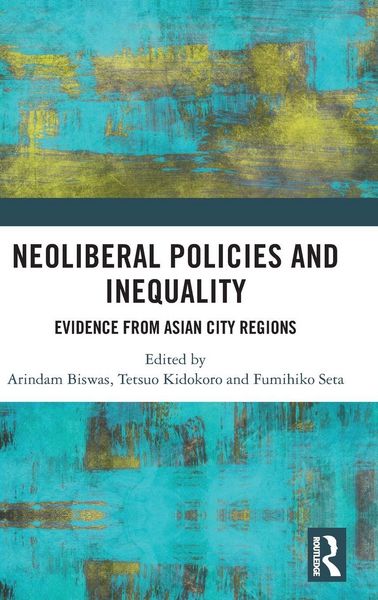

Neoliberal Policies and Inequality Evidence from Asian City Regions
-
- Hardcover ausgewählt
- Taschenbuch
- eBook
-
Sprache:Englisch
205,99 €
UVP
247,70 €
inkl. gesetzl. MwSt.,
Beschreibung
Produktdetails
Einband
Gebundene Ausgabe
Erscheinungsdatum
21.08.2024
Abbildungen
63 SW-Abb., 47 SW-Fotos, 16 SW-Zeichn., 19 Tabellen
Herausgeber
Biswas Arindam + weitereVerlag
Taylor & FrancisSeitenzahl
202
Maße (L/B/H)
24/16,1/1,6 cm
Gewicht
473 g
Sprache
Englisch
ISBN
978-1-03-211329-6
This book explores the discourse on urban and regional inequality within the framework of neoliberalism. It analyzes the widespread application of neoliberal policies in Asian city regions and identifies their influence on rising inequality. The book captures inequality through spatial and non-spatial policy narratives with empirical evidence from India, Japan, South Korea, Taiwan, and Thailand. The book uses analytics, narratives and simulation to unfold the opportunities and threats to urban regions that bear the impacts of globalization and neoliberal policies.
Lucid and topical, this book will be an essential read for scholars and researchers of urban economics, urban and regional planning, urban studies, urban sociology, political economy, public policy, governance, development studies and Asian economy.
Ein neues Kapitel für Ihre Bücher
Ein neues Kapitel für Ihre Bücher
Schenken Sie Ihren alten Schätzen ein zweites Leben und erhalten dafür eine Thalia Geschenkkarte.
Noch keine Bewertungen vorhanden
Verfassen Sie die erste Bewertung zu diesem Artikel
Helfen Sie anderen Kundinnen und Kunden durch Ihre Meinung.
Kurze Frage zu unserer Seite
Vielen Dank für Ihr Feedback
Wir nutzen Ihr Feedback, um unsere Produktseiten zu verbessern. Bitte haben Sie Verständnis, dass wir Ihnen keine Rückmeldung geben können. Falls Sie Kontakt mit uns aufnehmen möchten, können Sie sich aber gerne an unseren Kund*innenservice wenden.
zum Kundenservice