KI-Beratung Beta

Gutscheinbedingungen

Gültig bis 21.10.2026 | Gültig für nicht preisgebundene fremdsprachige Bücher | Einzelne Artikel können ausgeschlossen sein | Online auf thalia.de und in der Thalia App einlösbar | Click & Collect nur mit Online-Zahlung (Paypal/Kreditkarte) vorab | Nicht kombinierbar mit anderen Gutscheinen oder Preisaktionen | Nur einmal pro Einkauf einlösbar | Gutschein wird auf max. 500€ Bestellwert angerechnet | Keine Barauszahlung | Nicht gültig für Versandkosten und Services

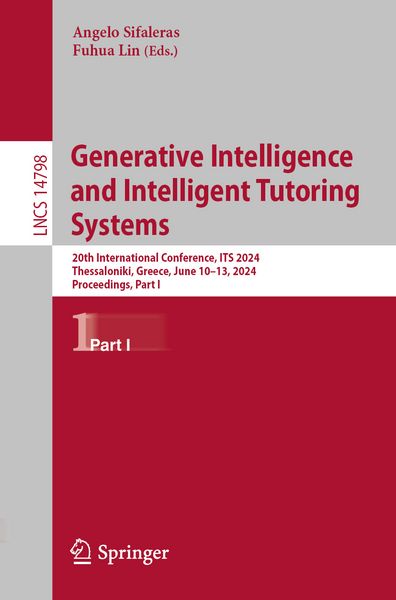
Produktbild: Generative Intelligence and Intelligent Tutoring Systems
Band 14798 - 57%

Generative Intelligence and Intelligent Tutoring Systems 20th International Conference, ITS 2024, Thessaloniki, Greece, June 10–13, 2024, Proceedings, Part I

57% sparen

68,99 € UVP 160,49 €

inkl. gesetzl. MwSt., Versandkostenfrei


Beschreibung

Produktdetails

Einband

Taschenbuch

Erscheinungsdatum

06.06.2024

Abbildungen

XXVII, 427 p. 123 illus., 80 illus. in color.

Herausgeber

Angelo Sifaleras + weitere

Verlag

Springer

Seitenzahl

427

Maße (L/B/H)

23,5/15,5/2,5 cm

Gewicht

686 g

Auflage

2024

Sprache

Englisch

ISBN

978-3-031-63027-9

Beschreibung

Produktdetails

Einband

Taschenbuch

Erscheinungsdatum

06.06.2024

Abbildungen

XXVII, 427 p. 123 illus., 80 illus. in color.

Herausgeber

Verlag

Springer

Seitenzahl

427

Maße (L/B/H)

23,5/15,5/2,5 cm

Gewicht

686 g

Auflage

2024

Sprache

Englisch

ISBN

978-3-031-63027-9

Herstelleradresse

Springer-Verlag KG
Sachsenplatz 4-6
1201 Wien
AT

Email: ProductSafety@springernature.com

Ein neues Kapitel für Ihre Bücher

Ein neues Kapitel für Ihre Bücher

Schenken Sie Ihren alten Schätzen ein zweites Leben und erhalten Sie dafür eine Thalia Geschenkkarte.

Jetzt verkaufen
Jetzt verkaufen

Noch keine Bewertungen vorhanden

Verfassen Sie die erste Bewertung zu diesem Artikel

Helfen Sie anderen Kundinnen und Kunden durch Ihre Meinung.

Kundinnen und Kunden meinen

Bewertungen (0)

  • Produktbild: Generative Intelligence and Intelligent Tutoring Systems
  • .- Generative Intelligence and Tutoring Systems.

    .- Using Large Language Models to Support Teaching and Learning of Word Problem Solving in Tutoring Systems.

    .- A Generative Approach for Proactive Assistance Forecasting in Intelligent Tutoring Environments.

    .- Combined maps as a tool of concentration and visualization of knowledge in the logic of operation of the Intelligent Tutoring Systems.

    .- Fast Weakness Identification for Adaptive Feedback.

    .- QuizMaster: An Adaptive Formative Assessment System.

    .- Preliminary Systematic Review of Open-Source Large Language Models in Education.

    .- Jill Watson: Scaling and Deploying an AI Conversational Agent in Online Classrooms.

    .- Improving LLM Classification of Logical Errors by Integrating Error Relationship into Prompts.

    .- Enhancement of Knowledge Concept Maps Using Deductive Reasoning with Educational Data.

    .- Individualised Mathematical Task Recommendations through Intended Learning Outcomes and Reinforcement Learning.

    .- Developing Conversational Intelligent Tutoring for Speaking Skills in Second Language Learning.

    .- SAMI: An AI Actor for Fostering Social Interactions in Online Classrooms.

    .- Exploring the Methodological Contexts and Constraints of Research in Artificial Intelligence in Education.

    .- A Constructivist Framing of Wheel Spinning: Identifying Unproductive Behaviors with Sequence Analysis.

    .- Evaluating the ability of Large Language Models to generate motivational feedback.

    .- Towards Cognitive Coaching in Aircraft Piloting Tasks: Building an ACT-R Synthetic Pilot Integrating an Ontological Reference Model to Assist the Pilot and Manage Deviations.

    .- Impact of Conversational Agent Language and Text Structure on Student Language.

    .- Analyzing the role of Generative AI in fostering self-directed learning through Structured prompt engineering.

    .- Detecting Function Inputs and Outputs for Learning-Problem Generation in Intelligent Tutoring Systems.

    .- Automated Analysis of Algorithm Descriptions Quality, through Large Language Models.

    .- An AI-Learner Shared Control Model Design for Adaptive Practicing.

    .- Early Math Skill as a Predictor for Foundational Literacy.

    .- Explaining Problem Recommendations in an Intelligent Tutoring System.

    .- Distributed Feedback in a Tool that Supports Peer-directed Simulation-based Training.

    .- Keeping Humans in the Loop: LLM supported Oral Examinations.

    .- Generating Learning Sequences Using Contextual Bandit Algorithms.

    .- A Generative Artificial Intelligence empowered chatbot: System usability and student teachers’ experience.

    .- Predicting Rough Error Causes in Novice Programmers using Cognitive Level.

    .- Social AI Agents Too Need to Explain Themselves.

    .- Students’ Perceptions of Adopting Learning Analytics.

    .- AI4LA: an Intelligent Chatbot for Supporting Dyslexic Students, Based on Generative AI.

    .- EvaAI: A Multi-Agent Framework Leveraging Large Language Models for Enhanced Automated Grading.

    .- Optimising a Peer based Learning Environment.

    .- Difficulty Estimation and Simplification of French Text Using Large Language Models.

    .- LLM-based Course Comprehension Evaluator.

    .- Exploring Item Difficulty Prediction: Data Driven Approach for Item Difficulty Estimation.