KI-Beratung Beta

Gutscheinbedingungen

Gültig bis 21.10.2026 | Gültig für nicht preisgebundene fremdsprachige Bücher | Einzelne Artikel können ausgeschlossen sein | Online auf thalia.de und in der Thalia App einlösbar | Click & Collect nur mit Online-Zahlung (Paypal/Kreditkarte) vorab | Nicht kombinierbar mit anderen Gutscheinen oder Preisaktionen | Nur einmal pro Einkauf einlösbar | Gutschein wird auf max. 500€ Bestellwert angerechnet | Keine Barauszahlung | Nicht gültig für Versandkosten und Services

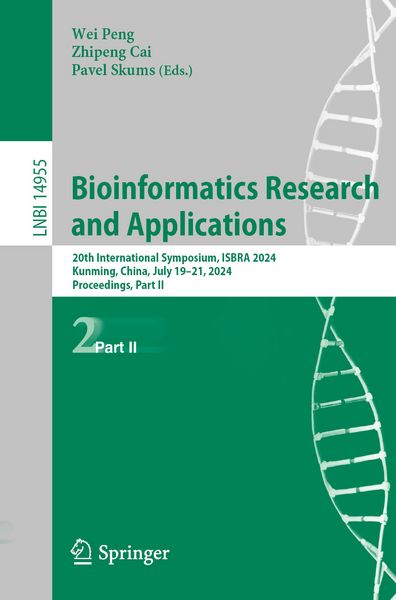
  • Produktbild: Bioinformatics Research and Applications
  • Produktbild: Bioinformatics Research and Applications
Band 14955 - 52%

Bioinformatics Research and Applications 20th International Symposium, ISBRA 2024, Kunming, China, July 19–21, 2024, Proceedings, Part II

52% sparen

75,99 € UVP 160,49 €

inkl. gesetzl. MwSt., Versandkostenfrei


Beschreibung

Produktdetails

Einband

Taschenbuch

Erscheinungsdatum

10.07.2024

Abbildungen

XVI, 501 p. 148 illus., 137 illus. in color.

Herausgeber

Wei Peng + weitere

Verlag

Springer Singapore

Seitenzahl

501

Maße (L/B/H)

23,5/15,5/2,8 cm

Gewicht

779 g

Auflage

2024

Sprache

Englisch

ISBN

978-981-9751-30-3

Beschreibung

Produktdetails

Einband

Taschenbuch

Erscheinungsdatum

10.07.2024

Abbildungen

XVI, 501 p. 148 illus., 137 illus. in color.

Herausgeber

Verlag

Springer Singapore

Seitenzahl

501

Maße (L/B/H)

23,5/15,5/2,8 cm

Gewicht

779 g

Auflage

2024

Sprache

Englisch

ISBN

978-981-9751-30-3

Herstelleradresse

Springer-Verlag KG
Sachsenplatz 4-6
1201 Wien
AT

Email: ProductSafety@springernature.com

Ein neues Kapitel für Ihre Bücher

Ein neues Kapitel für Ihre Bücher

Schenken Sie Ihren alten Schätzen ein zweites Leben und erhalten Sie dafür eine Thalia Geschenkkarte.

Jetzt verkaufen
Jetzt verkaufen

Noch keine Bewertungen vorhanden

Verfassen Sie die erste Bewertung zu diesem Artikel

Helfen Sie anderen Kundinnen und Kunden durch Ihre Meinung.

Kundinnen und Kunden meinen

Bewertungen (0)

  • Produktbild: Bioinformatics Research and Applications
  • Produktbild: Bioinformatics Research and Applications
  • .- Exploring Hierarchical Structures of Cell Types in  scRNA-seq Data.

    .- Predicting Frequencies of Drug Side Effects Using Graph Attention Networks with Multiple Features.

    .- RabbitTrim: highly optimized trimming of Illumina sequencing data on multi-core platforms.

    .- A hybrid feature fusion network for predicting HER2 status on H&E-stained histopathology images.

    .- scCoRR: a data-driven self-correction framework for labeled scRNA-seq data.

    .- KT-AMP: Enhancing Antimicrobial Peptide Functions Prediction through Knowledge Transfer on Protein Language Model.

    .- A Multi-Scale Attention Network for Sleep Arousal Detection with Single-Channel ECG.

    .- RabbitSAlign: Accelerating Short-Read Alignment for CPU-GPU Heterogeneous Platforms.

    .- FedKD-DTI: Drug-Target Interaction Prediction Based on Federated Knowledge Distillation.

    .- Accurately Deciphering Novel Cell Type in Spatially Resolved Single-Cell Data through Optimal Transport.

    .- Synthesis of Boolean Networks with Weak and Strong Regulators.

    .- Patch-based coupled attention network to predict MSI status in colon cancer.

    .- Predicting Blood-Brain Barrier Permeability through Multi-View Graph Neural Network with Global-Attention and Pre-trained Transformer.

    .- LLMDTA: Improving Cold-Start Prediction in Drug-Target Affinity with Biological LLM.

    .- DMSDR: Drug Molecule Synergy-Enhanced Network for Drug Recommendation with Multi-Source Domain Knowledge.

    .- A Graph Transformer-Based Method for Predicting LncRNA-Disease Associations Using Matrix Factorization and Automatic Meta-Path Generation.

    .- The Dynamic Spatiotemporal Features Based on Rich Club Organization in Autism Spectrum Disorder.

    .- Integrated Analysis of Autophagy-Related Genes Identifies Diagnostic Biomarkers and Immune Correlates in Preeclampsia.

    .- Multi-Grained Cross-Modal Feature Fusion Network for Diagnosis Prediction.

    .- MOL-MOE:Learning Drug Molecular Characterization Based on Mixture of Expert Mechanism.

    .- A Multimodal Federated Learning Framework for Modality Incomplete Scenarios in Healthcare.

    .- FunBGC: An Intelligent Framework for Fungal Biosynthetic Gene Cluster Identification.

    .- An Automatic Recommendation Method  for Single-Cell DNA Variant Callers  Based on Meta-Learning Framework.

    .- Incomplete Multimodal Learning with Modality-Aware Feature Interaction for Brain Tumor Segmentation.

    .- Multi-Scale Mean Teacher for Unsupervised Cross-Modality Abdominal Segmentation with Limited Annotations.

    .- Subgraph-aware dynamic attention network for drug repositioning.

    .- Multi-filter based signed graph convolutional networks for predicting interactions on drug networks.

    .- CPSORCL: A Cooperative Particle Swarm Optimization Method with Random Contrastive Learning for Interactive Feature Selection.

    .- Hypergraph representation learning for cancer drug response prediction.

    .- DGCL: a contrastive learning method for predicting cancer driver genes based on graph diffusion.

    .- KUMA-MI: A 12-Lead Knowledge-guided Multi-branch Attention Networks for Myocardial Infarction Localization.

    .- scAHVC: Single-cell Multi-omics clustering algorithm based on adaptive weighted hyper-laplacian regularization.

    .- Early Prediction of SGA-LGA Fetus at the First Trimester Ending through Weighted Voting Ensemble Learning Approach.

    .- A Hierarchical Classification Model for Annotating Antibacterial Biocide and Metal Resistance Genes via Fusing Global and Local Semantics.

    .- Secure Relative Detection in (Forensic) Database with Homomorphic Encryption.

    Noninvasive diagnosis of cancer based on the heterogeneity and fragmentation features of cell-free mitochondrial DNA.

    .- A Novel Dual Interactive Network for Parkinson's Disease Diagnosis Based on Multi-modality Magnetic Resonance Imaging.

    .- DVMPDC: A deep learning model based on dual-view representation and multi-strategy pooling for predicting synergistic drug combinations.

    .- MEMDA: a multi-similarity integration pre-completion algorithm with error correction for predicting microbe-drug associations.

    .- ResDeepGS:A deep learning-based method for crop phenotype prediction.

    .- Benchmarking Biomedical Relation Knowledge in Large Language Models.