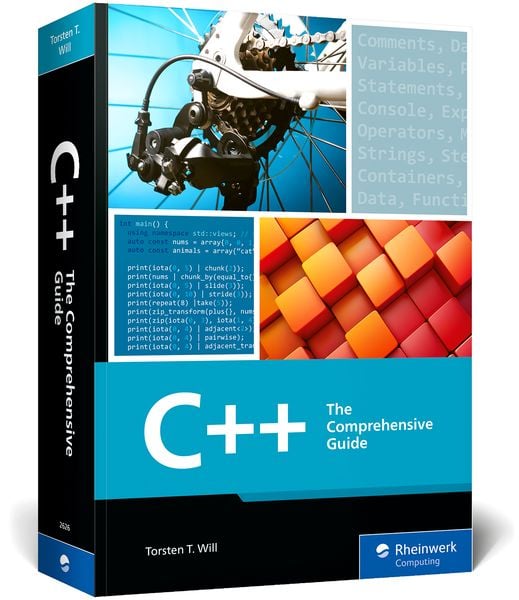
Produktbild: C++

C++ The Comprehensive Guide

69,95 €

inkl. gesetzl. MwSt., Versandkostenfrei


Beschreibung

Produktdetails

Verkaufsrang

47529

Einband

Taschenbuch

Erscheinungsdatum

07.11.2024

Verlag

Rheinwerk Publishing

Seitenzahl

1089

Maße (L/B/H)

25,4/17,8/4,8 cm

Gewicht

1870 g

Farbe

Graublau / Lichtgrau

Auflage

1

Sprache

Englisch

ISBN

978-1-4932-2626-9

Beschreibung

Produktdetails

Verkaufsrang

47529

Einband

Taschenbuch

Erscheinungsdatum

07.11.2024

Verlag

Rheinwerk Publishing

Seitenzahl

1089

Maße (L/B/H)

25,4/17,8/4,8 cm

Gewicht

1870 g

Farbe

Graublau / Lichtgrau

Auflage

1

Sprache

Englisch

ISBN

978-1-4932-2626-9

Herstelleradresse

Rheinwerk Verlag GmbH
Rheinwerkallee 4
53227 Bonn
DE

Email: service@rheinwerk-verlag.de

Ein neues Kapitel für Ihre Bücher

Ein neues Kapitel für Ihre Bücher

Schenken Sie Ihren alten Schätzen ein zweites Leben und erhalten dafür eine Thalia Geschenkkarte.

Jetzt verkaufen
Jetzt verkaufen

Noch keine Bewertungen vorhanden

Verfassen Sie die erste Bewertung zu diesem Artikel

Helfen Sie anderen Kundinnen und Kunden durch Ihre Meinung.

Kundinnen und Kunden meinen

Bewertungen (0)

  • Produktbild: C++
  • ... Preface ... 27


    PART I ... Fundamentals ... 31


    1 ... C++: The Comprehensive Guide ... 33


    1.1 ... New and Modern ... 33


    1.2 ... “Dan” Chapters ... 34


    1.3 ... Presentation in This Book ... 35


    1.4 ... Formatting Used ... 35


    1.5 ... Let’s Talk Lingo ... 36


    2 ... Programming in C++ ... 37


    2.1 ... Compiling ... 38


    2.2 ... Translation Phases ... 39


    2.3 ... Current Compilers ... 39


    2.4 ... Development Environments ... 41


    2.5 ... The Command Line under Ubuntu ... 43


    2.6 ... The Visual Studio Code IDE under Windows ... 46


    2.7 ... Speed Up the Sample Program ... 53


    3 ... C++ for Newcomers ... 55


    4 ... The Basic Building Blocks of C++ ... 63


    4.1 ... A Quick Overview ... 66


    4.2 ... A Detailed Walkthrough ... 70


    4.3 ... Operators ... 97


    4.4 ... Built-In Data Types ... 111


    4.5 ... Undefined Behavior ... 149


    5 ... Good Code, 1st Dan: Writing Readable Code ... 151


    5.1 ... Comments ... 151


    5.2 ... Documentation ... 152


    5.3 ... Indentations and Line Length ... 153


    5.4 ... Lines per Function and File ... 154


    5.5 ... Brackets and Spaces ... 154


    5.6 ... Names ... 156


    6 ... Higher Data Types ... 159


    6.1 ... The String Type “string” ... 160


    6.2 ... Streams ... 166


    6.3 ... Container and Pointer ... 172


    6.4 ... The Simple Sequence Containers ... 174


    6.5 ... Algorithms ... 179


    6.6 ... Pointers and C-Arrays ... 180


    7 ... Functions ... 181


    7.1 ... Declaration and Definition of a Function ... 182


    7.2 ... Function Type ... 183


    7.3 ... Using Functions ... 184


    7.4 ... Defining a Function ... 185


    7.5 ... More about Parameters ... 186


    7.6 ... Functional Body ... 190


    7.7 ... Converting Parameters ... 192


    7.8 ... Overloading Functions ... 194


    7.9 ... Default Parameter ... 196


    7.10 ... Arbitrary Number of Arguments ... 198


    7.11 ... Alternative Notation for Function Declaration ... 198


    7.12 ... Specialties ... 199


    8 ... Statements in Detail ... 203


    8.1 ... The Statement Block ... 206


    8.2 ... The Empty Statement ... 208


    8.3 ... Declaration Statement ... 209


    8.4 ... The Expression Statement ... 211


    8.5 ... The “if” Statement ... 212


    8.6 ... The “while” Loop ... 216


    8.7 ... The “do-while” Loop ... 218


    8.8 ... The “for” Loop ... 219


    8.9 ... The Range-Based “for” Loop ... 221


    8.10 ... The “switch” Statement ... 222


    8.11 ... The “break” Statement ... 227


    8.12 ... The “continue” Statement ... 228


    8.13 ... The “return” Statement ... 228


    8.14 ... The “goto” Statement ... 229


    8.15 ... The “try-catch” Block and “throw” ... 231


    8.16 ... Summary ... 232


    9 ... Expressions in Detail ... 233


    9.1 ... Calculations and Side Effects ... 234


    9.2 ... Types of Expressions ... 235


    9.3 ... Literals ... 236


    9.4 ... Identifiers ... 237


    9.5 ... Parentheses ... 237


    9.6 ... Function Call and Index Access ... 238


    9.7 ... Assignment ... 238


    9.8 ... Type Casting ... 240


    10 ... Error Handling ... 243


    10.1 ... Error Handling with Error Codes ... 245


    10.2 ... What Is an Exception? ... 248


    10.3 ... Minor Error Handling ... 251


    10.4 ... Throwing the Exception Again: “rethrow” ... 251


    10.5 ... The Order in “catch” ... 252


    10.6 ... Types for Exceptions ... 254


    10.7 ... When an Exception Falls Out of “main” ... 255


    11 ... Good Code, 2nd Dan: Modularization ... 257


    11.1 ... Program, Library, Object File ... 257


    11.2 ... Modules ... 258


    11.3 ... Separating Functionalities ... 259


    11.4 ... A Modular Example Project ... 260


    PART II ... Object-Oriented Programming and More ... 273


    12 ... From Structure to Class ... 275


    12.1 ... Initialization ... 278


    12.2 ... Returning Custom Types ... 279


    12.3 ... Methods Instead of Functions ... 280


    12.4 ... The Better “print” ... 283


    12.5 ... An Output Like Any Other ... 285


    12.6 ... Defining Methods Inline ... 286


    12.7 ... Separate Implementation and Definition ... 287


    12.8 ... Initialization via Constructor ... 288


    12.9 ... Struct or Class? ... 295


    12.10 ... Interim Recap ... 299


    12.11 ... Using Custom Data Types ... 300


    12.12 ... Type Inference with “auto” ... 315


    12.13 ... Custom Classes in Standard Containers ... 319


    13 ... Namespaces and Qualifiers ... 323


    13.1 ... The “std” Namespace ... 324


    13.2 ... Anonymous Namespace ... 327


    13.3 ... “static” Makes Local ... 329


    13.4 ... “static” Likes to Share ... 330


    13.5 ... Remote Initialization or “static inline” Data Fields ... 332


    13.6 ... Guaranteed to Be Initialized at Compile Time with “constinit” ... 333


    13.7 ... “static” Makes Permanent ... 333


    13.8 ... “inline namespace” ... 335


    13.9 ... Interim Recap ... 336


    13.10 ... “const” ... 337


    13.11 ... Volatile with “volatile” ... 357


    14 ... Good Code, 3rd Dan: Testing ... 361


    14.1 ... Types of Tests ... 361


    14.2 ... Frameworks ... 368


    14.3 ... Boost.Test ... 372


    14.4 ... Helper Macros for Assertions ... 376


    14.5 ... An Example Project with Unit Tests ... 379


    15 ... Inheritance ... 391


    15.1 ... Relationships ... 392


    15.2 ... Inheritance in C++ ... 394


    15.3 ... Has-a versus Is-a ... 395


    15.4 ... Finding Commonalities ... 396


    15.5 ... Derived Types Extend ... 398


    15.6 ... Overriding Methods ... 399


    15.7 ... How Methods Work ... 400


    15.8 ... Virtual Methods ... 402


    15.9 ... Constructors in Class Hierarchies ... 404


    15.10 ... Type Conversion in Class Hierarchies ... 405


    15.11 ... When to Use Virtual? ... 407


    15.12 ... Other Designs for Extensibility ... 409


    16 ... The Lifecycle of Classes ... 411


    16.1 ... Creation and Destruction ... 412


    16.2 ... Temporary: Short-Lived Values ... 414


    16.3 ... The Destructor to the Constructor ... 416


    16.4 ... Yoda Condition ... 420


    16.5 ... Construction, Destruction, and Exceptions ... 421


    16.6 ... Copy ... 423


    16.7 ... Assignment Operator ... 426


    16.8 ... Removing Methods ... 429


    16.9 ... Move Operations ... 430


    16.10 ... Operators ... 435


    16.11 ... Custom Operators in a Data Type ... 438


    16.12 ... Special Class Forms ... 446


    17 ... Good Code, 4th Dan: Security, Quality, and Sustainability ... 451


    17.1 ... The Rule of Zero ... 451


    17.2 ... Resource Acquisition Is Initialization ... 457


    18 ... Specials for Classes ... 467


    18.1 ... Allowed to See Everything: “friend” Classes ... 467


    18.2 ... Nonpublic Inheritance ... 471


    18.3 ... Signature Classes as Interfaces ... 477


    18.4 ... Multiple Inheritance ... 481


    18.5 ... Diamond-Shaped Multiple Inheritance: “virtual” for Class Hierarchies ... 490


    18.6 ... Literal Data Types: “constexpr” for Constructors ... 495


    19 ... Good Code, 5th Dan: Classical Object-Oriented Design ... 497


    19.1 ... Objects in C++ ... 499


    19.2 ... Object-Oriented Design ... 500


    PART III ... Advanced Topics ... 519


    20 ... Pointers ... 521


    20.1 ... Addresses ... 522


    20.2 ... Pointer ... 523


    20.3 ... Dangers of Aliasing ... 525


    20.4 ... Heap Memory and Stack Memory ... 526


    20.5 ... Smart Pointers ... 530


    20.6 ... Raw Pointers ... 539


    20.7 ... C-Arrays ... 543


    20.8 ... Iterators ... 550


    20.9 ... Pointers as Iterators ... 551


    20.10 ... Pointers in Containers ... 552


    20.11 ... The Exception: When Cleanup Is Not Necessary ... 552


    21 ... Macros ... 555


    21.1 ... The Preprocessor ... 556


    21.2 ... Beware of Missing Parenthesis ... 560


    21.3 ... Feature Macros ... 561


    21.4 ... Information about the Source Code ... 561


    21.5 ... Warning about Multiple Executions ... 562


    21.6 ... Type Variability of Macros ... 563


    21.7 ... Summary ... 566


    22 ... Interface to C ... 567


    22.1 ... Working with Libraries ... 568


    22.2 ... C Header ... 569


    22.3 ... C Resources ... 572


    22.4 ... “void” Pointers ... 572


    22.5 ... Reading Data ... 573


    22.6 ... The Main Program ... 575


    22.7 ... Summary ... 575


    23 ... Templates ... 577


    23.1 ... Function Templates ... 578


    23.2 ... Function Templates in the Standard Library ... 588


    23.3 ... A Class as a Function ... 593


    23.4 ... C++ Concepts ... 609


    23.5 ... Template Classes ... 616


    23.6 ... Templates with Variable Argument Count ... 630


    23.7 ... Custom Literals ... 634


    PART IV ... The Standard Library ... 645


    24 ... Containers ... 647


    24.1 ... Basics ... 648


    24.2 ... Iterator Basics ... 660


    24.3 ... Allocators: Memory Issues ... 665


    24.4 ... Container Commonalities ... 668


    24.5 ... An Overview of the Standard Container Classes ... 669


    24.6 ... The Sequential Container Classes ... 673


    24.7 ... Associative and Ordered ... 716


    24.8 ... Only Associative and Not Guaranteed ... 749


    24.9 ... Container Adapters ... 779


    24.10 ... Special Cases: “string”, “basic_string”, and “vector” ... 781


    24.11 ... Special Cases: “vector”, “array”, and “bitset” ... 782


    24.12 ... Special Case: Value Array with “valarray<>” ... 786


    25 ... Container Support ... 795


    25.1 ... Algorithms ... 796


    25.2 ... Iterators and Ranges ... 798


    25.3 ... Iterator Adapter ... 800


    25.4 ... Algorithms of the Standard Library ... 800


    25.5 ... Parallel Execution ... 802


    25.6 ... Lists of Algorithm Functions and Range Adapters ... 805


    25.7 ... Element-Linking Algorithms from “” and “” ... 831


    25.8 ... Copy instead of Assignment: Values in Uninitialized Memory Areas ... 838


    25.9 ... Custom Algorithms ... 840


    25.10 ... Writing Custom Views and Range Adapters ... 842


    26 ... Good Code, 6th Dan: The Right Container for Each Task ... 845


    26.1 ... All Containers Arranged by Aspects ... 845


    26.2 ... Recipes for Containers ... 850


    26.3 ... Implementing Algorithms That Are Specialized Depending on the Container ... 856


    27 ... Streams, Files, and Formatting ... 857


    27.1 ... Input and Output Concept with Streams ... 857


    27.2 ... Global, Predefined Standard Streams ... 858


    27.3 ... Methods for Stream Input and Output ... 860


    27.4 ... Error Handling and Stream States ... 864


    27.5 ... Manipulating and Formatting Streams ... 867


    27.6 ... Streams for File Input and Output ... 879


    27.7 ... Streams for Strings ... 892


    27.8 ... Stream Buffers ... 898


    27.9 ... “filesystem” ... 900


    27.10 ... Formatting ... 902


    28 ... Standard Library: Extras ... 909


    28.1 ... “pair” and “tuple” ... 909


    28.2 ... Regular Expressions ... 917


    28.3 ... Randomness ... 926


    28.4 ... Mathematical ... 935


    28.5 ... System Error Handling with “system_error” ... 960


    28.6 ... Runtime Type Information: “” and “” ... 968


    28.7 ... Helper Classes around Functors: “” ... 972


    28.8 ... “optional” for a Single Value or No Value ... 980


    28.9 ... “variant” for One of Several Types ... 980


    28.10 ... “any” Holds Any Type ... 982


    28.11 ... Special Mathematical Functions ... 983


    28.12 ... Fast Conversion with “” ... 984


    29 ... Threads: Programming with Concurrency ... 987


    29.1 ... C++ Threading Basics ... 988


    29.2 ... Shared Data ... 1005


    29.3 ... Other Synchronization Options ... 1021


    29.4 ... In Its Own Storage with “thread_local” ... 1024


    29.5 ... Waiting for Events with “condition_variable” ... 1025


    29.6 ... Waiting Once with “future” ... 1030


    29.7 ... Atomics ... 1040


    29.8 ... Coroutines ... 1046


    29.9 ... Summary ... 1051


    30 ... Good Code, 7th Dan: Guidelines ... 1055


    30.1 ... Guideline Support Library ... 1056


    30.2 ... C++ Core Guidelines ... 1056


    ... Appendices ... 1069


    A ... Cheat Sheet ... 1069


    B ... The Author ... 1073


    ... Index ... 1075