KI-Beratung Beta

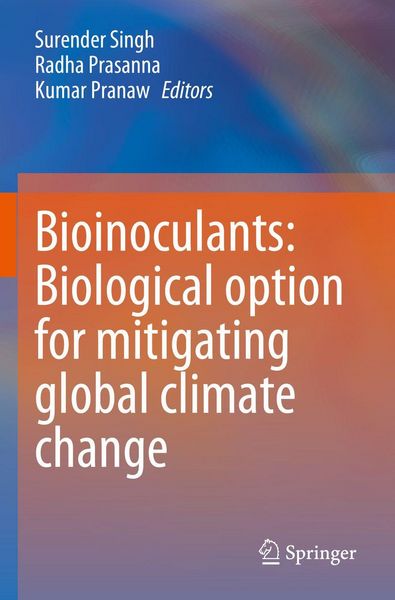
Produktbild: Bioinoculants: Biological Option for Mitigating global Climate Change
- 12%

Bioinoculants: Biological Option for Mitigating global Climate Change

12% sparen

187,99 € UVP 213,99 €

inkl. gesetzl. MwSt., Versandkostenfrei


Beschreibung

Produktdetails

Einband

Taschenbuch

Erscheinungsdatum

27.07.2024

Abbildungen

XVII, 317 p. 1 illus.

Herausgeber

Surender Singh + weitere

Verlag

Springer Singapore

Seitenzahl

317

Maße (L/B/H)

23,5/15,5/1,9 cm

Gewicht

511 g

Auflage

2023

Sprache

Englisch

ISBN

978-981-9929-75-7

Beschreibung

Portrait


Surender Singh


Prof. Surender Singh received his BSc (Hons.) Agriculture from Chaudhary Charan Singh


Haryana Agricultural University, Hisar (India). He obtained his MSc and PhD in Microbiology


from Indian Agricultural Research Institute (IARI), New Delhi, in 2005 and 2009, respectively, before


joining as Scientist (ARS) in IARI, New Delhi. He joined Central University of Haryana in 2018.


His research focuses on the development of multi-stress tolerant bioinoculants and organic


matter recycling including bioethanol production from lignocellulosic material. He was awarded


the prestigious Endeavour Research Fellowship (2011) by Government of Australia for his


academic excellence to carry out 6-month research in University of South Australia, Adelaide. He


was also awarded with Young Scientist Award 2015 by Association of Microbiologists of India


(AMI), Young Scientist Award (2015–2016) by National Academy of Agricultural Sciences (NAAS),


New Delhi, and Haryana Yuva Vigyan Ratan (2018) by Department of Science and Technology,


Government of Haryana. Dr. Singh has been involved in six research projects funded extramurally


by ICAR, DBT, DST, and MoEF (Government of India). He is currently supervising six doctoral


scholars and has supervised 15 PG dissertations in the past. He has authored more than 80 research


articles, 1 book, and 15 book chapters and is an active reviewer for many reputed journals in

microbiological research. He is also an editorial board member of Electronic Journal of


Biotechnology and Frontiers of Microbiology. Prof. Singh is a Life member of Association of


Microbiologists of India (AMI) and Indian Science Congress.


Radha Prasanna


Dr. Radha Prasanna completed her Masters and PhD programs from Indian Agricultural Research

Institute (ICAR-IARI), joined as Scientist in 1996, and presently serves as Principal Scientist,


Division of Microbiology, ICAR-IARI, New Delhi. Her major interests include investigations in


the areas of natural resource management and crop protection, through deploying integrated


nutrient/disease management strategies and modern omics tools. She is passionate toward


diversifying the role of cyanobacteria and their consortia in crops, besides rice, and their significant

role as plant growth promoting inoculants for wheat, maize, cotton, legumes, and vegetable crops


and as biocontrol agents against phytopathogenic fungi in cereal and vegetable crops.


She is actively involved in post-graduate teaching and research guidance of MSc/PhD students


at ICAR-IARI. She has been recognized as Outstanding Reviewer by Elsevier, Springer, and


Wiley journals, besides being identified as Top Peer Reviewer by Publons. She is serving as


Associate Editor, BMC Microbiology and CABI Agriculture and Bioscience, and Member,


Editorial Advisory Board, Journal of Basic Microbiology. She has published more than 230


research papers in peer-reviewed journals, most of them being highly cited. She is the recipient of


NAAS Fellowship (2022), Fellowship of the Academy of Microbiological Sciences (FAMSc


2019), Hari Krishna Shastri Award (2017), ICAR Panjabrao Deshmukh Outstanding Woman


Scientist Award (2012), and IARI Best Teacher Award (2008), for her outstanding contributions


to research and teaching.


Kumar Pranaw


Dr. Kumar Pranaw completed his bachelor’s in 2006 with BSc (Hons.) Microbiology from Sam


Higginbottom Institute of Agriculture, Technology & Sciences, Allahabad, India. He obtained his


Master’s degree in Microbiology from Vellore Institute of Technology, Vellore, India, in 2008. He


joined Indian Agricultural Research Institute in 2009 as Senior Research Fellow and started


working on microbial enzymes and their role in bio-pesticidal activity as well as in bioremediation.


He registered for his doctoral study at the National Institute of Technology, Durgapur, India, in


collaboration with the Indian Agriculture Research Institute, New Delhi, India, and received his


PhD (Biotechnology) in 2014. His expertise has been enriched by academic as well as industrial


research experience at eminent national and international institutions. Currently, he leads a


multinational research group at the University of Warsaw, Poland, which works toward


innovative solutions for realizing the zero-waste circular economy concept by probing plant


growth-promoting bacteria for sustainable agriculture and utilizing the generated agro-wastes for


high value-added products. Presently, he is supervising two postdocs and two doctoral scholars and

has supervised several PG/UG dissertations in the past. He has authored more than 20 research


articles in different peer-reviewed journals and is an active reviewer for many reputed international


journals in the field of applied microbiology, sustainable agriculture and environment, and waste


valorization. He has presented his research achievements at several national and international


conferences. He is actively engaged in different professional societies like Life member at the

Association of Microbiologists of India; Life member at The Biotech Research Society, India;


Member of American Society for Microbiologists, USA; and Member of European Federation of


Biotechnology.


Produktdetails

Einband

Taschenbuch

Erscheinungsdatum

27.07.2024

Abbildungen

XVII, 317 p. 1 illus.

Herausgeber

Verlag

Springer Singapore

Seitenzahl

317

Maße (L/B/H)

23,5/15,5/1,9 cm

Gewicht

511 g

Auflage

2023

Sprache

Englisch

ISBN

978-981-9929-75-7

Herstelleradresse

Springer-Verlag KG
Sachsenplatz 4-6
1201 Wien
AT

Email: ProductSafety@springernature.com

Ein neues Kapitel für Ihre Bücher

Ein neues Kapitel für Ihre Bücher

Schenken Sie Ihren alten Schätzen ein zweites Leben und erhalten Sie dafür eine Thalia Geschenkkarte.

Jetzt verkaufen
Jetzt verkaufen

Noch keine Bewertungen vorhanden

Verfassen Sie die erste Bewertung zu diesem Artikel

Helfen Sie anderen Kundinnen und Kunden durch Ihre Meinung.

Kundinnen und Kunden meinen

Bewertungen (0)

  • Produktbild: Bioinoculants: Biological Option for Mitigating global Climate Change

  • Chapter 1_ Microbial inoculants in the climate change scenario: An overview.- Chapter 2_Climate change, its effects on soil health and role of bioinoculants in mitigating climate change.- Chapter 3_ Emerging weeds under climate change and their microbial management.- Chapter 4_Climate change and agriculture: Impact assessment and sustainable alleviation approach using Rhizomicrobiome.- Chapter 5_Micronutrient mobilizer microorganisms: Significance in crop sustainability.- Chapter 6_Legume-rhizobium symbiosis and beyond: producing synthetic communities for increasing crop production under climate change challenges.- Chapter 7_Salinity mitigation using microbial inoculants.- Chapter 8_Cyanobacterial bioinoculants for abiotic stress management in the changing climate scenario.- Chapter 9_Alleviation of drought stress and amelioration of tomato plant growth by bacterial inoculants for mitigating climate change.- Chapter 10_Associative nitrogen fixers- Options for mitigating climate change.- Chapter 11_Trichoderma-based bioinoculant: A potential tool for sustainable rice cultivation.- Chapter 12_Photosynthetic microorganisms and their role in mitigating climate change through C sequestration and plant-soil interactions.- Chapter 13_Arbuscular Mycorrhizal Fungi: A keystone to climate-smart agriculture.- Chapter 14_Microbial siderophores in sustainable agriculture applications - preventing and mitgating effects of climate change.