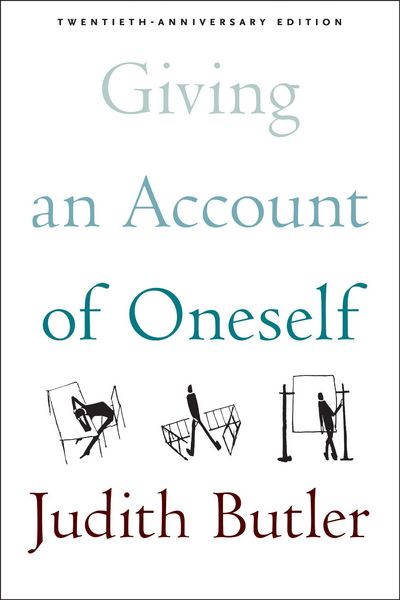
Giving an Account of Oneself Twentieth Anniversary Edition, with a New Preface by the Author
-
- Hardcover
- Taschenbuch ausgewählt
- eBook
-
Sprache:Englisch
- Deutsch 17,00 €
- Englisch 29,99 € ausgewählt
29,99 €
inkl. gesetzl. MwSt.,
Beschreibung
Produktdetails
Einband
Taschenbuch
Erscheinungsdatum
01.04.2025
Verlag
Fordham University PressSeitenzahl
176
Maße (L/B/H)
22,5/14,8/1,1 cm
Gewicht
242 g
Auflage
2nd edition
Sprache
Englisch
ISBN
978-1-5315-0997-2
What does it mean to lead a moral life?
In their first extended study of moral philosophy, Judith Butler offers a provocative outline for a new ethical practice-one responsive to the need for critical autonomy yet grounded in the opacity of the human subject.
Butler takes as their starting point one's ability to answer the questions ""What have I done?"" and ""What ought I to do?"" They show that these questions can be answered only by asking a prior question, ""Who is this 'I' who is under an obligation to give an account of itself and to act in certain ways?"" Because I find that I cannot give an account of myself without accounting for the social conditions under which I emerge, ethical reflection requires a turn to social theory.
In three powerfully crafted and lucidly written chapters, Butler demonstrates how difficult it is to give an account of oneself, and how this lack of self-transparency and narratibility is crucial to an ethical understanding of the human. In dialogue with Adorno, Levinas, Foucault, and other thinkers, they eloquently argue the limits, possibilities, and dangers of contemporary ethical thought.
Butler offers a critique of the moral self, arguing that the transparent, rational, and continuous ethical subject is an impossible construct that seeks to deny the specificity of what it is to be human. We can know ourselves only incompletely, and only in relation to a broader social world that has always preceded us and already shaped us in ways we cannot grasp. If inevitably we are partially opaque to ourselves, how can giving an account of ourselves define the ethical act? And doesn't an ethical system that holds us impossibly accountable for full self-knowledge and self-consistency inflict a kind of psychic violence, leading to a culture of self-beratement and cruelty? How does the turn to social theory offer us a chance to understand the specifically social character of our own unknowingness about ourselves?
By recasting ethics as a project in which being ethical means becoming critical of norms under which we are asked to act, but which we can never fully choose, Butler illuminates what it means for us as ""fallible creatures"" to create and share an ethics of vulnerability, humility, and ethical responsiveness.
Ein neues Kapitel für Ihre Bücher
Ein neues Kapitel für Ihre Bücher
Schenken Sie Ihren alten Schätzen ein zweites Leben und erhalten Sie dafür eine Thalia Geschenkkarte.
Noch keine Bewertungen vorhanden
Verfassen Sie die erste Bewertung zu diesem Artikel
Helfen Sie anderen Kundinnen und Kunden durch Ihre Meinung.
Kurze Frage zu unserer Seite
Vielen Dank für Ihr Feedback
Wir nutzen Ihr Feedback, um unsere Produktseiten zu verbessern. Bitte haben Sie Verständnis, dass wir Ihnen keine Rückmeldung geben können. Falls Sie Kontakt mit uns aufnehmen möchten, können Sie sich aber gerne an unseren Kund*innenservice wenden.
zum Kundenservice