
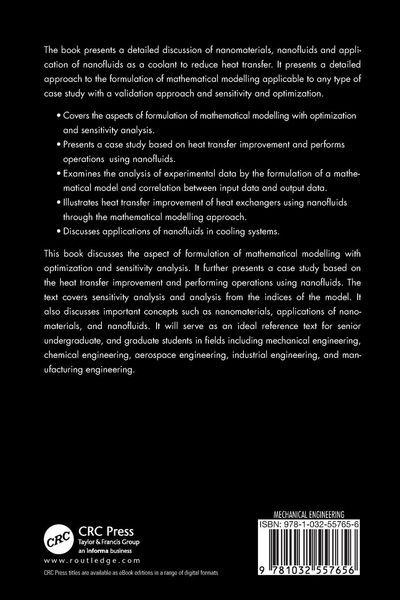
• Produktbild: Mathematical Modelling of Heat Transfer Performance of Heat Exchanger using Nanofluids
  • Produktbild: Mathematical Modelling of Heat Transfer Performance of Heat Exchanger using Nanofluids
- 20%

Mathematical Modelling of Heat Transfer Performance of Heat Exchanger using Nanofluids

20% sparen

55,99 € UVP 70,50 €

inkl. gesetzl. MwSt., Versandkostenfrei


Beschreibung

Produktdetails

Einband

Taschenbuch

Erscheinungsdatum

30.01.2025

Abbildungen

6 SW-Abb., 50 Farbabb., 3 SW-Fotos, 53 SW-Zeichn., 45 Tabellen

Verlag

Taylor & Francis

Seitenzahl

150

Maße (L/B/H)

23,4/15,6/0,8 cm

Gewicht

240 g

Sprache

Englisch

ISBN

978-1-03-255765-6

Beschreibung

Produktdetails

Einband

Taschenbuch

Erscheinungsdatum

30.01.2025

Abbildungen

6 SW-Abb., 50 Farbabb., 3 SW-Fotos, 53 SW-Zeichn., 45 Tabellen

Verlag

Taylor & Francis

Seitenzahl

150

Maße (L/B/H)

23,4/15,6/0,8 cm

Gewicht

240 g

Sprache

Englisch

ISBN

978-1-03-255765-6

EU-Ansprechpartner

Taylor & Francis Verlag GmbH
Kaufingerstraße 24
80331 München
DE
GPSR@taylorandfrancis.com

Herstelleradresse

Taylor & Francis Group
5 Howick Place
SW1P 1WG London
UK
GPSR@taylorandfrancis.com

Ein neues Kapitel für Ihre Bücher

Ein neues Kapitel für Ihre Bücher

Schenken Sie Ihren alten Schätzen ein zweites Leben: Einfach Barcode scannen, Versandetikett ausdrucken, Bücher verschicken und Thalia Geschenkkarte erhalten.

Jetzt verkaufen
Jetzt verkaufen

Noch keine Bewertungen vorhanden

Verfassen Sie die erste Bewertung zu diesem Artikel

Helfen Sie anderen Kundinnen und Kunden durch Ihre Meinung.

Kundinnen und Kunden meinen

Bewertungen (0)

Die Leseprobe wird geladen.
  • Produktbild: Mathematical Modelling of Heat Transfer Performance of Heat Exchanger using Nanofluids
  • Produktbild: Mathematical Modelling of Heat Transfer Performance of Heat Exchanger using Nanofluids
  • Chapter 1
    Nanofluids

    1.1 Nanotechnology
    1.2 Nanomaterials
    1.3 Applications of Nanomaterials
    1.4 Nanofluids
    1.5 Compact Heat Exchangers
    1.6 Heat Transfer Enhancement through Nanofluids
    1.7 Improvement in Heat Exchanger Performance
    1.8 Application of Nanofluid in Cooling Systems
    1.9 Mathematical Modelling

    Chapter 2
    Concept of Experimental Data-Based Modelling

    2.1 Introduction
    2.2 Nanofluid for Heat Transfer
    2.3 Brief Methodology of Theory of Experimentation
    2.4 Methods of Experimentation
     
    Chapter 3
    Design of Experimentation

    3.1 Introduction
    3.2 Design of Experiment - Methodical Approach
    3.3 Experimental Setup and Procedure
    3.4 Two-Wire Method
    3.5 Radiator as a Heat Exchanger: Experimental Procedure
    3.6 Design of Instrumentation for Experimental Setup
    3.7 Components of Instrumentation Systems
    3.8 Identification of Variables in Phenomenon
    3.9 Mathematical Relationship for Heat Transfer Phenomena
    3.10 Formation of Pi Terms for Dependent & Independent
    3.11 Reduction of Variables by Dimensional Analysis
    3.12 Plan for Experimentation
    3.13 Experimental Observations
    3.14 Sample Selection

    Chapter 4
    Mathematical Models

    4.1 Introduction
    4.2 Model Classification
    4.3 Formulation of Experimental Data-Based Models (Two-Wire Method)
    4.4 Sample Calculations of Pi Terms

    Chapter 5
    Analysis using SPSS Statistical Packages Software

    5.1 Introduction
    5.2 Developing the SPSS Model for Individual Pi Terms
    5.3 SPSS Output for Thermal Conductivity K (Concentration)
    5.4 SPSS Output for Thermal Conductivity Kt (Size)
    5.5 SPSS Output for Thermal Conductivity Ks (Shape)
    5.6 SPSS Output for piD1 (Temperature Difference, DeltaT)
    5.7 SPSS Output for piD2 (Heat Flow, Q)
     5.8 SPSS Output for piD3 (Heat Transfer Coefficient, h)

    Chapter 6
    Analysis of Model using Artificial Neural Network Programming
     
    6.1 Introduction
    6.2 Procedure for Artificial Neural Network Phenomenon
    6.3 Performance of Models by ANN
    6.3.1 ANN using SPSS o/p for Thermal Conductivity K
    6.3.2 ANN using SPSS o/p for Thermal Conductivity Kt (Size)
    6.3.3 ANN using SPSS o/p for Thermal Conduct. Ks (Shape)
    6.3.4 ANN using MATLAB Program for piD1 (Temp. Diffe., DeltaT)
    6.3.5 Comparison of Various Model Values

    Chapter 7
    Analysis of the Indices of Model

    7.1 Introduction
    7.2 Analysis of the Model for Dependent Pi Term piD1 (K )
    7.3 Analysis of the Model for Dependent Pi Term piD2 (Kt)
    7.4 Analysis of the Model for Dependent Pi Term piD3 (Ks)
    7.5 Analysis of the Model for Dependent Pi Term piD1 (DeltaT)
    7.6 Analysis of the Model for Dependent Pi Term piD2 (Q)
    7.7 Analysis of the Model for Dependent Pi Term piD3 (h)

    Chapter 8
    Optimization and Sensitivity Analysis
    8.1 Introduction
    8.2 Optimization of the Models
    8.3 Sensitivity Analysis for Two-Wire Method
    8.4 Estimation of Limiting Values of Response Variables
    8.5 Performance of the Models
    8.6 Reliability of Models
    8.7 Coefficient of Determinants R2 for Two-Wire Method

    Chapter 9
    Interpretation of the Simulation
    9.1 Interpretation of Independent Variables vs. Response Variables after Optimization
    9.2 Interpretation of Temperature Difference against the Mass Flow Rate
    9.3 Interpretation of Reliability and Coefficient of Determinant
    9.4 Interpretation of Mean Error of Models Corresponding to Response Variables