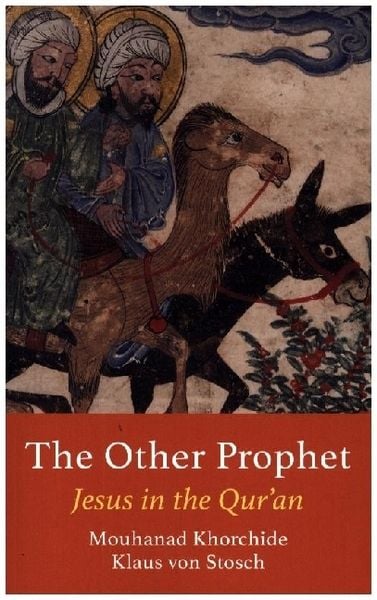
Produktbild: The Other Prophet
- 17%

The Other Prophet Jesus in the Qur’an

17% sparen

23,99 € UVP 29,00 €

inkl. gesetzl. MwSt., Versandkostenfrei


Beschreibung

Produktdetails

Einband

Taschenbuch

Erscheinungsdatum

18.06.2025

Verlag

Haus Publishing

Seitenzahl

332

Maße (L/B/H)

22,8/14,8/1,4 cm

Gewicht

358 g

Übersetzt von

Simon Pare

Sprache

Englisch

ISBN

978-1-909942-96-7

Beschreibung

Produktdetails

Einband

Taschenbuch

Erscheinungsdatum

18.06.2025

Verlag

Haus Publishing

Seitenzahl

332

Maße (L/B/H)

22,8/14,8/1,4 cm

Gewicht

358 g

Übersetzt von

Simon Pare

Sprache

Englisch

ISBN

978-1-909942-96-7

EU-Ansprechpartner

Edoardo Braschi
Via Dino Camapana 2B
50038 San Piero a Sieve
IT
gpsr@gingko.org.uk

Herstelleradresse

GINGKO
4 Molasses Row
SW11 3UX London
GB
gingko@gingko.org.uk

Ein neues Kapitel für Ihre Bücher

Ein neues Kapitel für Ihre Bücher

Schenken Sie Ihren alten Schätzen ein zweites Leben und erhalten dafür eine Thalia Geschenkkarte.

Jetzt verkaufen
Jetzt verkaufen

Noch keine Bewertungen vorhanden

Verfassen Sie die erste Bewertung zu diesem Artikel

Helfen Sie anderen Kundinnen und Kunden durch Ihre Meinung.

Kundinnen und Kunden meinen

Bewertungen (0)

Die Leseprobe wird geladen.
  • Produktbild: The Other Prophet
  • 1. Introduction

    2. The State of Christology in the Seventh Century

    2.1 The Chalcedon controversy

    2.2 A political compromise on dogma

    2.3 The neo-Chalcedonian doctrine of enhypostasis

    2.4 Christological debates among non-Chalcedonians

    2.5 The Arabian Peninsula as a confluence of heresies?

    2.6 The situation in the Arabian Peninsula in the seventh century

    3. New Developments in Modern Christology

    3.1 The starting point of consciousness Christology

    3.2 The modern paradigm shift in relational ontology and its impact on Christology

    3.3 Testing against the historical Jesus

    3.4 Multiple incarnations?

    4. A Holistic Reading of Surahs 19, 3 and 5 in the Context of a Diachronic Reading of the Qur’an’s Verses about Jesus

    4.1 Jesus in Surah Maryam

    4.1.1 Zachariah and John

    4.1.2 Mary and her child

    4.1.3 Jesus’s self-image

    4.1.4 An anti-Christological intervention in Q 19:34–40?

    4.1.5 Further themes in Surah Maryam

    4.1.6 Prophetological consolidation in the late Meccan and early Medinan periods

    4.2 Surah al ‘Imran

    4.2.1 Prologue (verses 1–32)

    4.2.2 Narrative core (verses 33–62)

    4.2.3 Religio-political arguments (verses 63–99)

    4.2.4 Self-assurance of the Muslim community (verses 100–200)

    4.2.5 Jesus crucified?

    4.3 Surah al-Ma’ida

    4.3.1 Structure and themes of the surah

    4.3.2 Criticism of any deification of human beings

    4.3.3 A break with Christianity?

    5. Jesus’s Position in Qur’anic Prophetology (Zishan Ghaffar)

    5.1 the early Meccan surahs: eschatological prophecy

    5.1.1 Imminent eschatological expectation?

    5.2 The middle Meccan surahs: prophetology as a combination of salvation, election and mercy

    5.2.1 The new context of the proclamation in the middle Meccan

    period and its central topoi

    5.2.2 The Qur’an’s apostolic doctrine in the middle Meccan period

    5.2.3 The birth of prophecy out of God’s mercy

    5.2.4 Muhammad as Moses redivivus – the consolidation of Qur’anic prophetology in the middle Meccan period

    5.3 Late Meccan prophetology: the apology of the messengers

    5.4 Qur’anic prophetology in Medina

    5.4.1 from existential to textual typology

    5.4.2 from community of fate to the universal community of the covenant: Qur’anic prophetology between universality and

    exclusivity

    5.4.3 the Messenger Muhammad as lawmaker and his special

    prestige as a prophetic dignitary

    5.4.4 Prophetology as a counter-discourse to Christology?

    6. The Work of Jesus Christ and the Qur’an: A Forensic Search for Functional Equivalents

    6.1 God’s self-revelation in the Islamic tradition (with the involvement of Darius asghar-Zadeh)

    6.2 The relation between God and humans as a liberating relationship

    6.3 On the soteriological relevance of the Qur’an (with the involvement of Darius asghar-Zadeh)

    6.4 Can God suffer?

    6.5 Qur’anic stimuli for conceiving of emotions in God

    7. New Perspectives on the Qur’an

    7.1 Systematic conclusions from a Christian perspective

    7.2 Systematic conclusions from a Muslim perspective

    Bibliography

    Reference text