
• Produktbild: Social Robotics
  • Produktbild: Social Robotics
Band 15562

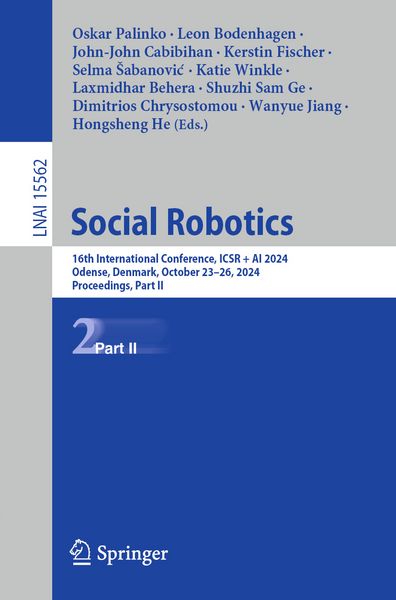
Social Robotics 16th International Conference, ICSR + AI 2024, Odense, Denmark, October 23–26, 2024, Proceedings, Part II

72,99 €

inkl. gesetzl. MwSt., Versandkostenfrei


Beschreibung

Produktdetails

Einband

Taschenbuch

Erscheinungsdatum

25.03.2025

Herausgeber

John-John Cabibihan + weitere

Verlag

Springer Singapore

Seitenzahl

512

Maße (L/B/H)

23,5/15,5/2,9 cm

Gewicht

792 g

Auflage

1. Auflage

Sprache

Englisch

ISBN

978-981-9635-18-4

Beschreibung

Produktdetails

Einband

Taschenbuch

Erscheinungsdatum

25.03.2025

Herausgeber

Verlag

Springer Singapore

Seitenzahl

512

Maße (L/B/H)

23,5/15,5/2,9 cm

Gewicht

792 g

Auflage

1. Auflage

Sprache

Englisch

ISBN

978-981-9635-18-4

Herstelleradresse

Springer-Verlag GmbH
Tiergartenstr. 17
69121 Heidelberg
DE

Email: GPSR Kontakt

Ein neues Kapitel für Ihre Bücher

Ein neues Kapitel für Ihre Bücher

Schenken Sie Ihren alten Schätzen ein zweites Leben und erhalten dafür eine Thalia Geschenkkarte.

Jetzt verkaufen
Jetzt verkaufen

Noch keine Bewertungen vorhanden

Verfassen Sie die erste Bewertung zu diesem Artikel

Helfen Sie anderen Kundinnen und Kunden durch Ihre Meinung.

Kundinnen und Kunden meinen

Bewertungen (0)

  • Produktbild: Social Robotics
  • Produktbild: Social Robotics
  • .- Should Robot Arms Be Thicc or Thinn? Examining The Impact of Shape Characteristics on Human Perceptions of Robot Arms.

    .- Humanoid robots, a future health care service?.

    .- Reaching and Grasping with NAO robot.

    .- Theory of Mind Assessment in Human-Robot Interaction.

    .- Combining control and validity: Context management issues in proactive social robotics research.

    .- Design Considerations for Applications of Social Robots in the Stuttering Clinic.

    .- Towards knowledge-based utilization of social robotics in renewing welfare services: Case Northern Finland.

    .- Interaction Matters When It Comes to Hand Disinfection using Robots at Hospitals.

    .- A Multi-Agent Framework for Upper Limb Mobility through a Gamified Music-Driven System in Social Robotics.

    .- Posthuman Dance Performance Based on Embodied Mechanical Prosthetics: LUDDITES.

    .- Robots That Perform Norm-Based Reference Resolution.

    .- Investigating the Impact of Encouraging Utterances by Conversational Robots on Subjective Well-Being: A 15-Day Sustained Interaction.

    .- Trust Prediction in Assistive Robotics using Multi-Modal Video Transformers.

    .- Towards Human-Robot Co-Creative Collaboration Through Interactive Task Dialogue.

    .- Speech-Guided Sequential Planning for Autonomous Navigation using Large Language Model Meta AI 3 (Llama3).

    .- Zen Wakarimasen - mobile robot raking a Zen garden in an artistic installation.

    .- Enhancing Open Conversations Using Visual Percepts From a Socially As sistive Robot – Preliminary Assessmen.

    .- MiKa - Assistive Humanoid Robot for Metro Passengers.

    .- Classifying Attention Drops in EEG Signals for ADHD Training with the Virtual Agent Flobi.

    .- An Epistemic Human-Aware Task Planner which Anticipates Human Beliefs and Decisions.

    .- Categorizing Robots as Living or Non-living: From Descriptive to Normative Assessments.

    .- A Framework for Mapping High-Dimensional Perceptual Features into the Low-Dimensional Salient Feature Space of a Social Robot.

    .- Baby-Robot Interaction: An Observational Analysis of Young Children’s Interactions with Robot Cleaners.

    .- A Semi-Automated Multi-Robot Comedy Performance System: From Script to Performance.

    .- The Impact of Perceived Risk on Trust in Human-Robot Interaction.

    .- "Novel Roboting": A Playful Learning Approach to Digital Literacy in Early Childhood Education through Story-Tinkering and Computational Play with Robots.

    .- A dual-control dialogue framework for human-robot interaction data collec tion: integrating human emotional and contextual awareness with conversa tional AI.

    .- A Case Study on Robot Sound Design for a Sidewalk Delivery Robot.

    .- Exploring Human Attribution of Emotional Intent to Motion Features in a Humanoid Robot.

    .- Clinician Perspectives on Autonomy and Trust in Robots for Pediatric In tervention.

    .- Dude, Where’s My Robot Voice? Sometimes More Robotic is Better in Social Robot Speech Generation.

    .- Overtrusting a simple Non-humanoid Robot in a training process.

    .- An EEG Benchmark Dataset for Data-Driven Trust Assessment in Social HRI.

    .- Evaluating Robot Influence on Pedestrian Behavior Models for Crowd Sim ulation and Benchmarking.

    .- reMap: Spatially-grounded and Queryable Semantics for Interactive Robots.

    .- Social, but Still Uncanny.

    .- Social Robots as Physical Education Instructors for Primary School Pupils: Exploration of Child-Robot Interaction at a Summer Camp.

    .- Exploring Children’s Strategies in Response to Robot’s Advice during a Group Task with iCub and Nao.

    .- Apples and oranges: validity and reliability of the three main anthropomor phism measures.

    .- Agent-Exploitation Affordances: From Basic to Complex Representation Patterns.

    .- From Functional Affordances to Reciprocal Dispositions: An Ontological Representation.

    .- Envision a future of living with robots through participatory theatre: A field report.

    .- Child Speech Recognition in Human-Robot Interaction: Problem Solved?.

    .- Follow Me: A Study on the Dynamics of Alignment Between Humans and LLM-based Social Robots.

    .- Off my Chest with my Robot? The Influence of Psychological Ownership on Self-Disclosure to a Robot.