KI-Beratung Beta

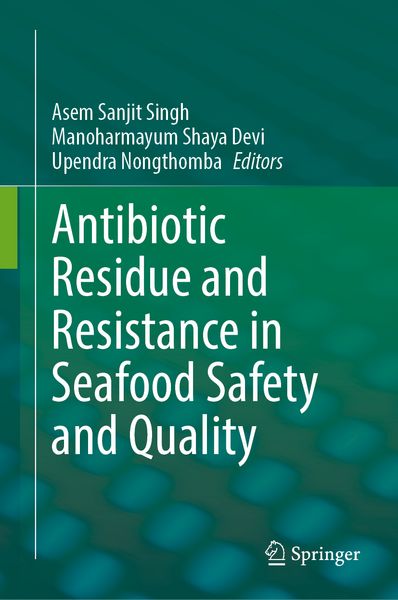
Produktbild: Antibiotic Residue and Resistance in Seafood Safety and Quality
- 19%

Antibiotic Residue and Resistance in Seafood Safety and Quality

19% sparen

171,99 € UVP 213,99 €

inkl. gesetzl. MwSt., Versandkostenfrei


Beschreibung

Produktdetails

Einband

Gebundene Ausgabe

Erscheinungsdatum

27.04.2025

Abbildungen

XIX, 229 p. 23 illus., 22 illus. in color.

Herausgeber

Asem Sanjit Singh + weitere

Verlag

Springer Singapore

Seitenzahl

229

Maße (L/B/H)

24,1/16/2 cm

Gewicht

495 g

Auflage

1. Auflage

Sprache

Englisch

ISBN

978-981-9646-39-5

Beschreibung

Portrait


Dr. Asem Sanjit Singh is currently a post-doctoral research fellow at the renowned Indian Institute of Science, Bangalore. He completed his bachelor's degree at the College of Fisheries, Central Agricultural University, Imphal, and earned his master’s at ICAR-Central Institute of Fisheries Education, Mumbai, India. Dr. Asem's research focuses on antibiotic resistance and residues in seafood. His work includes documenting the first case of bla
NDM-5
-producing
E. coli
in India, marking a significant contribution to antimicrobial resistance studies. Dr. Asem has authored 12 research articles, 14 reviews, and 2 book chapters in esteemed peer-reviewed journals.


Dr. Manoharmayum Shaya Devi (ARS) specialized in fisheries science and currently serves as a Scientist (ARS) at the ICAR-Central Inland Fisheries Research Institute, West Bengal, India. With a bachelor's degree in fisheries science (B.F.Sc.) from the College of Fisheries (Central Agricultural University), Tripura, India, she pursued further studies, earning a master's degree (M.F.Sc.) and a Ph.D. from the Central Institute of Fisheries Education (CIFE). She works on understanding fish health management, antimicrobial resistance, and the efficacy of fish epidermal mucus as a biomarker for environmental stress. Dr. Devi's research achievements have been recognized through publications in reputable journals and presentations at national and international conferences. Additionally, Dr. Manoharmayum Shaya Devi is a recipient of the esteemed Sir J.K. Jena Young Scientist Award for her contribution to scientific education and research accessibility in fisheries.


Prof. Upendra Nongthomba (Ph.D.) holds the distinguished position of Chair, Department of Developmental Biology and Genetics, Indian Institute of Science, Bangalore. His scholarly contributions encompass over 90 research articles published in esteemed peer-reviewed journals, reflecting his profound commitment to scientific inquiry and dissemination. Prof. Upendra is a recipient of the esteemed Sir C. V. Raman Young Scientist Award. He possesses extensive expertise spanning freshwater ecology, drug screening, and the intricate dynamics of host-pathogen interactions. Presently, Prof. Upendra and his team focus on exploring toxicological relationships, particularly concerning antibiotics, microplastics, and their impact on hosts.

Produktdetails

Einband

Gebundene Ausgabe

Erscheinungsdatum

27.04.2025

Abbildungen

XIX, 229 p. 23 illus., 22 illus. in color.

Herausgeber

Verlag

Springer Singapore

Seitenzahl

229

Maße (L/B/H)

24,1/16/2 cm

Gewicht

495 g

Auflage

1. Auflage

Sprache

Englisch

ISBN

978-981-9646-39-5

Herstelleradresse

Springer-Verlag GmbH
Europaplatz 3
69115 Heidelberg
DE

Email: ProductSafety@springernature.com

Ein neues Kapitel für Ihre Bücher

Ein neues Kapitel für Ihre Bücher

Schenken Sie Ihren alten Schätzen ein zweites Leben und erhalten Sie dafür eine Thalia Geschenkkarte.

Jetzt verkaufen
Jetzt verkaufen

Noch keine Bewertungen vorhanden

Verfassen Sie die erste Bewertung zu diesem Artikel

Helfen Sie anderen Kundinnen und Kunden durch Ihre Meinung.

Kundinnen und Kunden meinen

Bewertungen (0)

  • Produktbild: Antibiotic Residue and Resistance in Seafood Safety and Quality

  • Chapter 1. Exploring global antibiotic use: A focus on seafood.- Chapter 2. Assessing the impact of processing technologies on antibiotic residues in seafood.- Chapter 3. Prevalence and antimicrobial resistance of seafood-borne bacterial pathogens.- Chapter 4. Antimicrobial resistance in fish and fishery products: an emerging threat for public health.- Chapter 5. Quinolone and colistin resistance in
    Escherichia coli
    : Occurrence, mechanisms, and future challenges.- Chapter 6. Technological interventions to mitigate antibiotic use in seafood processing.- Chapter 7. Exploring antibiotic substitutes for sustainable aquaculture.- Chapter 8. Potential plant-based phytochemicals as an alternative to antibiotic in the fight against bacterial drug resistance.- Chapter 9. Fighting the Spread of Antibiotic Resistance in Bacteria: A Global Challenge in Environment and Food.- Chapter 10. Nano-enabled Solutions for Antibiotic Degradation in Aquatic Systems.- Chapter 11. Metagenomic approaches to antibiotic resistance characterization: an overview.