KI-Beratung Beta

Gutscheinbedingungen

Gültig bis 21.10.2026 | Gültig für nicht preisgebundene fremdsprachige Bücher | Einzelne Artikel können ausgeschlossen sein | Online auf thalia.de und in der Thalia App einlösbar | Click & Collect nur mit Online-Zahlung (Paypal/Kreditkarte) vorab | Nicht kombinierbar mit anderen Gutscheinen oder Preisaktionen | Nur einmal pro Einkauf einlösbar | Gutschein wird auf max. 500€ Bestellwert angerechnet | Keine Barauszahlung | Nicht gültig für Versandkosten und Services

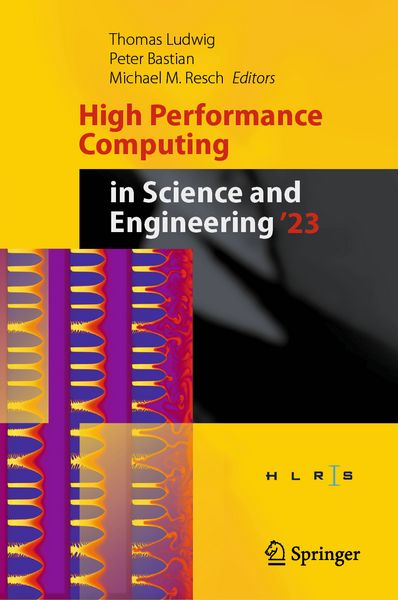
Produktbild: High Performance Computing in Science and Engineering '23
- 10%

High Performance Computing in Science and Engineering '23 Transactions of the High Performance Computing Center, Stuttgart (HLRS) 2023

10% sparen

171,99 € UVP 192,59 €

inkl. gesetzl. MwSt., Versandkostenfrei


Beschreibung

Produktdetails

Einband

Gebundene Ausgabe

Erscheinungsdatum

24.01.2026

Abbildungen

X, 532 p. 264 illus., 243 illus. in color.

Herausgeber

Thomas Ludwig + weitere

Verlag

Springer

Seitenzahl

532

Maße (L/B/H)

24,1/16/3,3 cm

Gewicht

1071 g

Sprache

Englisch

ISBN

978-3-031-91311-2

Beschreibung

Portrait


Thomas Ludwig is professor in computer science with a focus on jigh performance computing, high performance storage systems, and energy efficiency in high performance computiing systems. He holds a position at Universität Hamburg since 2009. He is also the director of the German Climate Computing Center (Deutsches Klimarechenzentrum, DKRZ) in Hamburg. The mission of DKRZ is to provide compute power, storage space and service to the German Earth science research community. Thomas Ludwig has authored and co-authored more than 200 publications. He started his scientific carreer in 1988 at Technische Universität München, and was a professor for parallel and distributed systems at Universität Heidelberg from 2001 to 2009.


Peter Bastian is a professor for parallel computing at the Interdisciplinary Center for Scientific Computing of Heidelberg University since 2008. The focus of his work is the numerical solution of partial differential equations, including discretization methods, robust and scalable preconditioners for large sparse linear systems, high-performance computing aspects of these methods and applications in environmental flow problems. He got his education in computer science at University of Erlangen-Nürnberg in the 1980s, obtained his doctoral degree from Heidelberg University in 1994 and held previous professorships at Heidelberg University from 2001 to 2006 and Stuttgart University from 2006 to 2008.


Michael Resch is a professor for High Performance Computing at the University of Stuttgart, the director of the Institute for HPC at the University of Stuttgart and the director of the national High Performance Computing Center Stuttgart (HLRS) at the University of Stuttgart. The focus of his work is on HPC applications and methods as well as on the theory of science of simulation. He got his education in Technical Mathematics from the Technical University of Graz/Austria in the 1980s, obtained his doctoral degree from Stuttgart University in 2001 and held an assistant professorship from the University of Houston, Texas in 2002.

Produktdetails

Einband

Gebundene Ausgabe

Erscheinungsdatum

24.01.2026

Abbildungen

X, 532 p. 264 illus., 243 illus. in color.

Herausgeber

Verlag

Springer

Seitenzahl

532

Maße (L/B/H)

24,1/16/3,3 cm

Gewicht

1071 g

Sprache

Englisch

ISBN

978-3-031-91311-2

Herstelleradresse

Springer-Verlag GmbH
Europaplatz 3
69115 Heidelberg
DE

Email: ProductSafety@springernature.com

Ein neues Kapitel für Ihre Bücher

Ein neues Kapitel für Ihre Bücher

Schenken Sie Ihren alten Schätzen ein zweites Leben und erhalten Sie dafür eine Thalia Geschenkkarte.

Jetzt verkaufen
Jetzt verkaufen

Noch keine Bewertungen vorhanden

Verfassen Sie die erste Bewertung zu diesem Artikel

Helfen Sie anderen Kundinnen und Kunden durch Ihre Meinung.

Kundinnen und Kunden meinen

Bewertungen (0)

  • Produktbild: High Performance Computing in Science and Engineering '23

  • Part 1 Physics.- Part 2 Molecules, Interfaces, and Solids.- Part 3 Materials Science.- Part 4 Computational Fluid Dynamics.- Part 5 Reactive Flows.- Part 6 Transport and Climate.- Part 7 Particle-based Simulations.