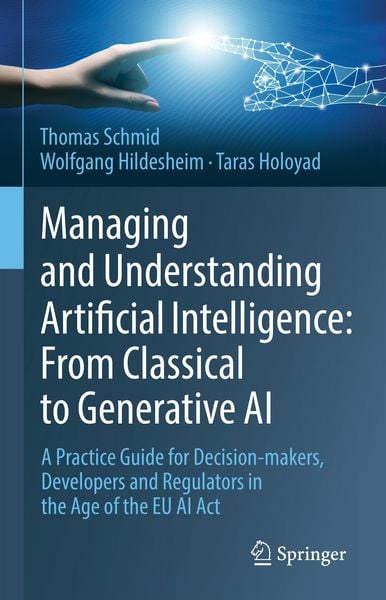
Managing and Understanding Artificial Intelligence: From Classical to Generative AI A Practice Guide for Decision-makers, Developers and Regulators in the Age of the EU AI Act
59,99 €
inkl. gesetzl. MwSt.,
Beschreibung
Produktdetails
Einband
Gebundene Ausgabe
Erscheinungsdatum
17.06.2026
Abbildungen
XXVIII, 356 p. 142 illus., 140 illus. in color.
Verlag
SpringerSeitenzahl
356
Maße (L/B/H)
24,1/16/2,7 cm
Gewicht
738 g
Sprache
Englisch
ISBN
978-3-032-00532-8
Artificial Intelligence (AI) is taking over the world, becoming an essential part of our daily lives. Self-driving cars, medical diagnoses, robotic processes, chatbots, and urban planning are just a few examples of how AI is being used. But what exactly is AI? What makes it successful? Are there concrete examples of AI applications currently in use? How do we mitigate risks? What norms do we need?
This comprehensive book addresses these questions, with a particularly strong focus on the European Union’s AI Act. By delving into foundational models and generative AI, it explores trending topics like the disruptive Transformer architecture and provides a rich understanding of how these foundational models have revolutionized the field and are driving innovation across industries. Within the EU, creating digital sovereignty in dealing with AI is crucial, requiring excellence from policymakers, industry, and academia in ensuring the trustworthiness of AI among citizens. Therefore, the book tries to answer the question “How to build trust in AI?”
The authors propose the classification matrix “AI=MC²” (AI Methods, Capabilities, and Criticality) and demonstrate its applicability for an “AI Label” transparency seal as a solution for clear future classification of AI products and services. The AI label is used in a series of illustrative practical examples, such as AI-powered customer service virtual assistants, AI-based object recognition in public sector and GenAI-based text and image processing. All real life projects are described in detail.
Highlighting European regulation and AI standardization, with a focus on medical devices, the book provides the knowledge necessary for making informed decisions in the field of AI solutions, aiming to serve as a practical guide for managers, AI developers, compliance officers, employees in government agencies, companies and anyone interested in understanding the topic of AI. Numerous illustrations complement the reading and concrete recommendations are provided to representatives from politics, industry, and academia.
Ein neues Kapitel für Ihre Bücher
Ein neues Kapitel für Ihre Bücher
Schenken Sie Ihren alten Schätzen ein zweites Leben und erhalten dafür eine Thalia Geschenkkarte.
Noch keine Bewertungen vorhanden
Verfassen Sie die erste Bewertung zu diesem Artikel
Helfen Sie anderen Kundinnen und Kunden durch Ihre Meinung.
Kurze Frage zu unserer Seite
Vielen Dank für Ihr Feedback
Wir nutzen Ihr Feedback, um unsere Produktseiten zu verbessern. Bitte haben Sie Verständnis, dass wir Ihnen keine Rückmeldung geben können. Falls Sie Kontakt mit uns aufnehmen möchten, können Sie sich aber gerne an unseren Kund*innenservice wenden.
zum Kundenservice