KI-Beratung Beta

Produktbild: Regenerative Medicine and the Bioethics of Globalization, Justice and Hegemony
Band 5 - 10%

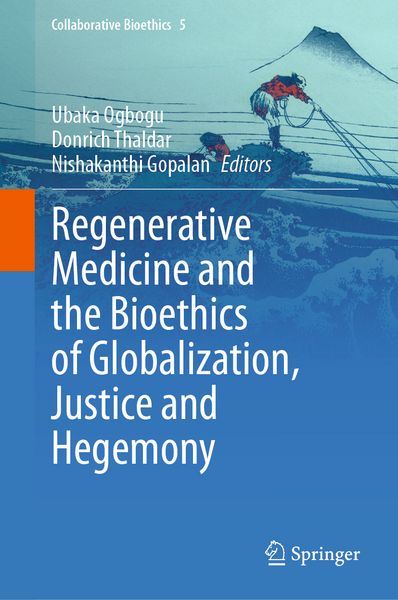
Regenerative Medicine and the Bioethics of Globalization, Justice and Hegemony

Aus der Reihe Collaborative Bioethics
10% sparen

171,99 € UVP 192,59 €

inkl. gesetzl. MwSt., Versandkostenfrei


Beschreibung

Produktdetails

Einband

Gebundene Ausgabe

Erscheinungsdatum

11.12.2025

Abbildungen

XIV, 289 p. 5 illus., 4 illus. in color.

Herausgeber

Ubaka Ogbogu + weitere

Verlag

Springer

Seitenzahl

289

Maße (L/B/H)

24,1/16/2,2 cm

Gewicht

621 g

Sprache

Englisch

ISBN

978-3-032-07288-7

Beschreibung

Portrait


Ubaka Ogbogu
is a Professor and the Katz Chair in Health Law and Science Policy in the Faculty of Law at the University of Alberta. He is the Chair of the University of Alberta’s Research Ethics Board 2 and a Member of the Royal Society of Canada’s College of New Scholars, Artists and Scientists. Dr. Ogbogu is a recipient of the Confederation of Alberta Faculty Associations Distinguished Academic Early Career Award. He holds a doctorate in law from the University of Toronto, a Master of Laws degree from the University of Alberta, and undergraduate degrees in law from the University of Benin, Nigeria, and the Nigerian Law School.


Dr. Ogbogu's scholarly work focuses broadly on the ethical, legal, and societal implications of novel and emerging biotechnologies and related research. His recent work engages with the global governance of regenerative medicine, highlighting issues of epistemic injustice, structural inequities, and the underrepresentation of low- and middle-income country perspectives in bioethics and innovation policy. Through this work, he examines how context-sensitive, collaborative, and pluralistic approaches to ethics can address disparities in the development and distribution of cutting-edge health technologies.


Dr. Ogbogu has served on several boards and councils with a direct focus on regenerative medicine governance and policy, including the Council of Canadian Academies Expert Panel on Somatic Gene and Engineered Cell Therapies, the Canadian Institutes of Health Research Stem Cell Oversight Committee, and the International Society for Stem Cell Research Task Force on Guidelines for Stem Cell Research and Clinical Translation.


Donrich Thaldar
is a full Professor of Law at the University of KwaZulu-Natal, Durban, where he chairs the Health Law & Ethics Research Interest Group. He is currently principal investigator of an NIH-funded project that investigates the legal aspects of data science in health innovation in Africa. Professor Thaldar also has a private law practice, where he specializes in strategic litigation in reproductive law (reprolaw). Before starting his academic career in 2017, he practiced as an advocate at the Pretoria Bar. He served as legal counsel or as amicus curiae in several landmark cases in the field of reprolaw in South Africa. Some highlights are: The first case that considered the concept of ‘designer children’ (2016); the first case of posthumous conception (2018); the first case of gamete withdrawal from a comatose person (2020); and the first case about the enforceability of a sperm donor agreement (2021); and a successful legal challenge to the constitutionality of the statutory prohibition on non-medical preimplantation sex selection (2022).


Nishakanthi Gopalan
is a Senior Lecturer at the Medical Humanities and Ethics Unit (MedHEU), Faculty of Medicine, Universiti Malaya (UM), Kuala Lumpur, Malaysia, and Programme Coordinator for the Master of Health Research Ethics (MOHRE), the first postgraduate programme in health research ethics in Southeast Asia. MOHRE was developed in collaboration with the Berman Institute of Bioethics at Johns Hopkins University through a Fogarty International Center bioethics training grant, MOHRE focuses on building regional capacity in culturally attuned health research ethics. Dr. Gopalan holds a PhD in research ethics, and her scholarship centres on bioethics, research ethics, and the governance of emerging technologies, with particular emphasis on low- and middle-income country contexts.


She serves on the Universiti Malaya Research Ethics Committee (UMREC) and the Universiti Malaya Medical Centre–Medical Research Ethics Committee (UMMC-MREC), and is an editorial board member of the Asian Bioethics Review. Her research and publications explore the ethical, legal, and social implications of emerging technologies, including stem cell research, genetic testing, artificial intelligence in healthcare, and synthetic biology.

Produktdetails

Einband

Gebundene Ausgabe

Erscheinungsdatum

11.12.2025

Abbildungen

XIV, 289 p. 5 illus., 4 illus. in color.

Herausgeber

Verlag

Springer

Seitenzahl

289

Maße (L/B/H)

24,1/16/2,2 cm

Gewicht

621 g

Sprache

Englisch

ISBN

978-3-032-07288-7

Herstelleradresse

Springer-Verlag KG
Sachsenplatz 4-6
1201 Wien
AT

Email: ProductSafety@springernature.com

Ein neues Kapitel für Ihre Bücher

Ein neues Kapitel für Ihre Bücher

Schenken Sie Ihren alten Schätzen ein zweites Leben und erhalten Sie dafür eine Thalia Geschenkkarte.

Jetzt verkaufen
Jetzt verkaufen

Noch keine Bewertungen vorhanden

Verfassen Sie die erste Bewertung zu diesem Artikel

Helfen Sie anderen Kundinnen und Kunden durch Ihre Meinung.

Kundinnen und Kunden meinen

Bewertungen (0)

  • Produktbild: Regenerative Medicine and the Bioethics of Globalization, Justice and Hegemony

  • Part I: Foundational Critiques — Epistemic Injustice and Global Asymmetries.- Chapter 1. Reframing Regenerative Medicine: Global Asymmetries and Ethical Futures.- Chapter 2. Towards Epistemic Justice: Regenerative Medicine Activity and Governance in Low- and Middle-Income Countries.- Chapter 3. A Case for Inclusive Global Governance for Regenerative Medicine.- Chapter 4. Integrating Regenerative Medicine into Medical Curricula in the Global South: A Tanzanian Perspective.- Part II: National Case Studies — Governance, Context, Constraint, and Endogenous Innovation.- Chapter 5. Translation and Commercialisation of Regenerative Medicine in South Africa: Navigating the Regulatory Landscape.- Chapter 6. Regenerative Medicine at the Tip of Africa: Far-Reaching Consequences of Slow Progress.- Chapter 7. The Kenyan Legal and Policy Framework for Stem Cell Research.- Chapter 8. Stem Cell and Genetic Engineering for Regenerative Medicine: An Indian Perspective.- Chapter 9. Ethical Crossroads and Regulatory Pathways: Navigating Regenerative Medicine in Malaysia.- Chapter 10. Regenerative Medicine in China: Current Regulatory Challenges and Global Advancements.- Chapter 11 Regenerative Medicine and Advanced Therapy Medicinal Products in Ukraine: Research, Regulation and Challenges in a Time of War.