KI-Beratung Beta

Produktbild: Protein Misfolding and Human Diseases

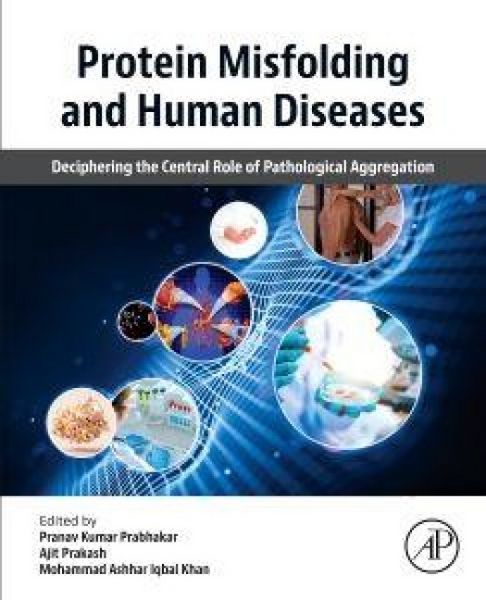
Protein Misfolding and Human Diseases Deciphering the Central Role of Pathological Aggregation

169,99 €

inkl. gesetzl. MwSt., Versandkostenfrei


Beschreibung

Produktdetails

Einband

Taschenbuch

Erscheinungsdatum

08.07.2026

Herausgeber

Pranav Kumar Prabhakar + weitere

Verlag

Elsevier

Seitenzahl

398

Maße (L/B/H)

18,9/23,4/2,5 cm

Gewicht

816 g

Sprache

Englisch

ISBN

978-0-443-36636-9

Beschreibung

Portrait

Pranav Kumar Prabhakar is Professor and Head of the Department of Biotechnology, School of Engineering and Technology, Nagaland University, Kohima, India. His research focuses on understanding molecular mechanisms involved in metabolic disorders, particularly diabetes, and on developing strategies for oral insulin delivery using natural products and biotechnology-based approaches. He is actively involved in research, academic mentoring, peer review, and editorial activities within the biomedical and biotechnology fields. His professional interests include translational research, signaling pathways associated with metabolic diseases, and the application of biotechnology to improve therapeutic outcomes. He contributes to scientific and academic initiatives that support advancements in biotechnology and healthcare research.

Dr. Ajit Prakash completed his B.Sc. Biotechnology at Jamia Millia Islamia, Delhi, and M.Sc. Genomics at Madurai Kamaraj University, Tamil Nadu, India. Further, Dr. Ajit obtained his Ph.D. in Biochemistry in 2016 from Nanyang Technological University, Singapore. He carried out his first postdoctoral fellowship at the University of Cambridge, UK. Following this he worked at Lovely Professional University as an assistant professor for almost a year and then finally relocated to the USA for his second postdoc at the University of North Carolina, Chaple Hill, USA. After 5 years of postdoctoral research at UNC, he is currently working as a Research Associate at UNC, Chapel Hill, USA. In addition to 3 book chapters and a book which are under publication, Dr. Ajit has published 16 high-impact research papers/book chapters in the fields of protein biochemistry, structural biology, and molecular biology related to disease conditions like cancer, and neurological disorders.

Dr. Mohammad Ashhar Iqbal Khan is currently a Research Associate in the Department of Biochemistry and Biophysics at the University of North Carolina at Chapel Hill, USA. He completed his PhD in Biochemistry and Biophysics from the Indian Institute of Technology-Delhi in 2016. Dr. Khan's doctoral research focused on elucidating the molecular mechanisms of protein aggregation in neurodegenerative diseases like ALS and Parkinson's using biophysical techniques. As a postdoctoral researcher at UNC Chapel Hill and Lund University in Sweden, he expanded his expertise to study key cell adhesion proteins vinculin and metavinculin linked to cardiomyopathies and cancer. He has authored several peer-reviewed publications and delivered invited talks and poster presentations at scientific conferences. He is a recipient of prestigious fellowships and awards including the Erasmus Mundus Scholarship and the Carl Trygger Foundation Postdoctoral Scholarship. He serves as an editorial board member and reviewer for many reputed national and international journals.

Produktdetails

Einband

Taschenbuch

Erscheinungsdatum

08.07.2026

Herausgeber

Verlag

Elsevier

Seitenzahl

398

Maße (L/B/H)

18,9/23,4/2,5 cm

Gewicht

816 g

Sprache

Englisch

ISBN

978-0-443-36636-9

Herstelleradresse

Libri GmbH
Europaallee 1
36244 Bad Hersfeld
DE

Email: gpsr@libri.de

Ein neues Kapitel für Ihre Bücher

Ein neues Kapitel für Ihre Bücher

Schenken Sie Ihren alten Schätzen ein zweites Leben und erhalten Sie dafür eine Thalia Geschenkkarte.

Jetzt verkaufen
Jetzt verkaufen

Noch keine Bewertungen vorhanden

Verfassen Sie die erste Bewertung zu diesem Artikel

Helfen Sie anderen Kundinnen und Kunden durch Ihre Meinung.

Kundinnen und Kunden meinen

Bewertungen (0)

  • Produktbild: Protein Misfolding and Human Diseases
  • Part I: Fundamentals of protein aggregation
    1. Protein aggregation as a mechanistic consequence of proteostasis collapse and environmental¿biophysical interactions

    Part II: Protein aggregation in neurodegenerative diseases
    2. Protein aggregation in amyotrophic lateral sclerosis
    3. Protein aggregation in prion diseases
    4. Protein aggregation in Huntington's disease
    5. Protein aggregation in Alzheimer's disease
    6. Protein aggregation in Parkinson's disease

    Part III: Other protein aggregation diseases
    7. Systemic amyloidosis
    8. Protein aggregation and aging

    Part IV: Structural insights and therapeutic strategies
    9. Structural insights into pathological protein aggregates: from amyloid fibrils to inclusion bodies
    10. Therapeutic strategies against protein aggregation
    11. Recent advances in protein aggregation research and future outlook