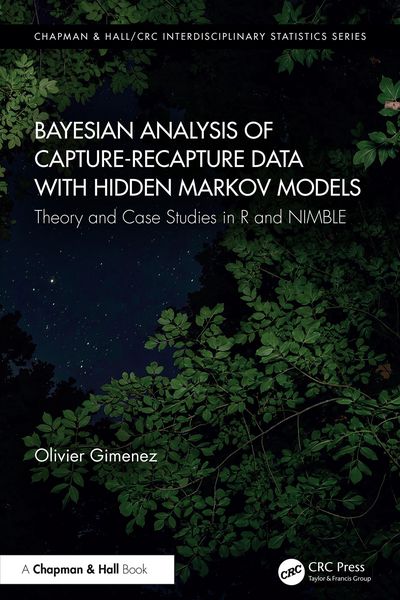
Bayesian Analysis of Capture-Recapture Data with Hidden Markov Models Theory and Case Studies in R and NIMBLE
129,99 €
inkl. gesetzl. MwSt.Beschreibung
Produktdetails
Format
Kopierschutz
Ja
Family Sharing
Nein
Text-to-Speech
Nein
Erscheinungsdatum
30.03.2026
Verlag
Taylor & Francis eBooksSeitenzahl
362 (Printausgabe)
Dateigröße
35166 KB
Auflage
1. Auflage
Sprache
Englisch
EAN
9781040467350
Bayesian Analysis of Capture-Recapture Data with Hidden Markov Models: Theory and Case Studies in R and NIMBLE introduces ecologists and statisticians to a powerful and unifying framework for analyzing capture-recapture data. Hidden Markov models (HMMs) have become a cornerstone in modern population ecology, offering a flexible way to decompose complex processes such as survival, recruitment, and dispersal into simpler building blocks, while explicitly accounting for the fact that we only observe imperfect data rather than the true underlying states. Combined with Bayesian inference, HMMs provide a natural and transparent approach to handle uncertainty, explore model structures, and draw robust conclusions. This book illustrates how to bring these ideas to life using the R package NIMBLE, a fast-developing environment for building and fitting hierarchical models.
Key Features:
- A clear introduction to the principles of Bayesian statistics, HMMs, and the NIMBLE package
- Step-by-step tutorials showing how to implement a wide range of capture-recapture models for open populations
- Fully reproducible examples with data and R code, following a "learning by doing" philosophy
- Case studies drawn from the ecological literature, illustrating how to apply methods to real-world conservation questions
- Practical guidance on model specification, coding strategies, and interpretation of results
Written in an accessible style, this book is designed for ecologists, wildlife biologists, and conservation scientists who already use R and wish to deepen their modeling toolkit, as well as statisticians interested in ecological applications. Beginners will find a self-contained path into Bayesian capture-recapture modeling, while experienced researchers will discover a flexible framework to extend and adapt to their own data and questions.
Noch keine Bewertungen vorhanden
Verfassen Sie die erste Bewertung zu diesem Artikel
Helfen Sie anderen Kundinnen und Kunden durch Ihre Meinung.
Kurze Frage zu unserer Seite
Vielen Dank für Ihr Feedback
Wir nutzen Ihr Feedback, um unsere Produktseiten zu verbessern. Bitte haben Sie Verständnis, dass wir Ihnen keine Rückmeldung geben können. Falls Sie Kontakt mit uns aufnehmen möchten, können Sie sich aber gerne an unseren Kund*innenservice wenden.
zum Kundenservice