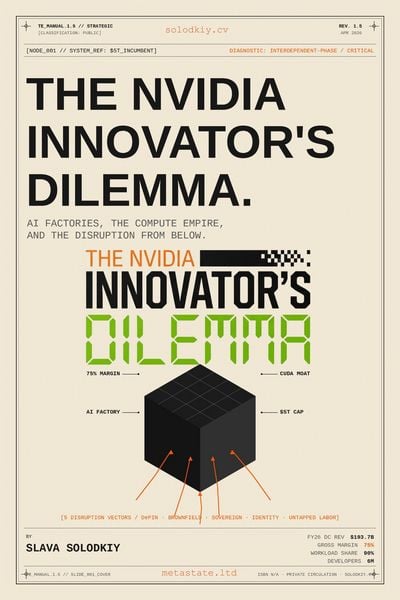
The Nvidia Innovator's Dilemma
-
- Einzelkauf Download ausgewählt
-
Sprache:Englisch
0,99 €
inkl. gesetzl. MwSt.Beschreibung
Produktdetails
Format
ePUB
Kopierschutz
Ja
Family Sharing
Ja
Text-to-Speech
Ja
Erscheinungsdatum
29.04.2026
Verlag
Slava SolodkiySeitenzahl
(Printausgabe)
Dateigröße
3731 KB
Sprache
Englisch
EAN
9798235142671
A $5 Trillion Tragedy of Having Too Much Money
Are you tired of business books that celebrate actual success? Do you wake up in a cold sweat worrying that making $750 million a day is actually a terminal disease? If not, please, put this book down and walk away.
In The NVIDIA Innovator's Dilemma, Slava Solodkiywriting from Shoreditch and openly admitting he lacks the "measured, generous" voice of a "Mormon professor"attempts to tell you why NVIDIA is doomed. Why? Because they are too good. Because they have a grotesque 75% gross margin. Because they are worth $5 trillion. Because they are executing their roadmap flawlessly. Naturally, in the twisted logic of this book, this means they are walking corpses suffering from the "Paradox of Doing Everything Right". Here is why you should absolutely save your time and skip this operational autopsy:
1. The "Prescription" is Hilariously Deranged To "save" NVIDIA from making billions off Microsoft and Google, the author insists that CEO Jensen Huang must cannibalize his own company to "hunt zero-billion-dollar markets". Yes, zero. The author seriously proposes that NVIDIA should spin out autonomous business units to corner the market on renting out teenagers' idle RTX 4090 gaming GPUs (DePIN). If that's not enough, he wants NVIDIA to become a distressed real estate prospector, buying up decommissioned coal plants in West Virginia and abandoned aluminum smelters in Tajikistan. And for customers? He suggests abandoning hyperscalers to sell infrastructure to "metastates" like crypto-libertarian charter cities in Honduras. If you prefer corporate strategy that doesn't read like a cyberpunk fever dream, skip this.
2. The Author Literally Debunks Himself Why read 16 chapters of paranoid doom-mongering when the author dedicates Chapter 15 to meticulously explaining why his entire premise is probably garbage?. In a stunning display of self-irony, Solodkiy openly admits that Jensen Huang is an "extreme statistical outlier" who has already beaten this exact dilemma twice before. He confesses that NVIDIA's CUDA moat might actually be an indestructible operating system that will last for decades. By the end of his own argument, the author admits his confidence level in NVIDIA's demise is a whopping 25-35%. He even gives you six falsifiable predictions to prove him wrong by 2027. Just wait a couple of years, check his math, and laugh.
3. The Ultimate Grotesque Nihilism (Meat Computers) If you actually manage to care about the silicon wars for 300 pages, the author casually slaps you in the face with a "Coda" declaring that none of this matters anyway. Why? Because in 20 to 30 years, silicon will be obsolete, replaced by biological "DNA computing" brewed in vats by robot scientists named Adam and Eve. Your premium GPUs are destined to be replaced by hyper-dense meat computers with a density advantage of nine orders of magnitude. So why exactly are we worrying about NVIDIA's profit margins today if we're all going to be running AI on biological sludge by 2050?
Conclusion: If you enjoy the agonizing, self-inflicted pain of watching a $5 trillion company successfully sell $40,000 chips to desperate tech giants, just read NVIDIA's quarterly earnings reports. You don't need to read a contrarian manifesto telling you that having "too much money" and "the best engineers" is a fatal structural trap. Leave Jensen Huang to suffer his tragic, multi-trillion-dollar fate in peace.
ISBN: 9798235142671 (e-Book)
ISBN: 9798195009434 (Paperback)
DOI 10.6084/m9.figshare.32133316
Noch keine Bewertungen vorhanden
Verfassen Sie die erste Bewertung zu diesem Artikel
Helfen Sie anderen Kundinnen und Kunden durch Ihre Meinung.
Kurze Frage zu unserer Seite
Vielen Dank für Ihr Feedback
Wir nutzen Ihr Feedback, um unsere Produktseiten zu verbessern. Bitte haben Sie Verständnis, dass wir Ihnen keine Rückmeldung geben können. Falls Sie Kontakt mit uns aufnehmen möchten, können Sie sich aber gerne an unseren Kund*innenservice wenden.
zum Kundenservice