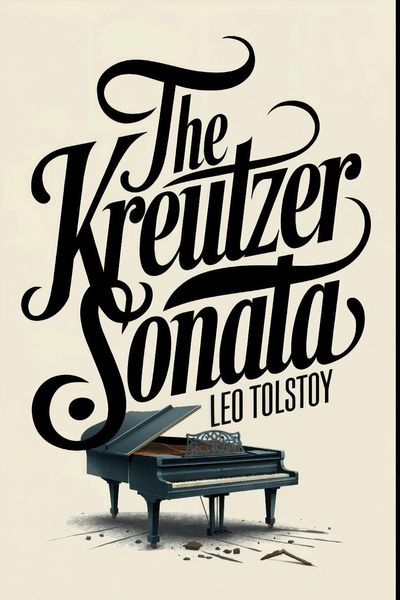
The Kreutzer Sonata A New Translation
-
- Hardcover
- Taschenbuch ausgewählt
- eBook
- Hörbuch
-
Sprache:Englisch
-
Verlag:Independently Published
- Outlook 49,90 €
- Editorium 15,99 €
- The Library of Alexandria 24,99 €
- Bloomsbury USA 11,99 €
- Oxford University Press 10,97 €
- Penguin Publishing Group 12,99 €
- Bloomsbury Publishing 14,99 €
- Sanage Publishing House 23,99 €
- Digireads.com 19,99 €
- Creative Media Partners, LLC 21,99 €
- Independently Published 11,99 € ausgewählt
- Stonewell Press 17,99 €
- Sovereign 11,99 €
- Kessinger Publishing, LLC 37,99 €
- Modern Library PRH US 11,99 €
- Double 9 Books 26,99 €
11,99 €
inkl. gesetzl. MwSt.,
Beschreibung
Produktdetails
Einband
Taschenbuch
Erscheinungsdatum
20.02.2025
Verlag
Independently PublishedSeitenzahl
160
Maße (L/B/H)
22,9/15,2/1 cm
Gewicht
204 g
Übersetzt von
Sergey Adana
Sprache
Englisch
EAN
9798311453158
On a night train crossing Russia, a man named Pozdnyshev - a Marshal of the Nobility, acquitted by a court of law of murdering his own wife - begins to explain himself to a fellow passenger.
His account is the novella: a confession that moves backward through the wreckage of a marriage, from a young man's dissolution to a wedding undertaken for the wrong reasons, through years of mutual contempt punctuated by reconciliation, five children, and a hatred each party has learned to disguise as love. He describes the evening his wife and a violinist named Trukachevsky performed Beethoven's Kreutzer Sonata together, and what he saw on his wife's face as she played. He describes what he did when he returned home from a trip to find them together.
He was tried. He was acquitted. The court accepted his wife's apparent adultery as justification. He found the acquittal as disturbing as the murder.
Published in 1889 - and immediately suppressed by the Russian censors, who banned it from magazines and from Tolstoy's own collected works, forcing it to circulate in handwritten copies across Russia - The Kreutzer Sonata is the most extreme and the most honest expression of the views Tolstoy had been developing since his spiritual crisis of the early 1880s. In the Afterword he published separately in 1890, he confirmed that Pozdnyshev's views were essentially his own: that physical desire is degrading even within marriage, that the conventions governing relations between men and women in his society were organized around mutual deception, and that the ideal for human beings was complete chastity. Theodore Roosevelt called him a "sexual moral pervert." Émile Zola called the novella a nightmare. The US Post Office banned its distribution. The Russian tsar allowed it to be published only after Tolstoy's wife personally appealed to him.
The Beethoven sonata that gives the novella its title was composed in 1803 for a virtuoso named George Bridgetower, re-dedicated after a quarrel to Rodolphe Kreutzer, who thought it "outrageously unintelligible" and refused to play it. The music it was never meant to carry went on to mean everything Tolstoy said it meant. Whether he was right is a question the novella forces the reader to sit with on a moving train, with nowhere to go until the journey ends.
Ein neues Kapitel für Ihre Bücher
Ein neues Kapitel für Ihre Bücher
Schenken Sie Ihren alten Schätzen ein zweites Leben und erhalten Sie dafür eine Thalia Geschenkkarte.
Noch keine Bewertungen vorhanden
Verfassen Sie die erste Bewertung zu diesem Artikel
Helfen Sie anderen Kundinnen und Kunden durch Ihre Meinung.
Kurze Frage zu unserer Seite
Vielen Dank für Ihr Feedback
Wir nutzen Ihr Feedback, um unsere Produktseiten zu verbessern. Bitte haben Sie Verständnis, dass wir Ihnen keine Rückmeldung geben können. Falls Sie Kontakt mit uns aufnehmen möchten, können Sie sich aber gerne an unseren Kund*innenservice wenden.
zum Kundenservice